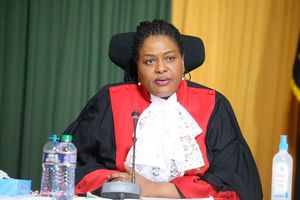
Anne Amadi when she appeared before the Selection panel for applicant for the Independent Electoral and Boundaries Commission chairperson in Nairobi on March 24, 2025.

The recent appointment of Anne Amadi, Kenya’s former Chief Registrar of the Judiciary, to the East African Court of Justice, sums up her long journey to the regional court in a process marred by court cases and questions on qualifications to the court.
Ms Amadi was sworn in on Saturday, March 7, as a judge of the First Instance Division of the East African Court of Justice (EACJ) by the East African Community heads of state summit meeting in Arusha, Tanzania.
The EACJ hears cases on violations of the rule of law, one of the fundamental and operational principles set out in the East African Community Treaty.
Established in 1999 and located in Arusha, Tanzania, the court hears cases from Burundi, Kenya, Rwanda, Uganda, Tanzania, South Sudan, Democratic Republic of Congo and Somalia.
She is the first Kenyan female Judge to the EACJ.
The swearing in of Judge Amadi might have put to an end the legal battle that raged between the Kenya’s Judicial Service and the government over the appointment process.
“Amadi was nominated by Kenya in a consultative process and a process that was above board, which is what we opposed with the previous nominee Zablon Mokua. Kenya did the right thing. So, we think she'll be a valuable addition to the court,” said Donald Deya, CEO of the Pan African Lawyers Union.
“In the 25 years of existence of this court and despite having made over 10 nominations, Kenya has never nominated a woman. It's always been men from Justice Moijo Ole Keiwua to Justice Kasanga Mulwa, to the late Justice Benjamin Kubo, to Aaron Ringera, to Isaac Lenaola, to Charles Nyachae, and so on. They've never nominated a woman.”
Charles Nyachae resigned as a judge of the East African Court of Justice (EACJ) on November 26, 2023, paving the way for his replacement by Kenya.
Appointed in 2018 by former President Uhuru Kenyatta, Nyachae left the regional court roughly two years before his seven-year term was scheduled to end.

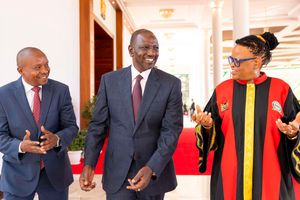
Then the outgoing Chief Registrar Anne Amadi addresses participants during the handover ceremony at Milimani Law Courts in Nairobi on January 12, 2024.
Upon his resignation, the then Kenya’s Cabinet Secretary in charge of the EAC Affairs Peninah Malonza forwarded the name of the then less known Dr Zablon Muruka Mokua to President William Ruto to appoint to the First Instance Division Court of EACJ.
However, it was the outgoing CEO of the JSC, Ms Anne Amadi, who was the JSC’s nominee for this post.
In a letter dated April, 18, 2024, Ms Malonza wrote to the EAC Secretary General appointing Dr Mokua to replace Judge Nyachae.
“Following the voluntary resignation of Justice Charles Ayacko Nyachae as a Judge of the EACJ with effect from 8th January, 2024, Kenya hereby nominates Dr Zablon Muruka Mokua, for appointment to the First Division of the EACJ,” said Malonza in the letter also copied to the Judge President of the EACJ, Justice Nestor Kayobera.
In the letter, the Minister did not however, state how the name of Dr Mokua, an advocate of the High Court of Kenya as well as a theologian, was arrived at.
Neither did she specify whether the JSC or the President had forwarded the name to her ministry to consider the nominee to the EACJ, sparking speculation as to how this important decision was arrived at.
In his Curriculum Vitae, Dr Mokua describes himself as the managing partner and head of litigation at Zablon Mokua & Company Advocates.
Selection process lacked transparency
He also indicated that he was once elected as a member of the County Assembly of Kisii for Bassi central Ward between 2017 and 2022.
He is also currently a Pastor at the Pentecostal Mission Church-Kenya since 1999 to date.
She also admitted that Dr Mokua’s name was not among the list of those forwarded to the JSC although she did not disclose that the JSC’s nomination all along was Amadi.
However, she argued that the appointment of Dr Mokua was and is as per the articles of the EAC Treaty on the appointment of Judge to the EACJ.
“We are following the Treaty. The Treaty has given authority and responsibility of appointment of a Judge to the EACJ, to the head of State. The treaty is very clear on what needs to be done so once a country nominates a name, the name will go through to the Council of Ministers not really to approve but to know that the country has nominated someone,” said Malonza in defence of her decision to forward Dr Mokua’s name to the EAC secretariat.
The East African Law Society (EALS) and the Law Society of Kenya faulted the procedure that was used by President Ruto to appoint Dr Mokua to the EACJ.
The LSK, led by the president Faith Odhiambo challenged his nomination in Court, arguing that he did not possess the necessary qualifications to serve as a judge.
“The 3rd Respondent (Dr Mokua) does not meet the requisite qualifications to be nominated as a Judge of a Superior Court in Kenya and subsequently as a Judge of the East African Court of Justice’s First Instance Division,” LSK argued in its petition.
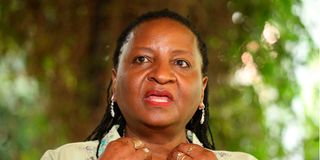
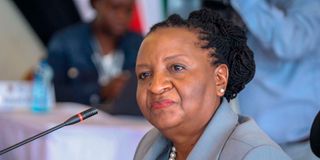
Anne Amadi during an interview in Karen, Nairobi on November 27, 2023.
The LSK further argued that Dr Mokua’s selection process lacked transparency and fairness, depriving other qualified Kenyans of the opportunity to compete for the position.
“The nomination process of Dr Mokua was shrouded in secrecy, flouting the national values and principles of governance such as the rule of law, participation of the people, inclusiveness, equality, protection of the marginalized, transparency, and accountability,” LSK stated.
According to the EAC Treaty, a candidate for appointment as a judge of the EACJ must have at least ten years of experience as a superior court judge, a professionally qualified magistrate, or a distinguished academic or legal practitioner. LSK argued that Dr Mokua did not meet these criteria.
By handpicking Dr Mokua, the government undermined the competitive selection process required for such high-ranking judicial positions.
LSK said, "According to Article 24(1) of the EAC Treaty, the East African Community Partner States are responsible for choosing judges for the East African Court of Justice. As such, they must follow the Constitution and laws of those Partner States."
They argued that Dr Mokua, who is also a Pastor as per his CV, did not meet the criteria for appointment as a Judge of the High Court of Kenya.
They argued that appointing a Judge to the EACJ is equitable to appointing a Judge of the High Court of Kenya, and therefore the requirements as per Kenya’s constitution and procedures was not adhered to when the CS Malonza appointed Dr Mokua for consideration as a Judge to the EACJ.
“We are a bit concerned with the nature of appointment and we are also concerned about the procedure that has been used to make this particular appointment,” said David Sigano, the President of the East African Law Society (EALS).
“Because appointing a Judge to the EACJ is equivalent to appointing a Judge of the High Court of Kenya. There is a very clear procedure on what really needs to be done before you can get someone into that position.”
The EALS said the nominee to the EACJ has first to be nominated by the JSC, then interviewed publicly as is the norm and practice with the appointment of Kenyan Judges.
“There is a very clear procedure on what really needs to be done before you can get someone into that position. This is not someone we see practice law to a level that will give everyone confidence that this is the right appointment to the regional court or a court to the calibre of the EACJ,” said Mr Sigano.
On January 31, 2025, the High Court of Kenya declared the nomination of Dr Mokua as a judge of the EACJ unconstitutional, illegal, and null and void, paving way for Amadi’s nomination to the EACJ.

Anne Amadi during an interview in Karen, Nairobi on November 27, 2023.
Justice Chacha Mwita ruled that the nomination process, led by the then EAC CS Malonza on April 18, 2024, failed to adhere to the Constitution of Kenya and the Treaty Establishing the EAC.
The court found that the process lacked public participation and oversight from key legal bodies, including the LSK and the JSC, which are responsible for determining the qualifications of judicial nominees.
“The nomination of Dr Mokua was illegal and unconstitutional because it was not subjected to public participation, was not transparent, and his suitability was not determined by the LSK,” Justice Mwita ruled.
He emphasized that Kenya's Constitution mandates an open and competitive process for appointments to public offices.
With the High Court’s decision, the government restarted the nomination process that culminated in the appointment of Amadi, bringing a two-year legal battle to an end.
Follow our WhatsApp channel for breaking news updates and more stories like this.