Expectations in Kenya were high. Prime Cabinet Secretary Musalia Mudavadi’s visit to Moscow followed months of protests by families of Kenyan nationals caught up in Russia’s war in Ukraine, who had pressed the government to bring home those still trapped in the conflict, return the injured, recover the bodies of the dead and secure compensation for those killed.
Their hopes were shaped in part by South Africa’s success in bringing home some of its citizens. So far, those hopes remain unmet. Instead, for many Kenyans drawn into the war, their fate now rests on a fraught mix of contract law, diplomacy and geopolitics.
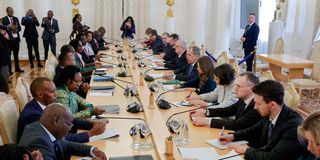
The tensions surrounding Kenyan recruits in the Russian army were evident at a joint news conference in Moscow on March 16.
Russia’s Foreign Minister Sergey Lavrov insisted that the foreign recruits had joined voluntarily, ignoring mounting evidence, including from Kenyan authorities, that many had been misled.
Mudavadi did not publicly challenge the claim. His stance appeared to contradict a statement issued by Kenya’s Ministry of Foreign Affairs on October 27, 2025, warning that its citizens had been lured to Russia by what it described as “corrupt and ruthless agents” using fraudulent job offers and falsified documents, only to find themselves caught up and detained in Russian military camps.
The ministry added that some victims were being held for military operations and pressured to sign contracts.
That account stands in direct conflict with Moscow’s insistence that the recruits joined voluntarily. Kenyan officials have not publicly reconciled the two positions. Despite their differences, Kenyan and Russian officials appear to converge on one point: the contracts.
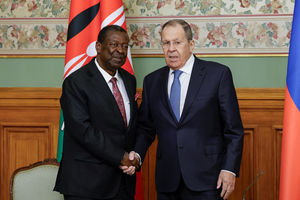
Russian Foreign Minister Sergei Lavrov shakes hands with Kenyan Foreign Minister Musalia Mudavadi during a press conference following their talks in Moscow, Russia, March 16, 2026.
Photo credit: Reuters
Mudavadi and Lavrov have both framed the issue in legal terms, emphasising that the agreements signed by the recruits are binding and governed by contract law.
Under that interpretation, neither government has indicated it would broadly intervene to void or suspend those agreements.
“Each individual signed a contract that was meant to be fulfilled. If anyone chooses to terminate that contract prematurely, there will be no compensation,” Mr Lavrov said.
He added that once the contract period ends, recruits are free to leave. However, a review of the contracts indicates that attempts to leave active service may be treated as desertion, exposing recruits to penalties that effectively prevent them from exiting the system.
Legal experts say the central issue is not the existence of the contracts, but how they were obtained. Agreements signed through deception or without informed consent, they say, do not erase the underlying exploitation.
Recruits told the Nation that the reality is far more restrictive than the contracts suggest. Some of the agreements, previously reviewed by the Nation, were presented without explanation, leaving many unaware of their terms.
Several recruits said they signed contracts written in Russian without translation and were given no copies. In some cases, only partially scanned versions were later shared with family members. Many said they did not understand what they had signed.
From the outset, their efforts to opt out of the contracts appear doomed. A translator who worked with foreign recruits during training, often serving as their first point of contact in the military, told the Nation there was a steady stream of questions from new arrivals.
According to the Egyptian national, many recruits were well-educated, including doctors. Iraqi recruits, in particular, repeatedly asked how to cancel their contracts.
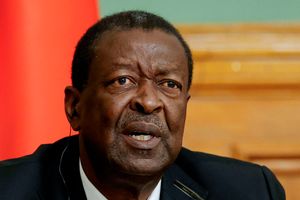
Prime Cabinet Secretary and CS for Foreign and Diaspora Affairs Musalia Mudavadi address journalists during a quarterly update on Kenya’s foreign policy at the Ministry headquarters in Nairobi on November 12, 2025.
Photo credit: Lucy Wanjiru | Nation Media Group
His answer, he said, was always the same: “Once you sign, it is finished.”
The issue of foreign recruits in the Russian military has drawn growing international scrutiny. In a resolution adopted on March 12, 2026, European lawmakers accused Russia of luring vulnerable foreign nationals into its war in Ukraine through deception and coercion, warning that the practice could amount to human trafficking and war crimes.
The resolution cited the case of Francis Ndung’u Ndarua, a Kenyan national fraudulently recruited and sent to the front in Ukraine.
European officials described Russia’s pledge to halt recruitment as the first tangible result of mounting international pressure.
The characterisation of recruitment as “voluntary” obscures the conditions under which many recruits were enlisted. Where recruitment is secured through deception, coercion or lack of informed consent, those involved are not considered volunteers but victims — a distinction that may place such practices within the scope of human trafficking under domestic and international law.
Although Russia and Kenya were unequivocal in disclaiming responsibility for compensation claims by families of those killed in the war, they left another question unaddressed: wages earned by Kenyan nationals while in Russia.
Families say they have been unable to access money held in Russian bank accounts — sums believed to be significant but effectively frozen by sanctions. This raises questions about whether Kenyan authorities have pursued mechanisms with Moscow to recover what may be the only remaining assets tied to their relatives’ service.
Kenya’s position underlines the dilemma facing African governments caught between mounting evidence of deception and the need to preserve diplomatic ties with Moscow.
At the news conference, Mudavadi emphasised stronger bilateral relations, pointing to cooperation in areas such as labour mobility, even as evidence showed recruiters and intermediaries had used some approved official channels to steer men into the war.
A joint communiqué issued after the meeting further blurred the picture, failing to clarify whether recruitment linked to the broader war economy, including private-sector industries supporting military operations, would continue.
Kenya’s shifting diplomatic stance does little to strengthen its demands. In 2022, Kenya’s ambassador to the United Nations strongly criticised Russia’s recognition of the self-declared Donetsk and Luhansk republics, calling it a violation of international law.
More recently, Kenyan officials have adopted more conciliatory language, at times echoing Russia’s description of the conflict as a “special military operation” — a phrase closely associated with the Kremlin’s account of the invasion.
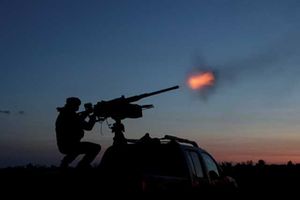
Ukrainian serviceman from mobile air defence unit fires a machine gun towards a Russian drone in Kharkiv region.
Photo credit: Sofiia Gatilova | Reuters
Don Deya, chief executive of the Pan African Lawyers Union, said African countries are confronting what he described as “a macabre crossroads” of poverty, joblessness and deception, facilitated by recruitment networks operating across the continent.
“We do not easily have the legal tools to address the scale and scope of this phenomenon,” he said, noting it stretches from the Horn of Africa to West Africa and Southern Africa. “We will have to innovate such tools and mechanisms to respond adequately — at the intersection of international labour law, human rights law and humanitarian law.”
Kenya has not addressed the fate of its nationals fighting for Russia who have been captured by Ukraine — another example of the impact of its shifting diplomatic stance.
In November 2025, President William Ruto spoke by phone with Ukraine’s President Volodymyr Zelenskyy to press for the release of Evans Kibet, the first Kenyan detained in Ukraine. A subsequent visit by Kenya’s honorary consul in Ukraine, Anatoliy Kovalenko, reinforced Kyiv’s stated willingness to facilitate his repatriation.
However, Kibet later said that on January 17, 2026, Kovalenko visited him in a prison camp and said a previously discussed plan for his repatriation would no longer proceed.
“They told me I had two choices: have my name placed on a list for a possible prisoner exchange or wait until the end of the war,” he said in a news interview.
Clinton Nyapara Mogesa who has been fighting in the Russia-Ukraine war.
Photo credit: Pool
He agreed to a prisoner exchange, but the swap never materialised. A large-scale exchange conducted on March 5 and 6, 2026, involving roughly 500 prisoners on each side, did not include any African nationals. Russia has not included African nationals in its exchange lists. Another Kenyan detainee, Wilson Muniu Macharia, said no consular officials had contacted him. For now, both men remain in limbo. Ghana’s decision to engage directly with Kyiv may offer a model for Kenya, much as South Africa’s efforts have done. Ghana’s Foreign Minister Samuel Okudzeto Ablakwa secured an agreement for the repatriation of two of his country’s nationals detained in Ukraine.
For families, the diplomatic deadlock has had deeply personal consequences.
Speaking at the European Parliament, where she called for accountability, Bibiana Waithaka described how her son, Charles Waithaka, left for what he believed was a job abroad but ended up in the military.
Her account mirrors those of returnees, detainees and other families, many of whom say they were drawn in by promises of work that quickly gave way to military deployment.
Ukrainian officials estimate that more than 27,000 foreign nationals have joined Russian forces since the start of the war, with recruitment rising sharply each year.
Russia enlisted 3,808 foreign fighters in 2023, 8,265 in 2024, and nearly 14,000 in 2025, according to Ukrainian intelligence spokesman Andriy Yusov.
According to Mudavadi’s position, Kenyans enlisted in the Russian military are expected to remain in service for the duration of their contracts, many of which run for about one year. The earliest contracts are expected to conclude around May 2026, based on reports of when the first Kenyans travelled to Russia — if they are still alive.
However, it appears that, for the Kenyan government, it is business as usual. Kenya said it had secured a commitment to expand civilian employment opportunities in Russia under a government-to-government labour migration framework, despite lingering concerns about safeguards in a wartime economy.