June 22, 2025, began as an ordinary Sunday morning for Regina Wangui Mwangi and her two children at church, only to end in tragedy that continues to haunt her family.
Ms Wangui had taken her children Margret Wanjiru, 3, and Isaac Mwangi, 7, for their usual service at PCEA Shalom Mchanganyiko in Posho Mill, Bahati sub-county, when the youngest went missing.
The three-year-old was later found dead, about 150 metres from the church compound, turning what had been a routine religious gathering into a nightmare from her family and congregants.
A year later, the circumstances surrounding the little girl’s killing remain difficult for her family to comprehend, even after the person responsible was arrested, convicted on her own plea of guilt, and sentenced to 20 years in prison.
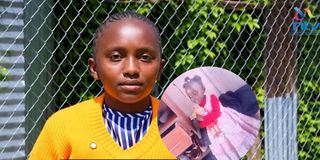
A picture of three-year-old Margret Wanjiru who was killed by an 18- year-old girl at PCEA Shalom Mchanganyiko in Posho Mill, Bahati sub-county.
Photo credit: Boniface Mwangi | Nation Media Group
Recalling the events of that day, Ms Wangui said upon arrival at the church, she took the two minors to the Sunday school class before she proceeded to the main service. The two structures were just metres apart, and she hoped to pick them later.
In an interview with Nation at her home, Ms Wangui said during the service, the young Wanjiru came to her almost three times. On the last time she came, she asked for money to purchase sweets, and she handed her Sh5.
At some point during the services, the Sunday school children had a presentation. Wanjiru and her brother came holding hands, made their presentation and were ushered out.
Recalling the last moments with her daughter, Ms Wangui said that the three-year-old came back with a sweet and after a brief moment she excused herself to play outside.
According to Ms Wangui, there were other activities going on. Apart from the regular service, the church had organised a yearly medical check-up and every member was encouraged to pass by the desks.
After completing her blood pressure check and collecting medication from the medics, she began looking for her children so they could leave for home.
Ms Wangui came out to find only her son who was also looking for her, thinking she was with her sister. They searched for the young Wanjiru within the church compound, but she was nowhere to be seen.
Convinced that Wanjiru could not have gone back home alone, she kept calm and continued with the search.
While in a moment of confusion looking for Wanjiru, she heard two people asking some of the church members if anyone had lost a child, as there was a girl who was sleeping a few metres from the church.
Hurriedly, she headed to the direction the men alleged to have seen a child as they had given a description of how the child was dressed -- a red trench coat and blue pants.
Regina Wangui, mother of the three-year-old Margret Wanjiru on June 23, 2025 narrates how her daughter was murdered by a 17- year-old girl.
Photo credit: Boniface Mwangi | Nation
However, before arriving one person shouted that she was dead, leaving Ms Wangui in confusion.
“We found about 150 metres from the church, I held my daughter to confirm if she had been sexually assaulted. She was okay. She was, however, unresponsive. I screamed for help and people came including the medics. One of them told me she was still alive. We rushed her to Kenlands Hospital but she was confirmed dead and we moved her body to the PNN Mortuary,” she recalled.
The matter was reported at the Kiugoine Police Station, with DCI Nakuru North launching an investigation which would reveal that the killing had not been accidental.
At the scene, police discovered that there were two homes with CCTV cameras installed outside the church compound and retrieved the footage.
Upon analysis, they found that at around noon, a teenager dressed in a red trench coat and grey trousers was seen leaving the church gate. A young girl wearing a scarf around her neck was following her.
About 130 metres from the entrance and after ensuring nobody was watching, the teenager strangled the toddler using the scarf she was wearing and left her lying unresponsive on the road before returning to the church.
Later, one of the church members would identify the teenager as Liz Njeri Mwangi – an 18-year-old daughter of a church member – saying she had seen her leave the church accompanied by the victim and also saw her return alone.
According to witnesses, around the time of the incident, the would-be killer was seen walking towards where Wanjiru was taking porridge with other children in her class.
She then instructed Wanjiru to follow her. A few minutes later, Njeri returned to the church premises alone. What followed was the discovery of the minor’s body.
The witnesses led police to the suspect’s home and upon searching it, they discovered the clothes Njeri had worn in church on the day of the incident. She was arrested and while being held at Kiugoine Police Station, she admitted to killing the minor.
A post-mortem examination conducted on Wanjiru’s remains by government pathologist Titus Ngulungu revealed that she had been strangled to death.
During court proceedings, defence counsel informed the court that Njeri was remorseful and claimed she did not understand how she committed the act.
They further suggested that the offence may have been influenced by psychological disturbances, including nightmares and a strange compulsion to kill.
They urged the court to impose a non-custodial sentence, preferably probation, to enable counselling and rehabilitation under the supervision of a probation officer.
The prosecution acknowledged that Njeri was a first offender who had pleaded guilty. However, the State strongly opposed a non-custodial sentence, arguing that the severity of the crime.
The State noted that the killing of a defenceless three-year-old demanded a custodial term to serve as a deterrent. Prosecutors maintained that public interest and the need to denounce such violence outweighed the mitigating factors advanced by the defence.
It indicated that the victim’s family remained deeply embittered by the incident, and that neither the offender’s family nor the wider community were prepared to accept her back, rendering the probation unsuitable.
The court also noted that it had not been demonstrated that Njeri was free from the disturbing influences said to have led to the killing.
After balancing the interests of justice, the court concluded that a custodial sentence was unavoidable.
On December 19, 2025, Njeri – who was a Form Four student at Upper Hill Secondary School – was sentenced to 20 years in prison by the High Court in Nakuru.
“Doing the best I can, I sentenced the accused to 20 years in prison,” ruled the judge.
Njeri was born in Nakuru on August 4, 2007. She never knew her biological mother. The mother died when she was barely three months old. Her father also died while she was young, leaving her in care of an aunt.
A probation report said the turning point for Njeri came when she learnt the people she believed were her parents were her foster parents.
The revelation hit hard, making her disappear from home for three days at some point. No one knew where she was. She became withdrawn, preferred eating alone, and reportedly began seeing images of her late mother.
For some, the sentence was justice delivered. But for others like Ms Wangui, it was too little as it cannot restore the life lost or erase the trauma of the day.
“I do not have any question to ask Njeri. I might ask her why she killed my daughter but she will just tell me she doesn’t know then what? My question will be to the judge: ‘You gave her 20 years which she will serve and later released. If Wanjiru was your child, would you have handed Njeri the sentence?’” she posed.
Ms Wangui said that Wanjiru had joined the playground and despite her tender age she loved school, noting that she was a humble girl.
She maintained that prior to the tragic incident, she did not know Njeri; that she only met her for the first time at Kiugoine Police Station.
“I miss her [Wanjiru] every day. I always ask myself: ‘If we did not go to church that day, could she be alive?’ She would be in PP1. It has not been easy for my family. After her burial, I have not gone back to her gravesite. It is painful. We had a family meeting in December, but I did not attend the event. Her siblings ask about her every day,” she said.
The killing also left a deep scar among congregants, particularly children who witnessed the aftermath of the tragedy or struggled to understand what had happened to Wanjiru.
Titus Mugo, a church elder at PCEA church and the Kiamaina location assistant chief, said the incident plunged the congregation into shock and grief, forcing the church to confront the trauma among its young members.
He said that the tragedy prompted the church to organise counselling sessions for children to help them process the incident and cope with fear and distress it had triggered.
For a congregation that had worshipped together for 15 years without witnessing such an accident, the killing was a painful wake-up call on the need to strengthen child safety measures within the church compound.
“We have been in this church for years and we have never witnessed such a thing. We had to put measures to ensure our children are safe while here and avert such incidents in future,” he said.
In an interview with a local media while in the confines of Nakuru Women’s Prison where she is serving her jail term, Njeri said on that day, she had been entrusted with looking after her younger siblings during the church service by her mother.
She maintained that she still struggled to understand what drove her to commit the crime, insisting that she had always loved children and that Wanjiru had been playing with her younger sister.
Njeri said she had not anticipated that the strangling would result in the child’s death, describing the incident as something she could not fully explain.
She went on to plead for forgiveness from Wanjiru’s mother and the family, acknowledging the pain her actions had caused.
“I do not know what happened, but I can say ni kitu iliniingi a [something got in me], since I love children. At the church, she was friends with my younger sibling and they used to play together even on that day. My mother was shocked when she was told what I had done. To Mama Wanjiru; sorry,” she said.