A lone Directorate of Criminal Investigations (DCI) officer arrived at Tseikuru police station on Thursday afternoon to feel the lay of the land before his colleagues arrive to start a murder investigation involving two of their own.
Usually, when the DCI headquarters is taking over such sensitive investigations, it will send an advance team to observe what work has been done by the initial responders as a squad is constituted.
In this case, that one officer was on Thursday observing what work has been done by other officers in relation to the murder of 24-year-old Administration Police (AP) officer Raphael Ojiambo.
Raphael died after sustaining a gunshot wound to the chest last Sunday inside the Wikithuku Border Patrol Unit (BPU) Training Camp in Tseikuru, Kitui County.
Family seeks justice for AP officer allegedly shot dead by colleague
Investigations are intended to establish whether another AP officer, Hussein Yusuf Ali, was the one who pulled the trigger of a police-issue G3 rifle aimed at Raphael’s chest. The investigation is also intended to establish the motive for Raphael’s murder.
One of the police officers who was among the initial responders told the Daily Nation that Raphael and Ali were friends who met at the AP Training College in Embakasi, Nairobi.
Raphael and Ali were among 10,000 individuals selected to join the National Police Service during a recruitment exercise conducted on November 17, 2025.
Raphael attended the recruitment exercise in Siagonjo Stadium in Budalangi Constituency, Busia County while Ali was picked after attending an exercise in his home county, Wajir.
Seven days after proving their physical fitness to recruiters who also verified academic papers submitted, Raphael and Ali were among 3,000 individuals directed to report to the AP Training College in Embakasi.
It is at the training college that fate began to script the darkest chapter in Raphael’s life, by ensuring that he and Ali met.
Despite not being in the same platoon, the two struck a friendship upon meeting. In the AP structure, at the training camp all the recruits are split into basic units called platoons. Each platoon has a maximum of 18 recruits. Platoons feed into companies. Each company has a minimum of two platoons.
Raphael's father, Edward Ojiambo, says he knew most of Raphael’s friends but knew nothing about Ali.
“I just saw his pictures on social media; he was not among the friends he had introduced me to,” said Edward.
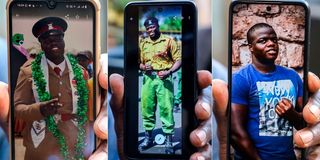
Edward Ojiambo displays a picture of his son Raphael Ojiambo on his mobile phone at the family's home in Kariobangi, Nairobi on October 28, 2026. Ojiambo was allegedly killed by a fellow police officer at Wikithuku Border Patrol Unit Training Camp in Tseikuru, Kitui County.
Photo credit: Lucy Wanjiru | Nation Media Group
Even as he waded into the complex and risky world of security, Raphael maintained a close relationship with his father who was in Nairobi encouraging his son to soldier on as the tough times would pass.
According to Edward, admission into the APTC was a sign that life would change for the family, but it took more than his zeal to keep him there, explaining his multilayered life in boots.
He remembers how, during training, they would keep in touch through senior officers checking in on his son, whose physique and love for bodybuilding had given him an edge over others.
“He would call and say, ‘Dad, the training is really hard, I am thinking of quitting,’ but I would encourage him. There is a day he called me telling me how he had been tortured to the extent of seeking medical treatment, but he stuck in there,” said the father.
Edward adds that even while pushing through, a challenge emerged during Raphael's training in Embakasi as a rookie.
Edward was summoned to the training college mid-training to resolve an issue where Raphael had fallen in love with a fellow recruit whose father held a senior rank in the service.
“He had some girl trouble, and during that period I was summoned to the Embakasi APTC to have a chat. We talked about the issue, and the father to the girl was there. We agreed that I should talk to my son while he does the same to his daughter,” said Edward.
“I met her after the passing-out parade, and Raphael had brought her to me so I could know her. I was asking him why he could not even inform me so that we could plan, and he told me that she was just passing by,” the father recalls.
And when news of Raphael's demise broke, she reached out to Edward to confirm the news.
On September 4, the hard work paid off as Raphael and Ali were among 3,000 graduands whose passing-out parade was attended by President William Ruto. After the celebrations, it was time to enter the second stage of training.
The AP has three units under its command. The Critical Infrastructure Protection Unit (CIPU) which guards government buildings, the Anti-Stock Theft Unit (ASTU) which deals with security involving livestock theft, and the Border Patrol Unit (BPU) which protects Kenya’s borders from external attacks.
The AP also offers other security services. This includes security services to government agencies, banks and VIP protection.
Raphael did not want to join the BPU as it would mean he would more likely than not be deployed to one of Kenya’s borders hence he would be far away from family.
A relative displays pictures of Raphael Ojiambo at the family's home in Kariobangi, Nairobi on October 28, 2026. Ojiambo was allegedly killed by a fellow police officer at Wikithuku Border Patrol Unit Training Camp in Tseikuru, Kitui County.
Photo credit: Lucy Wanjiru | Nation Media Group
“After graduation, we were here with him, but he said BPU was not his dream. I told him to be brave and do what he had been chosen to do, protect the country. He kept telling me his struggles at the BPU camp. The last time we spoke on October 22, he asked me where I was and if I had any money to send him. I did not have any, and he told me not to worry,” Edward said in an interview with the Daily Nation.
On October 21, the BPU recruits reported for training, Raphael among them. Four days later, Raphael fell ill and could not join his platoon for the day’s activities hence he stayed in bed.
Around 3pm, a loud gunshot was heard in the training camp, seemingly coming from their sleeping quarters. Everyone ran in that direction, but superiors ordered the recruits to stop outside their sleeping quarters.
A few senior officers walked into the sleeping halls, and then came out a few minutes later to announce that Raphael had been shot, and that there was no spent cartridge at the scene.
A few weeks into training in Embakasi, Raphael noticed that there were AP officers younger than him but with higher ranks. Rather than deflate him, it encouraged him to aim higher. This meant furthering his education beyond the computer packages he had done earlier.
“He said, ‘Dad, I have been in here and seen people who are way younger than I am having higher ranks than me. I am looking forward to going back to school, getting myself some papers, and climbing up the ranks’,” Edward recounted.
Now, his family has been left with memories of what could have been, with Raphael’s can-do attitude.
“He had been doing anything he laid his hands on, even manual jobs, just to ensure that he could chip in. I remember how he would go to a job and in the evening come home with loaves of bread and tell me, ‘Daddy, breakfast is sorted’,” Edward reminisces.
“Murder is a very serious crime in Kenya. We hope that the government agencies involved will ensure that the perpetrator pays for the act. It would also be good if the government would compensate us, since this is quite a huge setback that we may never recover from,” said Edward.
Edward now requests that the government do what it can to give them answers on why their firstborn was killed, and for the perpetrator to face justice.