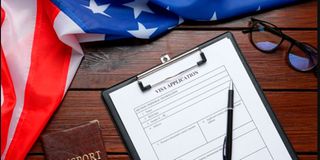
Kenyans have welcomed a US federal district judge’s decision that struck down a Trump era fee of $100, 000 (Sh13m) for H-1B visa applications, whose enforcement targeted immigrants, including thousands of Kenyans.
Judge Leo Sorokin stated that only Congress had the power to change federal immigration policy, adding that the levy by the President Donald Trump administration was imposing an unconstitutional tax on applicants.
H-1B visas allow foreigners in the US to look for work in professions that are considered to be more specialised. To qualify, applicants must hold a bachelor’s degree or a similar equivalent. The H-1B visa is valid for three years and can be renewed for another three years.
2026-05-06T190916Z_1953626497_RC2V3LAVFQ3I_RTRMADP_3_USA-TRUMP
Photo credit: Reuters
The ruling against the hefty visa application fee will be a big boost for thousands of Kenyan college and university graduates in the US. It will also help immigrants and applicants from Kenya looking to apply for jobs and gain H-1B visas to work in the US. They will no longer be forced to have their potential employers pay the hefty $100,000 (13m) fee to file H-1B applications.
For California-based Kenyan journalist Maurice Ndole, who attended journalism school at California State University Fresno, the ruling is a significant legal milestone.
“The ruling removes a major financial barrier that would have made it nearly impossible for most Kenyan professionals and graduates to pursue H-1B opportunities. In the short term, it preserves access to one of the most important pathways for highly skilled foreign workers,” says Mr Ndole.
He however cautions Kenyan students assuming this means the immigration environment has become friendlier.
“The current administration has signalled a tougher stance on immigration overall, and visa policies can still change through other legal avenues. The opportunity remains, but applicants should be prepared for greater scrutiny and uncertainty than in previous years,” Mr Ndole says.
He adds that Trump’s aggressive immigration enforcement policies will continue because the ruling by Judge Leo Sorokin, is limited to the specific fee of $100,000 and the legal authority used to impose it.
“It does not prevent the administration from pursuing other immigration restrictions or enforcement measures. The administration will likely appeal the decision, potentially all the way to the Supreme Court. Even if this particular policy does not survive, the broader push for stricter immigration controls is unlikely to disappear,” Mr Ndole argues.
“The judge argued, correctly in my view, that the $100,000 requirement for hiring an H-1B holder - that is the immigrant petitioner - is a levy, a tax that only Congress has the power to legislate. I also do not think this will restrict Trump’s harsh immigration policies. His nature is to double down when confronted or challenged. His supporters who are pushing this anti-immigrant campaign, are ideologues. This legal ruling will not change them,” Prof Orwel observes.
New York-based immigration lawyer Blaise Odhiambo feels that it is important to have a credible and professional attorney to file immigration paperwork even with this ruling. Blaise - who is an expert in employment related immigration law, states that in spite of this ruling “good legal advice in filling H-1B petitions is key to determining success or failure.” “Legal advisory services help students looking to get H-1B visas, navigate the complex areas of work authorisation and Adjustment of Status (AOS).”
On claims by the Trump Administration before Judge Leo Sorokin that the $100,000 fee was necessary in restricting H-1B visas being abused by employers to hire foreigners instead of Americans, Ndole acknowledges the concern.
“There is a legitimate debate about how some employers use the H-1B program, particularly concerns about wage suppression or overreliance on foreign labor in certain industries,” says Mr Ndole. “However, the program was originally designed to help employers fill specialised positions when qualified workers are difficult to find. Employers seeking H-1B workers must comply with federal labor requirements, including attesting that hiring a foreign worker will not adversely affect the wages and working conditions of similarly employed U.S. workers. There is generally no blanket requirement to prove that no American can do the job, which is a common misconception.”
He argues the controversy over hiring foreigners for H-1B visas over Americans should be addressed through stronger oversight and enforcement where abuse occurs. Making it prohibitively expensive for highly skilled professionals to apply only hurts industries in technology, healthcare, engineering, and research. There continues to be a human resource skills demand in these areas that Americans cannot fill.
Prof Orwel concedes some companies have formed cartel-like business operations around H-1B visas. They know the process and hire third party firms who work through the procedures of getting H-1B visas for workers. “That said, the judge's ruling is also fair for technology companies looking to hire foreigners. Most Americans are not into STEM, so there's a dearth of native-born tech professionals.”
According to the judge, the legislature had not delegated its powers to the executive. Therefore, the president could not unilaterally make such a change on immigration policy. In a 42-page opinion striking down the policy, the Obama appointee stated "the President had no power or delegated authority to impose a tax on H-1B petitions.”
The case challenging the H-1B visa fee was brought by a group of state attorneys general from Democratic states in December 2025. The Trump Administration argued the program importing workers on H-1B visas was being abused by employers to deny American workers jobs and depress wages.
Economists in support of the H-1B program say it allows American companies to maintain competitiveness and grow their business. It also creates jobs in the US, retains the best foreign talent in America and advances soft power diplomacy when US trained professionals go back to their countries.
Judge Sorokin rejected Trump administration arguments that the president had the power to implement the $100,000 fee because federal immigration law allowed him to change US policy in other ways. Judge Sorokin argued that nowhere in those laws did Congress also give the president the power to levy taxes in the immigration sphere. This was an over extension of executive Article 2 powers.
The US has historically benefited from immigrants studying technology courses, establishing companies and creating more jobs and increasing the tax revenues for the country. The world uses its resources to train for American companies and ultimately, the US benefits. Overall, Judge Leo Sorokin’s ruling is a big relief for Kenyan and foreign workers looking to get H1-B visas to live and work in the USA.