Fifty-nine Kenyans are among 485 Africans confirmed killed while fighting for Russia in its war with Ukraine, according to a watchdog that compiles a list of foreign casualties.
The platform, Stop Russian Recruiters, identified as many as 2,984 Africans from 40 countries who signed military contracts with Russia since the invasion of Ukraine began in 2022.
Now, one in every six of them is confirmed dead, with Cameroon recording the highest loss at 104 deaths, Ghana 85, Egypt 81 and Kenya 59.
The watchdog listed names of those it said were Africans killed while fighting for Russia, from original documents initially written in Cyrillic.
The platform says its database is based on Russian military records and other verified information documenting foreign recruits, listing identities of thousands of Africans alleged to have signed military contracts.
The report comes as more online adverts seeking to lure Africans to the frontline in Russia have been put out. And Counter-trafficking experts say recruitment methods have evolved, with Facebook, Telegram, WhatsApp and other online platforms increasingly being used to advertise what appear to be legitimate employment opportunities.
Prime Cabinet Secretary Musalia Mudavadi said that Kenya had secured the release of about 50 Kenyans fighting for Russia in the frontlines in Ukraine.
Photo credit: Shutterstock
Many recruits, they say, are promised jobs in construction, security, logistics or factory work before being pressured to sign military contracts upon arrival in Russia.
Stop Russian Recruiters, made up of war monitors from the Ukrainian Ministry of Defence, argues that digital recruitment has become one of the main gateways through which foreign nationals are enlisted into Russia’s armed forces.
For Kenya, the list of the dead runs counter to what officials had earlier said. Russia officially confirmed deaths of 19 Kenyans, but Kenya also said Russia would no longer deploy Kenyans on the battlefield. Moscow, however, indicated those with active contracts must serve them in full. Kenya had also said 32of its citizens were missing in action.
Members of the delegations, led by Russian Foreign Minister Sergei Lavrov and Kenyan Foreign Minister Musalia Mudavadi, hold talks in Moscow, Russia, March 16, 2026.
Photo credit: Reuters
In fact, some Kenyans were deployed just days after Prime Cabinet Secretary Musalia Mudavadi, who is also in charge of Foreign Affairs, visited Moscow in April and received assurances from Russia’s Foreign Minister Sergey Lavrov of stopping recruitments.
“And I want to make it clear that we have now agreed that Kenyans shall not be enlisted through the Russian Ministry of Defence. They will no longer be eligible to be enlisted. There will be no further enlisting,” Mr Mudavadi said.
However, online recruiters have targeted desperate youth in Kenya and other African countries with online recruitment drives.
While there is no evidence that the recent Facebook post was linked directly to the Russian government, analysts say recruitment networks often operate through intermediaries and informal agents, making them difficult to detect or dismantle.
Frederick Odhiambo, a consultant working with the Kenya National Commission on Human Rights who has been assisting affected families, said the scale of recruitment is likely much larger than official figures suggest.
“Thousands of Kenyans were taken to Russia to fight against Ukraine in different phases beginning in 2023. The families I am in contact with are almost 500 and each is missing a relative. Some speak of three,” he said.
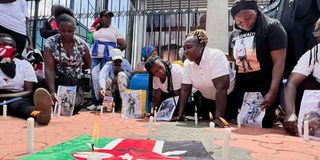
Among those confirmed dead is Erastus Mundia. The 38-year-old father of three had travelled to Russia in search of work before he went missing. His family had hoped that he would somehow find his way home. Every evening ended the same way, with unanswered questions.
The Kenyan government later confirmed Mundia’s death, ending months of agonising uncertainty for his family, while raising difficult questions about how a Kenyan seeking employment abroad ended up fighting in the war in Ukraine.
Vocal Africa Executive Director Hussein Khalid (Centre) flanked by families of Kenyans caught in the Russia-Ukraine war recruitment web address the media in Nairobi on January 27, 2026.
Photo credit: Lucy Wanjiru | Nation Media Group
To his mother, he was simply a son chasing a better life.
“I only knew he was travelling for work. He had worked as a salesman before and had even travelled to America, so I thought this was another ordinary job. He kept telling me, ‘Mother, I only need your prayers’. I asked him what was happening, but he wouldn’t explain,” she told the Nation .
Families have repeatedly petitioned Parliament to investigate recruitment agents operating in Kenya, arguing that many victims were deceived through online job advertisements and promises of well-paying work overseas.
Campaigners say shutting down recruitment will require more than diplomatic assurances between governments.
They argue that authorities must also monitor online recruitment networks, investigate agents operating locally and strengthen oversight of overseas labour recruitment, warning that as long as unemployment remains high, deceptive digital recruitment campaigns will continue to find willing audiences.
According to a 2026 Carnegie Endowment report, Moscow has expanded its diplomatic, security and information outreach across Africa since the full-scale invasion of Ukraine, although researchers argue Russia’s influence remains constrained by its relatively limited economic footprint and African states’ pursuit of multiple international partnerships.