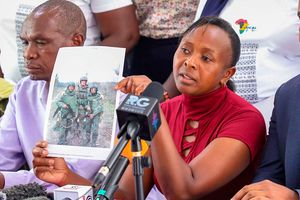
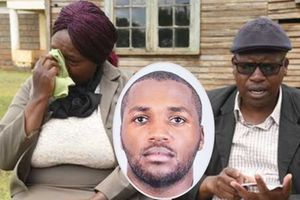
For months, Josephine Ngoya clutched her phone, praying each unfamiliar ring would carry news of her son.
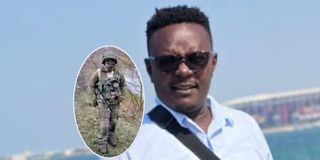
Erastus Mundia, a 38‑year‑old father of three, had left for Russia in search of work. Instead, he was swept into the war in Ukraine. This week, the government confirmed his death, ending his mother’s hopes and exposing the peril faced by Kenyans lured abroad with promises of jobs that turn into battlefronts.
To his mother, he was simply another son chasing a better life. It would become a deadly venture.
“I only knew he was travelling for work. He had worked as a salesman before and had even travelled to America, so I thought this was another ordinary job. He kept telling me, ‘Mother, I only need your prayers.’ I asked him what was happening, but he wouldn’t explain,” she told the Nation.
It was during a WhatsApp call that she discovered he was in Russia. Her son reassured her that he was safe but repeatedly asked for prayers.
“I have no information. I am just in pain. I don’t even know what is happening to my child,” she said.
Like thousands of families, Ms Ngoya believed overseas employment offered an opportunity to improve their lives. There was nothing, she says, to suggest her son would become caught up in one of the world’s deadliest conflicts.
“After he had been there for a month, he sent me Sh10,000. Then he told me that it was not safe and that I should pray for him. Later, I saw his picture in a military uniform, and I was scared. He was my firstborn, the breadwinner. What should I do? I am stressed,” she recalled.
As communication became increasingly irregular, anxiety replaced optimism. The family sought help from relatives, government offices and anyone who might know where Mundia was.
At one point, Ms Ngoya says, a man who had allegedly connected her son to the overseas job demanded Sh10,000, claiming he needed the money to follow up on the case.
For months, the family lived in uncertainty, unsure whether Mundia was alive, injured or missing.
Documents shared by Ukrainian military intelligence indicated that more Kenyans had been deployed, just days after the April trip by Kenya’s Prime Cabinet Secretary Musalia Mudavadi to Moscow, where he announced no more Kenyans would be deployed to the Russian battlefield. In fact, according to Ukrainian authorities, several Kenyans were killed on the battlefront in April after undergoing training and signing military service contracts.
Members of the delegations, led by Russian Foreign Minister Sergei Lavrov and Kenyan Foreign Minister Musalia Mudavadi, hold talks in Moscow, Russia, March 16, 2026.
Photo credit: Reuters
Details released included the identities of three Kenyans deployed and a photo of one said to have been killed. The men had arrived in Russia from October last year and were scheduled for gradual deployment.
One Kenyan fighter was identified through Ukraine’s “I Want to Live” project, a state‑run initiative launched in September 2022 to facilitate the voluntary surrender of Russian servicemen.
Among those named was Mwangi, born in 2003, who arrived in Yaroslavl on October 24, 2025. Others included Wanjiru (born 1997), Ngure (born 1995) and Kipkirui (born 2001).
Mwangi was initially assigned as a radio operator but later deployed to an assault unit near Borova in Kharkiv Oblast. He arrived alongside two other Kenyans who have since been confirmed dead: Denis Ombwori Bagaka and Simon Wahome Gititu.
Kenya’s Foreign and Diaspora Affairs Ministry confirmed Mundia’s death and said it was working with Kenya’s embassy in Moscow to establish the circumstances.
“The government is looking into the matter, and already the State Department for Diaspora Affairs is in communication with our embassy in Moscow to establish the circumstances surrounding Mr Mundia’s demise,” said Jacob Ng’etich, Director of Press in the Office of the Prime Cabinet Secretary’s office. Mr Mudavadi is also the Cabinet Secretary for Foreign and Diaspora Affairs.
During a joint press conference in Moscow with his host counterpart, Sergey Lavrov, Mudavadi said most Kenyans had agreed voluntarily to join the Russian army. Lavrov added that those on contract would continue to serve as per the terms, but said no further deployments would happen.
Mr Mudavadi promised to pursue a labour mobility deal with Russia to ensure Kenyans enter only genuine vacancies. “We do not want our partnership with Russia to be defined solely through the lens of the special operation agenda. The relationship between Kenya and Russia is broader than that,” he said.
Some 47 Kenyans have since been rescued from Russia, though Mr Mudavadi admitted the actual number recruited could be higher than the 252 identified so far.
Meanwhile, families across Kenya continue to raise concerns about missing relatives. In Homa Bay, the family of Richard Omondi , who disappeared on 7 August 2025, suspects he went to Russia to fight in Ukraine. His last message on Facebook described conditions at the warfront as dire.
Richard Omondi poses for a photo while in Russia. The ex-KDF soldier lost contact with his family in the country after he signed up to take part in the Russia-Ukraine war.
Photo credit: Pool
The Ukrainian military intelligence agency claims Kenya has the highest number of fighters among African countries recruited by Russia. It estimates 3,000 African mercenaries are fighting for Moscow. Other reports suggest Ukraine, too, has involved foreign fighters.
The top ten African countries providing mercenaries include Kenya, Egypt, Cameroon, Ghana, Nigeria, Uganda, Algeria, Mali, South Sudan and South Africa, which recently rescued 11 nationals.
Mr Mudavadi acknowledged that extracting Kenyans from the battlefield was complex. “The process of getting them back is not instant. They are involved in combat, and to remove them is not simply a matter of plucking them out and putting them on a plane,” he said.