The Ministry of Education has announced that its nationwide verification exercise to weed out “ghost” learners and schools has been a success, with 98 per cent of the institutions having submitted their enrolment data.
The audit is being undertaken to get the accurate number of schools and learners to enable accurate and equitable disbursement of capitation and other funds.
“I am happy to inform the nation that so far we have received data from our 32,000 primary and secondary schools that have complied with the directive,” said Basic Education Principal Secretary Julius Bitok during an assessment of the verification exercise at Machakos Teachers Training College.
So far, funds have been released to 3,000 schools whose data has been confirmed. The PS said that all schools with verified data will receive their full capitation by the end of next week.
The verification process, initiated last week, was prompted by an audit report by the Auditor-General, which indicated that over the past four years, disbursements may have been channelled to non-existent schools or done against inflated learner numbers.
“The only challenge we had at the beginning was that the format which was submitted was not consistent with our template. But we have been able to update our sub-county directors of education and heads of institutions. The data that is streaming in is consistent with our template,” said Prof Bitok.
While the majority of schools have complied, Prof Bitok urged the few remaining sub-county directors and school heads to expedite their submissions to ensure their institutions receive funding.
He noted that a majority of the schools already cleared are secondary schools, with junior schools and primary schools catching up despite some connectivity and infrastructure challenges they are facing.
“We anticipate that by the end of next week, all our schools will have received their capitation. More than 1,200 secondary schools have been cleared,” said the PS.
In an interview with a local TV station, Education Cabinet Secretary Julius Ogamba said his ministry was committed to conducting the audit.
“We had these issues going on for a long time but nobody had done an exercise to confirm the correct numbers,” he said.
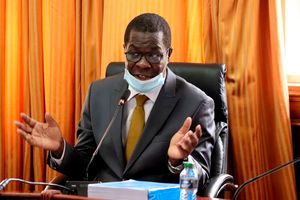
Education Cabinet Secretary Julius Ogamba before the National Assembly Committee on Implementation at Bunge Tower, Nairobi, on August 19, 2025.
Photo credit: Dennis Onsongo | Nation Media Group
The CS explained that the exercise involves cross-checking data from the National Education Management Information System (Nemis) against what has been submitted by school heads, including details on learners’ grades and gender, to prevent fraud.
Mr Ogamba acknowledged that the exercise had caused delays in capitation disbursement but emphasised that it is important for ensuring the prudent use of resources.
He also announced that the ministry is in the process of replacing the Nemis system with a new, centralised platform called the Kenya Education Management Information System (Kemis) to further combat fraud.
“We thought we should start with this verification, and as we transition to Kemis, the numbers that will be feeding into it will be correct,” he explained.
The ministry has for more than five years been using Nemis to disburse capitation to basic education institutions. However, school heads have been complaining about the system due to its inefficiency and inability to capture all learners, especially those without birth certificates. This inefficiency was exploited by officials to provide inaccurate data and steal capitation.