Parents who paid the Sh33,000 penalty imposed on each Ambira High School student following unrest in May are uncertain when they will get their money back after the school appealed against a High Court ruling that declared the levy illegal.
The school says the money has already been spent on emergency repairs and that any refunds must await the determination of the appeal. This leaves parents who paid the levy to secure their children's readmission uncertain about when they will recover their money.
The dispute has been compounded by a fresh Sh2,500 contribution sought from Form Four parents to finance laboratory repairs ahead of national examinations scheduled to start on Monday.
Parents are questioning why the school cannot deduct the laboratory repair costs from the Sh33,000 levy they have already paid but are yet to recover.
Principal Philemon Obege said the school had filed an appeal in a higher court in Kisumu last week and would await its determination before taking further action on the disputed money.
"The earlier ruling did not make a determination that a refund be made. As the money was coming in, school repairs were being undertaken, which means the money had already been committed," Mr Obege said.
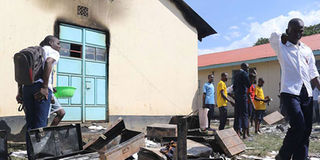
He said the damage caused during the May 18 and 19 unrest was extensive, making immediate repairs necessary before learners could resume classes.
Mr Obege, who said he had been at the school for only six weeks, added that the account holding the disputed funds could not be accessed following the court ruling.
"The money is not there, because I did not find it. Again, that account cannot be transacted following the court ruling until the final judgment is made," he said.
Students leave Ambira High School in Siaya County after the institution was closed following fire that razed one of their dormitories.
Parents who paid the levy, however, said the appeal had offered little clarity on when they would recover their money. Some questioned why they were being asked to make fresh payments while the earlier contributions remained unresolved.
One parent, who sought anonymity, said the school had not formally communicated its position on refunds following the High Court ruling that outlawed blanket levies imposed on learners after school unrest.
The parent said Form Four parents had been called to a meeting and informed that learners needed laboratory equipment for their examinations, with each family asked to contribute Sh2,500 towards the repairs.
"I did not make the payment until my son was sent home, but my expectation was that the school would deduct the Sh2,500 from the Sh33,000 already paid," the parent said.
Another parent questioned why a child who had cleared the term's fees would be sent home to collect Sh2,500 without the school first notifying the family.
"It does not make sense sending my child to Mombasa from Siaya for Sh2,500 without even having the courtesy to alert me," the parent said.
The parent said the school needed to clarify whether it had a mechanism for reconciling the two amounts, particularly for families that had already paid the Sh33,000 levy.
Mr Obege defended the additional contribution, saying it had been agreed upon during a meeting with parents and was intended to purchase laboratory apparatus and computers needed for the examinations.
"We were going into exams and there are no equipment, including laboratory apparatus and computers, to run exams, and there is no money for it. So we met parents and requested that they contribute Sh2,500, meaning it was not imposed," he said.
He added that the school was grappling with debts amounting to Sh140 million, making it difficult to obtain supplies on credit.
"No supplier is willing to give us anything on debt, so what do we do when we are getting into an examination period?" he asked.
The dispute stems from a decision by the school's Board of Management to require each of its 1,515 students to pay Sh33,000 following the destruction of school property during the unrest. The levy amounted to nearly Sh50 million.
In its ruling, the High Court quashed the blanket charge, describing collective financial punishment as unconstitutional and a violation of learners' rights to education and fair administrative action.
Justice David Kemei ruled that only the County Education Board could determine the conditions for readmission following mass indiscipline. He rejected the school's argument that the levy was compensation for damage to public property.
The court held that requiring families to pay an unlawful levy before their children could resume learning effectively forced them to pay for access to a constitutional right.