For thousands of university students across Kenya, campus life is increasingly becoming a daily lesson in survival.
What should be a period of academic growth and career preparation is instead turning into a struggle over rent, food, transport, tuition balances and the uncertainty of whether government funding will come through in time, or at all.
At the centre of the crisis is a widening mismatch between the growing number of students joining universities and technical and vocational education and training (TVET) institutions and the shrinking public funds available to support them through scholarships and loans under the student-centred funding model.
While the government insists the model, which was unveiled in May 2023, is designed to ensure needy students are not locked out of higher education, the reality on campuses tells a different story: students are getting admitted, but many are being left to figure out how to survive once they are there.
Data presented to Parliament recently by Higher Education Principal Secretary Beatrice Inyangala shows the scale of the problem.
Dr Beatrice Inyangala, the Principal Secretary, State Department for Higher Education and Research.
Photo credit: File | Nation
According to the State Department for Higher Education, the total Higher Education Loans Board (Helb) funding gap for the 2024/2025 and 2025/2026 financial years stands at Sh43.6 billion.
Of this, Sh10.7 billion relates to arrears from 2024/2025, representing 270,122 students who were not funded, while Sh32.9 billion is the projected shortfall for 2025/2026.
The PS said Helb’s 2025/2026 budget allocation is Sh41.5 billion against a requirement of Sh74.4 billion, money meant to support 1,104,157 students in universities and TVETs.
That means only 650,267 students can be funded, leaving 453,889 eligible applicants without support.
The scholarship component is also under pressure. The Universities Fund required Sh26.55 billion in 2024/2025 to fully support university students under the new model, but only Sh16.92 billion was allocated, leaving a funding gap of Sh9.63 billion.
In 2025/2026, the scholarship requirement rises to Sh29.59 billion, but the allocation remains unchanged at Sh16.92 billion, widening the shortfall to Sh12.67 billion.
In simple terms, more students are entering universities than the State can currently afford to support.
The Budget Appropriations Committee (BAC)in its report to the House noted that despite increased funding for loans and scholarships, significant gaps remain, with funding gaps at approximately 66 percent for loans and 62 percent for scholarships.
“This continues to place financial strain on students, households and universities,” notes the National Assembly Committee in its report tabled in March 2026.
And on campuses, that budget shortfall is translating into skipped meals, delayed fee payments, side hustles, rent-sharing arrangements and rising anxiety.
A Data Science student at Jomo Kenyatta University of Agriculture and Technology (JKUAT), said he has to juggle between studies and his side hustle of selling crafts bracelets to make ends meet.
Jomo Kenyatta University of Agriculture and Technology in Juja.
Photo credit: Pool
“After classes, I commute to my stall at Gataka’s shopping centre to sell the bracelets up until 10pm, then head home to a two-bedroom house shared with three other students,” he says.
He notes that sharing the house is the only way to afford rent at a decent place with adequate security and water.
For Millicent, a second-year student at the University of Nairobi (UoN), the pressure begins with her placement under Band 5, which requires a household contribution of 70 percent of tuition fees.
The entrance to the University of Nairobi.
Photo credit: File | Nation Media Group
She says the classification does not reflect her family’s financial reality as her father, who is a casual bread winner, is a casual labourer and is supporting three children.
At Band 5, her household contribution to the tuition fees stands at Sh46,000 per semester, nearly double what some of her classmates in Band 3 pay.
“I appealed, but nothing changed, yet I feel like I am really struggling because my parents have to pay much more than what some of my classmates pay, yet our situations are not that different,” she said.
To cope, she opted to stay off-campus because university accommodation, at Sh20,000, was beyond her household’s reach. She instead shares a Sh8,000 room with a friend, bringing her rent to Sh4,000.
While the upkeep money was disbursed on time, the scholarship amount reflected this semester was far below what she had anticipated. Her student portal reflected Sh33,000 against the Sh70,000 she was to receive.
Their saving grace, they note, is the fact that the University understands their struggles and allows students to sit exams as long as they have cleared the household component. But they note the broader cost of staying in school remains heavy.
Under the current model, scholarship and loan support are supposed to come in two tranches per academic year, split across the two semesters.
But many students say the money is often delayed, partial or inconsistent.
Miracle, a first-year Data Science student at Kenyatta University (KU) who transferred from the Technical University of Kenya (TUK), says no scholarship money has been reflected in her student account yet.
She says the Helb support for the first semester only arrived in February, while the money for the second-semester is yet to arrive.
Though she says she has managed so far, she has watched the strain push some of her classmates into desperate survival strategies.
Evaleen* , a first-year law student at the JKUAT, notes her placement Band 1, the category meant for the most financially vulnerable students and requiring only 10 per cent household contribution, is only on paper.
But in practice, she says, not a single shilling of her scholarship has reflected since she joined the university.
“Since I joined, not a single cent has been sent for my scholarship,” she says.
She says the Helb upkeep money only came two weeks into the semester, forcing her family to step in while she took on small gigs to survive.
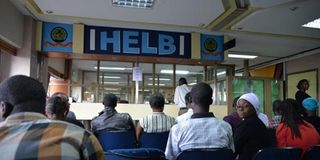
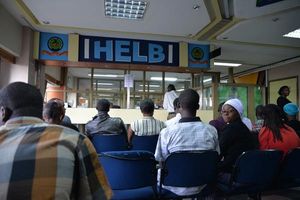
The Higher Education Loans Board's customer service desk at their Anniversary Towers offices.
Photo credit: File | Nation Media Group
Her experience exposes one of the deepest contradictions in the current system, that even students identified as most vulnerable are not always receiving timely support.
And in a university setting, timing matters almost as much as the amount itself.
A student may technically be “funded”, but if that money comes late, it does not stop the landlord from demanding rent, the shopkeeper from asking for payment or the student from going hungry.
Some institutions have adjusted their internal rules to avoid punishing students for delays they did not cause.
At Maasai Mara University, for instance, students can sit exams with fee balances as long as they have cleared the household contribution.
That flexibility has offered temporary relief to students like Edward *, a third-year political science student placed in Band 3.
“There has always been a delay in the disbursement of the scholarships. Even for this semester, the scholarship money is yet to reflect in my student portal account,” he says.
Universities themselves are under financial pressure, and delayed remittances affect their ability to run hostels, laboratories, teaching programmes and student welfare services.
In effect, the Helb and scholarship crisis is no longer just a student problem; it is also becoming a university stability problem.
Data tabled in Parliament shows Egerton University has overtaken the UoN as the most indebted public university, as total pending bills across institutions surged 17.6 percent to Sh100.3 billion in just eight months.
In July 2025, total pending bills across the public universities, which include unremitted SACCO and statutory deductions, unpaid suppliers, capital projects, and part-time lecturers, stood at Sh85 billion.