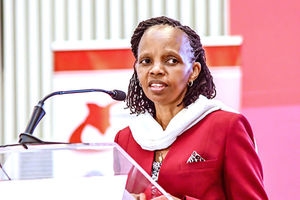
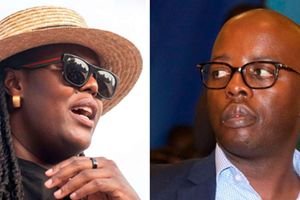
Higher Education PS Beatrice Inyangala was hard pressed to explain a Sh60.2 billion debt to private universities, which nearly doubled in a year despite the halt of government-sponsored admissions.
The PS decried inadequate budgetary allocation as the cause for the ballooning pending bill that has shot from Sh32 billion last year to the current Sh60.2 billion.
The National Assembly Committee on Education has rejected the figure and directed that the actual pending bill and the interest accrued be tabled before it as a matter of urgency.
“Who manufactures these pending bills yet there is no more admission of government-sponsored students in private universities. Give us the right figures before we go to the Budget Appropriations Committee,” Education Committee chairman Julius Melly told Dr Inyangala yesterday.
Principal Secretary, the State Department for Higher Education and Research Beatrice Muganda Inyangala before the National Assembly Education Committee at the Continental House Nairobi on Tuesday, June 11, 2024
Photo credit: Dennis Onsongo | Nation Media Group
In the financial year 2016/2017 the government introduced a policy shift allowing the Kenya Universities and Colleges Central Placement Service (KUCCPS) to place students in both public and private universities to help ease an admission crisis in public universities.
Under the arrangement, the government committed to funding 80 percent of tuition costs through the Differentiated Unit Cost (DUC) model, with households expected to cover the remaining 20 percent.
However, the Universities Fund has consistently defaulted on its obligation due to budgetary constraints, leading to the current financial strain.
“Across the 32 private universities included in the analysis, the cumulative 80 percent DUC requirement amounts to Sh77.2 billion, against disbursements of Sh18.9 billion, resulting in an overall validated funding deficit of Sh60.28 billion,” said Dr Inyangala.
Mr Melly noted that at the time the government ended the arrangement in the FY 2022/2023, the pending bill figure stood at Sh15 billion and has been on an upward trajectory ever since.
“We are throwing this pending bill issue back to you so that you verify it. We want this bill to be paid but you are making it murkier by giving a very unreasonable figure,” he said during consideration of the Supplementary Estimates 1 for the financial year 2025/2026.
Chairperson of the National Assembly Committee on Education Julius Kibiwot Melly.
Photo credit: Dennis Onsongo | Nation Media Group
Data presented to Parliament shows Mt Kenya University, KCA University and Kabarak University and top the list of 32 private universities that the UF owes Sh60.2 billion in unpaid tuition funding.
The data shows that Mount Kenya University is owed Sh11.6 billion, KCA University Sh6.6 billion, Kabarak University Sh6.4 billion, and Kenya Methodist University Sh5 billion.
In June last year, the Kenya Association of Private Universities (KAPU) told the Committee that the Universities Fund owes them Sh48.8 billion in unpaid tuition funding.
KAPU explained that the monies owed varies from one private university to the other based on the number of students placed in the institutions which is also tied to their declared capacities as verified by the Commission for University Education (CUE).
Dr Inyangala explained that in the Financial Year 2024/2025, the Universities Fund required Sh26.5 billion to fully support university students under the student-centred financing model (SCFM).
“However, only Sh16.9 billion was allocated, leaving a funding gap of Sh9.6 billion and the situation is worse in the financial year 2025/2026,” she said.
Education CS Julius Ogamba (left)and Principal Secretary State Department for Higher Education and Research Dr Beatrice Inyangala at Jogoo House, Nairobi, on July 1, 2025.
Photo credit: Lucy Wanjiru | Nation Media Group
The variation to the approved net recurrent budget for the state department of Higher Education for FY 2025/26 is Sh14.36 billion.
It includes Sh4.1 billion for the Higher Education Loans Board (Helb), Sh3.8 billion for collective Bargaining Agreement (CBA 2027-2021) and Sh1.5 billion for the Universities Fund among other vote heads.
The State Department’s development budget increased by Sh1.2 billion from Sh2.7billion in FY 2025/26 approved budget to Sh4.001 billion in the proposed Supplementary budget.