Reduced government funding, falling Module II revenue and years of unpaid statutory deductions have pushed the University of Nairobi (UoN) into a Sh17.2 billion debt crisis, compounded by mounting penalties and interest.
The financial troubles at the country’s premier university have been years in the making, but the scale of the crisis is now becoming increasingly difficult to contain.
The institution is grappling with current liabilities of Sh17.2 billion against current assets of Sh8.94 billion, leaving it with negative working capital of Sh8.25 billion.
Of the Sh17.2 billion in outstanding liabilities, Sh12.5 billion comprises remittances owed to the Kenya Revenue Authority (KRA) and the university’s pension scheme.
As of June 2025, unremitted deductions comprised PAYE of Sh4.2 billion, pension contributions of Sh8.1 billion, housing levy of Sh40.2 million, NSSF of Sh25.6 million and SHIF of Sh19.1 million.
These obligations have accumulated over the years, attracting penalties and interest and further deepening the financial hole.
UoN Vice-Chancellor Prof Ayub Gitau, in his submissions to Parliament, traced the institution’s financial difficulties to the 2017/2018 financial year, when changes in the university funding framework coincided with a sharp decline in revenue from privately sponsored students.
The crisis has since been compounded by inadequate government allocations, rising personnel costs, the Covid-19 pandemic and delayed disbursements under the new higher education funding model.
In 2017/2018, the government introduced the Differentiated Unit Cost (DUC) funding model, changing how public universities received funding.
However, the Universities Fund (UF) has consistently defaulted on its obligations due to budgetary constraints, leading to the current financial strain.
“Subsequently, government capitation to UoN declined by 30 percent, with annual allocations falling from Sh6.3 billion to Sh4.5 billion,” he told the National Assembly Public Investments Committee on Governance and Education (PIC-G&E).
The situation deteriorated in subsequent years as government allocations consistently covered only 40 to 55 per cent of the promised 80 per cent of training costs.
Prof Ayub Gitau, the 9th Vice Chancellor of the University of Nairobi, during the University’s 75th Graduation ceremony held on September 18, 2026 at the graduation square.
Photo credit: Pool
In the 2024/2025 financial year, UoN received just Sh1.4 billion in government capitation, further widening the funding gap.
The 2023 Presidential Working Party on Education Reform (PWPER) documented the shortfall, showing that government funding as a proportion of the DUC declined from 66.4 per cent in 2018/2019 to 48.1 per cent in 2022/2023.
As government funding declined, UoN was simultaneously losing another important source of income. The number of privately sponsored students, commonly referred to as Module II or parallel students, was on a downward trajectory.
For years, the Module II programme provided universities with substantial revenue. It allowed students who qualified for university admission but were not placed under government sponsorship to enrol in privately sponsored programmes and pay their own fees.
However, examination reforms introduced under former Education Cabinet Secretary Fred Matiang’i, aimed at curbing cheating in national examinations, coincided with a decline in the number of candidates attaining the minimum university entry grade of C+.
This reduced the pool of students eligible for university admission, affecting both regular and privately sponsored enrolment.
“The shrinking of module II students' admission led to a significant drop in Module II fees, which fell to Sh 4.4 billion from Sh6.2 billion annually generated in previous years,” Prof Gitau told the committee chaired by Luanda MP Dick Maungu.
Auditor-General Nancy Gathugu, in the UoN report for the year ending June 2025, notes that the statement of financial performance revealed a deficit of Sh1.6 billion, compared with a deficit of Sh1.17 billion reported in the previous financial year.
The decline in privately sponsored student numbers and reduced government capitation left the university increasingly exposed to cash-flow shortages, a situation further worsened by the Covid-19 pandemic, which disrupted operations and constrained revenue generation.
UoN Acting Director of Finance Stephen Kimeli said the pandemic compounded the institution’s inability to meet its obligations, including pension remittances.
What began as a revenue shortfall gradually evolved into a much bigger liability as the university struggled to meet its statutory obligations.
The latest financial position presented by UoN management shows that Sh12.5 billion of its Sh17.2 billion in current liabilities comprises remittances owed to KRA and the UoN pension scheme.
Failure to remit deductions on time exposed the institution to penalties and interest, adding to the original obligations and making the debt increasingly difficult to clear.
Prof Gitau disclosed that the university had previously failed to remit pension deductions but had since prioritised payments to retiring employees.
Management says that, during the financial year under review, it paid KRA deductions monthly and remitted the employee portion of pension contributions. However, the outstanding historical debts and obligations continue to weigh heavily on its finances.
The university’s statement of financial performance recorded a deficit of Sh1.63 billion, up from Sh1.18 billion in the previous financial year.
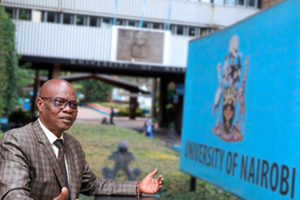
The entrance to the University of Nairobi, main campus.
Photo credit: File | Nation Media Group
The audit also raised material uncertainty over the university’s ability to continue operating, noting that its continued existence depended on financial assistance from the government, donors and creditors.
The financial strain has also affected the university’s ability to pay suppliers, with some obligations remaining outstanding for years.
An audit identified Sh3.93 billion in trade and other payables, including Sh726.8 million that had remained unpaid for more than two years.
Prof Gitau attributed delays in paying suppliers to reduced government capitation and delayed disbursements from the Higher Education Loans Board (HELB) and Universities Fund under the new funding model.
“As we speak, the UoN is currently owed about Sh3 billion by the Universities Fund and HELB for the 2025/2026 financial year,” he said.
The university has submitted pending bills dating back to June 2022 to the National Treasury’s Pending Bills Committee for consideration.
Beyond declining revenue, the university has struggled with rising personnel costs following successive collective bargaining agreements (CBAs).
Prof Gitau told MPs that CBAs covering the 2010–2013, 2013–2017 and 2017–2021 periods were not fully funded by the government, leaving the institution with an additional burden of approximately Sh1.2 billion.
Currently, UoN’s wage bill accounts for 56 per cent of its total revenue, exceeding the legally permissible threshold of 35 per cent. The university management attributes the high ratio to increases in basic salaries arising from negotiated CBAs.
Annual personnel expenditure, which peaked at Sh10 billion, has since been reduced to approximately Sh9 billion through austerity measures and expenditure controls.
The University Council has anchored its financial recovery ambitions in the 2023–2027 strategic plan, which prioritises efficient resource utilisation, research commercialisation, innovation, partnerships and financial stability.