The University of Nairobi (UoN) is under scrutiny after a parliamentary committee demanded evidence to explain about Sh10 billion in missing income tax and pension remittances flagged by Auditor-General Nancy Gathungu.
In a tense session, the National Assembly Public Investments Committee on Governance and Education (PIC-G&E) issued an ultimatum to the university management to produce supporting documents or face sanctions, warning that verbal explanations would no longer suffice.
UoN Vice-Chancellor Prof Ayub Gitau faced tough questions from the watchdog committee, chaired by Luanda MP Dick Maungu, which is considering the Auditor-General's reports on the university's accounts for the 2020/21 to 2024/25 financial years.
Prof Gitau's assertion that the government owes the university slightly more than Sh3 billion in outstanding funding and payments related to the Higher Education Loans Board (HELB) did not convince the committee.
“You are not giving us any workable steps of what the university is doing,” said Mr Maungu, adding: “As much as we wish to support the University, we are lacking the required documentation.”
Mr Maungu gave the university two weeks to submit documents detailing its financial obligations, negotiations with government agencies and measures to address its mounting liabilities, warning that failure to do so could attract sanctions.
Sh1.4bn deducted but not remitted
The audit reports raise concerns over unremitted pension contributions, unpaid Pay As You Earn (PAYE) and other statutory deductions collected from employees, as well as the university's continued reliance on proposed measures, including the commercialisation of its assets, to ease its financial difficulties.
Auditors told the committee that the university failed to remit about Sh1.4 billion in pension contributions and Sh50 million in PAYE during the 2021/22 financial year, despite deducting the amounts from employees' salaries. The unremitted amounts have accumulated over several years.
“The cumulative figure means it must have started earlier,” an officer from the Office of the Auditor-General told the committee, explaining that the liabilities included balances carried forward from previous years.
Mr Maungu said the audit findings required a substantive response from the university, particularly on the measures being taken to clear the debts.
Prof Gitau acknowledged that the institution had experienced periods when pension contributions were not remitted but said it had resumed some payments.
“What we have done is, for members who are retiring, we continuously pay,” Prof Gitau said, disclosing that the pension deficit had grown from about Sh5 billion to more than Sh10 billion.
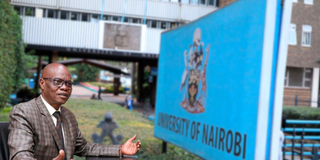
University of Nairobi Vice-Chancellor Professor Eng. Ayub Njoroge Gitau during an interview at his office at the University of Nairobi on July 16, 2026.
Photo credit: Bonface Bogita | Nation Media Group
The university's acting Director of Finance, Mr Stephen Kimeli, attributed its financial challenges to several factors, including collective bargaining agreements, declining student numbers, changes in university funding and the effects of the Covid-19 pandemic.
He said the reduction in the number of students qualifying for university admission had affected the institution's revenue, while the pandemic had further worsened the situation.
With questions mounting, Prof Gitau told the committee that the university was in discussions with pension scheme trustees and was considering using some of its land for development to help offset the deficit.
“We are going through the valuation of our assets. The University council and pension scheme had agreed to explore the possibility of making some land available for development,” said Prof Gitau.
University of Nairobi Vice-Chancellor Professor Ayub Njoroge Gitau during an interview at his office at the University of Nairobi on July 16, 2026.
Photo credit: Bonface Bogita | Nation Media Group
However, the committee chairman challenged the management to move beyond proposals and demonstrate how the university's property could be used to generate revenue.
“You seem to be very proud about that asset base, which is good, but it's not helping me out,” said Mr Maungu, challenging the university to develop practical strategies to turn its assets into resources for the institution.
Prof Gitau also revealed that the university's efforts had reduced outstanding HELB payments owed by the government from Sh10 billion to Sh3 billion, although the remaining amount continued to weigh on its finances.
Central Imenti MP Moses Kirima called for a deeper investigation into how the debts accumulated, citing previous concerns over financial management at Moi University, another public institution.
“We established how public funds were siphoned from the university by a number of players and cartels,” said Mr Kirima, urging the committee to establish what had led to the current situation at the country's premier institution of higher learning.
He warned against relying on verbal assurances, insisting that the management must provide written evidence of its engagements with relevant government agencies.
“We can't just continue on theory,” he said, adding: “Written evidence is all we require.”
The university's Deputy Vice-Chancellor in charge of Finance, Planning and Development, Prof Josiah Aduda, told the committee that the institution had submitted a remedial payment plan to the Retirement Benefits Authority (RBA).
He also revealed that the university had engaged the Kenya Revenue Authority (KRA) over the unpaid statutory deductions.
“My office has had meetings with the RBA together with the trustees, where we were asked to give a remedial payment plan for offsetting the debts that we owe the pension scheme,” Prof Aduda said.
Kilome MP Thaddeus Nzambia also demanded to know whether the university had sought a waiver of penalties imposed by KRA and, if so, the amount involved.