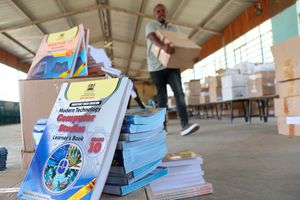
Billions of shillings meant for procurement of textbooks for learners in public schools are at the centre of a high-stakes war involving publishers, the Ministry of Education and State agencies.
Textbook procurement is one of the most lucrative tenders in basic education. The rollout of the competency-based education (CBE) has only raised the stakes.
With transition to senior school introducing specialised learning pathways, demand for new textbooks across multiple subjects runs into billions of shillings the government will need to spend.
A June 2025 report by Auditor-General Nancy Gathungu showed Sh27.9 billion was spent on school textbooks between 2020 and 2024.
However, the report poked holes into the process and raised queries on wastage of public funds through supply of excess books, those for subjects not offered in schools and books needed but not supplied. An insider at the ministry told the Sunday Nation that the “rot” needs to be cleaned up.
There is also a feeling in the ministry that the stiff competition and procurement process is locking out the Kenya Literature Bureau (KLB) from getting a piece of the pie yet it is a government agency.
“The playing field is not level and there are things the KLB cannot do,” the source said, citing the latest tender for Grade 10 textbooks.
Money for textbooks is usually allocated as part of the Free Primary Education (FPE) and Free Day Secondary Education (FDSE) programmes. The portion meant for the purchase of the reading materials is retained at the ministry when capitation grants are wired to school accounts.
This is the money forwarded to the Kenya Institute of Curriculum Development (KICD), which evaluates and approves books submitted by publishers.
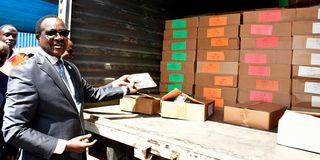
Education Cabinet Secretary Julius Ogamba flags off the distribution of Grade 10 textbooks at English Press Ltd offices on January 22, 2026. With him is Kenya Institute of Curriculum Development CEO Prof Charles Ong'ondo (in white shirt).
Photo credit: Francis Nderitu | Nation Media Group
Since the direct procurement model was adopted in 2017, the KICD acts as ministry’s agent to award contracts to publishers. The process has, however, been far from smooth. A recent exchange of correspondence between Basic Education Principal Secretary Julius Bitok and KICD Chief Executive Charles Ong’ondo exposes the inherent problems.
Reliable sources told the Sunday Nation on Friday, Head of Public Service Felix Koskei stepped in and called the two officials to de-escalate the matter, which was already in the public domain.
In an April 9 letter, Prof Bitok authorised KICD to complete the procurement for Grade 11 textbooks by notifying successful and failed bidders.
“The purpose of this letter is to authorise you to complete the procurement of Grade 11 books, based on the Constitution of Kenya and the Public Procurement and Asset Disposal Act No. 33 of 2015 and its regulations,” the letter reads.
In an earlier letter by Prof Ong’ondo to Prof Bitok, the KICD boss indicated that the evaluation of bids had been completed and the process was only awaiting final communication to publishers who participated in the tender.
When the Sunday Nation contacted Prof Bitok, he said the process delayed because of cash constraints at the Ministry of Education.
“We didn’t have the money. There’s no crisis or challenge. There’s no storm unless it’s a storm in a tea cup,” he said.
Prof Bitok’s letter to Prof Ong’ondo indicates that after completion of the Grade 11 textbooks procurement, the role will be taken away from KICD and handed to the School Equipment Production Unit (Sepu).
This is in accordance with recommendations of the Presidential Working Party on Education Reforms (PWPER). “We’ve allowed KICD to go on as we make transitional alignments in line with the PWPER,” Prof Bitok told the Sunday Nation.
The report, which was presented to President William Ruto in August 2023, proposed the restructuring of Sepu to School Learning and Instructional Materials Centre (SLIMC) “to coordinate the procurement and distribution of textbooks and other learning resources”. The process was to be completed in one year.
Interestingly, Executive Order 1 of 2025 by President Ruto lists Sepu among 16 State corporations “with outdated mandates or the good/service can be supplied by the private sector are proposed for divesture/dissolution”.
Kenya Publishers Association Chairperson Kiarie Kamau said once publishers receive award letters and sign contracts, they become eligible for a 20 per cent advance payment.
A teacher collects newly arrived Grade 10 textbooks from the collection centre in Nakuru Day Senior School on February 3, 2025.
Photo credit: Boniface Mwangi | Nation Media Group
“The 20 per cent enables us to begin printing and distributing as we wait for the next phase of payment,” Mr Kamau said.
He added that textbook supply has been fairly distributed among more than 25 publishers, dismissing claims that a few companies firms dominate the market.
“You’ll be surprised that while about five publishers have traditionally been known over the last 30 years, there are now about 20 new publishers—between three to 10 years old—who are part of this supply chain,” he said.
He attributed this growth to experienced teachers venturing into publishing after retirement, producing high quality books that successfully pass the Ministry of Education’s evaluation process.
On pricing, Mr Kamau said there were no significant differences in textbook costs among publishers for the same subjects, noting that Grade 11 books are more detailed and expensive to produce compared to junior school materials.
“The variation between publishers is insignificant. The cost is largely influenced by the depth of content and the relatively lower print volumes at senior school level,” he explained.
The PWPER raised concerns about the textbook approval and procurement system, noting that the long-standing one-textbook-per-subject policy had often prioritised the cheapest books rather than the best quality.
Stakeholders who appeared before the task force reported cases of poor quality books, shortages in some subjects and oversupply in others, raising questions about efficiency and accountability in the system.
“Most submissions (50.0 per cent) recommended that the government provide instructional resources beyond books. A proportion of 18.9 per cent of the submissions stated that schools had inadequate instructional materials, with 14.6 per cent indicating that books provided by the government were of poor quality in content and material. The one textbook per learning area/subject was based on the cheapest rather than the best in content quality. Other areas of concern raised were oversupply and undersupply of textbooks, while some learning areas lack books completely,” reads part of the report.
The Auditor-General’s report found that excess textbooks valued at Sh90.8 million were distributed to 394 secondary schools, 94 junior schools, and 182 secondary schools. Ironically, there was a shortfall of books in 415 secondary schools, 194 junior schools and 245 primary schools. The total value of the shortfall is put at Sh295.6 million.
Some of the Grade 10 textbooks flagged off during the distribution of Grade 10 textbooks at English Press Ltd offices on January 22, 2026.
Photo credit: Francis Nderitu | Nation Media Group
“As a result, students’ learning becomes a challenge since textbooks may not be readily available, leading to poor results,” the report reads.
Further pointing to the wastage of public funds Sh30.3 million was paid for books for subjects not offered in schools. The auditor’s report indicates that publishers also failed to deliver books worth Sh41.4 million.
“The instances of over or under-supply constitute breach of contract as the numbers of textbooks distributed did not correspond with delivery instructions under the contracts between KICD and the publishers,” the report reads.
According to the distribution of approved Grade 10 textbooks, Distinction Publishers got the biggest share at about 10.2 per cent of all approved titles, resulting in it claiming the largest share of the funds.
Booklyst follows with 9.0 per cent, while Mentor Publishers takes 8.4 per cent, placing the three firms at the top of the earnings ladder. KLB accounts for 8.3 per cent, meaning the government will indirectly retain a portion of the spending through its own publishing arm.
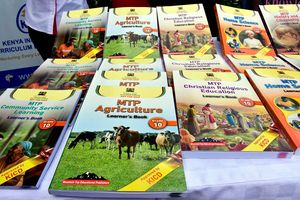
Mid-tier allocations show MTP receiving 7.1 per cent, Oxford University Press 6.5 per cent, Spotlight Publishers 6.1 per cent, and Longhorn Publishers 6.0 per cent. Moran Publishers and Hummingbird Publications complete the top tier with 5.6 per cent and 5.2 per cent, respectively.