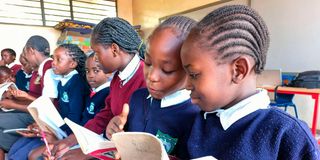
When the pioneer class of the competency-based education (CBE) was in Grade 6, the final year of primary school, the enrolment was 1,315,400. However, the number had shrunk by 184,941 when the learners sat the Kenya Junior School Education Assessment (KJSEA) last year.
It is not yet clear how many of the learners in the class transitioned to senior school in January this year. According to the Economic Survey 2026, thousands of learners were dropping out at every stage.
More than 27,900 learners dropped out when the first cohort under CBE transitioned to junior secondary school in 2023. Data from the Kenya National Bureau of Statistics (KNBS) shows that 1,287,500 learners joined Grade Seven, compared to 1,315,400 who were enrolled in Grade Six, the final year of primary school, the previous year.
Of those who dropped off, 18,300 were girls, accounting for 65.5 per cent, while 9,600 were boys, representing 34.4 per cent.
Further declines were recorded during subsequent transitions, with 44,300 learners dropping off at Grade 8 and a further 93,400 at Grade 9 pushing down the final learner enrolment to 1,149,800. However, this number dropped further as the total of those who sat the Kenya Junior School Education Assessment was 1,130,459.
This brings the total number of learners that have dropped off to 165,600 from the time the learners exited Grade 6 up to the time they got to Grade 9.
“The proportion of girls enrolled in Primary and Junior schools was 49.1 percent and 48.7 percent respectively with a general trend for girls’ enrollment declining from 49.3 percent in grade 1 to 48.7 percent in grade 9,”the KNBS says in the 2026 Economic Survey.
Junior secondary school teachers demonstrate in Eldoret City, Uasin Gishu County on April 30, 2026 demanding to be employed on permanent and pensionable terms.
Photo credit: Jared Nyataya | Nation Media Group
The revelations come on the back of a chaotic three years in junior school marked by teacher shortages, lack of laboratories and basic learning resources, which may have compromised foundational learning for learners.
Majority of the junior schools have heavily relied on intern teachers to plug the persistent teacher shortage gap. The government has since engaged 44,000 intern teachers.
While these interns have helped keep classrooms running, their presence has also sparked debate over workload, pay disparities, and job security with the Court of Appeal declaring the Teachers Service Commission (TSC) internship programme policy null and void.
School heads have reported teacher shortages are most acute in specialised subjects such as sciences, mathematics, and technical areas, forcing some teachers to handle multiple learning areas outside their training.
The strain has been compounded by inadequate laboratories, overcrowded classrooms, and limited learning materials, all of which are slowing effective delivery of the CBE.
Learning gaps from the turbulent three years in junior school are already emerging in senior schools, with teachers and principals reporting that a weak foundation was laid for learners during the junior school phase.
The learning gaps have been reported particularly in science and practical subjects, where many Grade 10 learners are now struggling with content due to limited exposure at the junior school lower level.
The TSC has been under pressure to confirm the intern teachers into permanent and pensionable basis with the Commission insisting it would do so if allocated budgetary support.
The KNBS data shows total enrolment in primary and junior schools rose by 11.2 per cent to 11,935,700 in 2025 compared to the 10,733,300 registered the year before.
During the review period, the first full set of enrollment for all the three grades in junior school under the CBE had 3,701,100 learners.