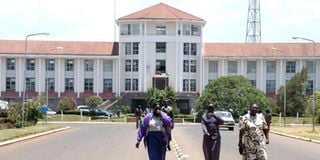
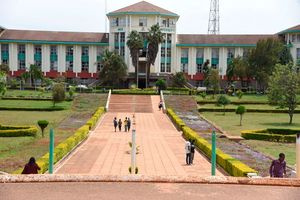
The financially troubled Moi University is staring at a deepening financial and operational crisis following the freezing of its key bank accounts over a debt exceeding Sh1 billion, raising fears of paralysis in one of the country’s largest public universities.
The High Court on Thursday ordered the attachment of the institution’s accounts over a debt that has ballooned to more than Sh1 billion in accrued interest and penalties on a Sh185 million debt owed to a contractor in a botched construction deal.
The university management yesterday termed the court ruling a major blow to its operations and said it will be seeking government intervention in the matter.
“Complying with the court directive and sustaining operations will be a tall order, considering that it comes when we are preparing for enrolment of first-year students,” said Prof Kiplagat Kotut, the university’s acting Vice-Chancellor.
Moi University Acting Vice-Chancellor Kiplagat Kotut.
Photo credit: Lucy Wanjiru | Nation Media Group
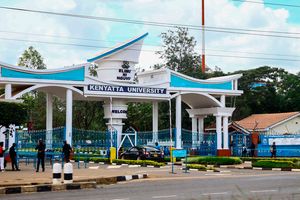
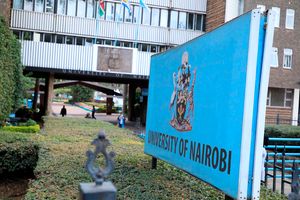
He said the freezing of the accounts will upset a turnaround strategy by the newly installed university council to revitalise operations at the cash-strapped institution that once rivalled the University of Nairobi (UoN) and Kenyatta University.
“We are seeking government intervention to negotiate a settlement and unlock the accounts to avert a full-blown institutional shutdown,” added Prof Kotut.
He said the court ruling cutting off the university’s access to key accounts will hit normal operations hard, including staff salaries, student services and procurement processes, unless an urgent solution is reached.
“We are staring at an impending crisis, and it is only the government that can bail us out,” said Prof Kotut.
At the heart of the crisis is a construction deal that went sour almost 30 years ago, with the contractor, Vishva Builders Ltd, seeking compensation after the project failed to take off as agreed.
Justice Wananda Anuro, sitting at the High Court in Eldoret on Thursday, ordered the freezing of more than 10 of the university’s 69 accounts as penalties arising from accumulated interest on an initial Sh185 million owed to Vishva Builders Ltd for the construction of the Faculty of Science complex almost three decades ago.
The frozen accounts are spread across several banks, including National Bank of Kenya, Kenya Commercial Bank, Co-operative Bank, Access Bank, Equity Bank and Absa Bank.
Justice Wananda excluded accounts that were opened for specific purposes such as research and student scholarships.
“Having already found in the earlier ruling that the excluded accounts were opened for specific purposes such as for research and for student scholarships, good order dictates that I uphold that decision, as I so do,” ruled Justice Wananda.
He further directed Moi University to meet the cost of the suit and awarded each of the affected banks Sh45,000 to be paid out of any of the bank accounts operated by the institution, save for those exempted by the orders.
The judge said it was unacceptable that a commercial suit of such magnitude should be held up in court for almost 25 years.
According to evidence placed before the court, Moi University entered into a construction deal with Vishva Builders on November 13, 1990, to build the Faculty of Science at the institution.
Moi University is set to auction some of its animals, a vehicle and an assortment of used tyres.
Photo credit: File | Nation
Drawings, bills of quantities and the tender form indicated that the contract was Sh476.3 million. The tender submitted by Moi University was Sh547.7 million, but the parties negotiated and the price was reduced to Sh476.3 million.
The university asked for the works to be stopped after seven certificates had been issued by the contractor, citing financial constraints.
The contractor obliged, and the works were stopped in April 1991. The parties mutually wound up the contract in November 1999.
The university agreed to pay for the works when funds were available and after verification by a government task force on pending bills.
The institution submitted that the contractor was paid Sh57.2 million, plus a retention sum of Sh6.3 million, under interim certificates.
It was unable to raise funds to complete the project, and the works were halted when they were about nine per cent complete.
The contractor later moved to court to demand payment, and the university was directed to pay Sh185.3 million for the botched contract.
The university failed to pay the Sh185 million, resulting in accrued interest amounting to over Sh1 billion over almost 25 years.
The High Court delivered judgment on February 2, 2024, ordering Moi University to pay a claim amounting to Sh1.2 billion when interest was applied at prevailing bank rates.
On February 2, 2025, Vishva Builders Ltd, represented by Nelson Havi and Company, obtained a decree for Sh1.08 billion as computation of the interest amount.
The High Court last month gave Moi University 30 days to come up with a plan to settle the debt, failure to which its 69 bank accounts would be attached.
Moi University is faced with numerous financial challenges, ranging from a Sh25 million tender for a new gate project to the diversion of Sh7.7 million in student fees by dishonest employees into a private account.
Other debt burdens include a Sh3 billion loan to modernise the New Rivatex after spending Sh600 million to buy it, declining student enrolment from 50,000 in 2015 to 27,000 in 2021, closure of non-viable campuses, reduced exchequer funding due to the implementation of the Differentiated Unit Cost (DUC) model, and rising personnel costs due to Collective Bargaining Agreements (CBAs) that have not been fully funded.
The newly installed Moi University council is working on a turnaround strategy focusing on infrastructural reorganisation, revenue diversification and staff redundancy as part of cost-cutting measures.
“The university has over time been constrained by a range of historical challenges that have undermined its ability to sustain its standing as a premier institution of higher learning in Kenya. These challenges, if left unaddressed, pose a serious risk to the institution’s long-term viability,” said Prof Noah Midamba, chair of the university council, in an earlier interview.
He admitted that the university is facing financial constraints despite an increase in student enrolment from 4,500 to 6,750 in the last academic year, among other strategies meant to restore confidence in staff by inculcating proper governance, transparency and accountability.
“The council is working on a five-pillar comprehensive strategy to guide the recovery of the university that has for long faced financial crisis, debt burden and administrative mismanagement,” said Prof Midamba.
According to the university’s acting Vice-Chancellor, Prof Kotut, student numbers have dropped from 48,000 in 2015 to the current 21,000, making it a challenge for the university to meet its financial obligations, including payment of employees’ emoluments.
The university has been grappling with significant financial issues, including certified outstanding debts of Sh8 billion, with Auditor-General Nancy Gathungu ordering a forensic audit of the university’s books of accounts.