The government has tightened its grip on the disbursement of capitation funds to basic learning institutions across the country to curb the loss of billions of shillings to ghost schools and students.
This follows a special audit by the Office of the Auditor General, which exposed massive fraud in the sector. The audit revealed that 33 non-existent schools had received billions of shillings in the past four years.
To weed out ghost schools and learners, the Ministry of Education has rolled out strict measures that all public schools must comply with before receiving capitation funds.
Before funds are issued, the Ministry says it will now undertake a rigorous validation process to confirm that each school is formally registered by the relevant county education board and that the Teachers Service Commission (TSC) has posted a substantive principal to the institution.
A school applying for capitation for the first time must attach key documents, including the original Free Day Secondary Education (FDSE) application form, a valid school registration certificate, minutes of a Board of Management (BOM) meeting and bank account details with designated signatories.
Unique Identification Codes
It will also be required to have a TSC appointment letter for the school principal, and a forwarding letter from the sub-county director of education indicating the school’s Kenya National Examination Council (Knec) and Unique Identification Codes (UIC).
The Ministry said it has already unearthed more than 50,000 ghost students in public schools through cross-checking learner enrolment data with the National Education Management Information System (Nemis) and records submitted by heads of institutions.
Education Cabinet Secretary Julius Ogamba, who represented Basic Education Principal Secretary Prof Julius Bitok at a Senate committee meeting in Mombasa last Friday, outlined the tools being used to eliminate ghost institutions and students.
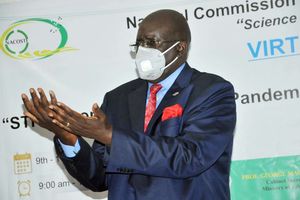
Principal Secretary Education, Prof Julius Bitok, before the National Assembly Education Committee on May 13, 2025.
Photo credit: File | Nation
“We have taken measures to reconcile school records and eliminate anomalies in data. Before any school is issued with capitation funds, the Ministry undertakes a rigorous validation process to ensure the school is duly registered and has a substantive principal posted by the TSC,” said Prof Bitok.
He added that the State Department for Basic Education is conducting a comprehensive data-cleaning exercise to ensure the accuracy of records used in disbursing capitation grants.
“To ensure accuracy, data collected from heads of institutions and sub-county directors of education is compared during the verification process,” he said.
The ministry has also introduced assessment numbers and index numbers as alternative learner identifiers to complement the existing Unique Personal Identifier (UPI). The Knec database ensures a learner can only be reflected in one secondary school.
Knec CEO David Njeng'ere at a past event.
Photo credit: Bonface Bogita | Nation Media Group
The CS further explained that the ministry is verifying school UICs, cross-checking enrolment data with Nemis, authenticating each school’s bank account details, and reconciling data with previous disbursement records.
“Any anomalies detected will be investigated, and appropriate legal action will follow. Through these measures, we ensure that only legitimate, operational public secondary schools with verified enrolments benefit from capitation funds,” he said.
So far, more than 29,000 schools have been verified out of the country’s 32,000 primary and secondary schools.
Mr Ogamba said the State had also uncovered over 50,000 inflated learners in the process.
He added that once the data-cleaning exercise is completed, the government will fully implement the Sh22,244 capitation per learner in secondary schools as outlined in policy.
“We are not using birth certificates. Previously, Nemis required birth certificates, which excluded some learners. We have now developed a tool to verify student numbers by gender and grade, from Grade 1 to Grade 9, so we can compare and validate figures,” said Mr Ogamba.
The CS urged school heads to support the verification process, saying it would resolve capitation challenges and strengthen future planning.
“We are currently undertaking verification in Nairobi. We are determined to weed out all ghost students and schools. By the end of this week, we want to have the right data on the number of schools and learners,” he said.
The audit template issued to institutions requires head teachers in both private and public schools to provide their institution names, UICs, and type (public or private).
For Grades 1–6, head teachers must indicate the number of boys and girls. Public junior schools must also report data for Grades 7–9, while private junior schools must submit similar details.
In secondary schools, the audit begins with Form 2 up to Form 4. There are no Form 1 students, as the final cohort under the 8-4-4 system is currently in Form Two.
The ministry also instructed heads to submit the following details for each learner from Grade 1 to Form 4: UPI, assessment number, surname, first name, other names, gender, date of birth, birth entry number, and disability type (if any).
Several school heads told Nation that the Ministry had directed them to submit all learners’ UPIs for the data-cleaning exercise before funds could be wired.
Previously, the Ministry relied solely on Nemis data to disburse funds. However, learners not captured in Nemis — often due to lack of birth certificates — were excluded from capitation. School heads have long complained that Nemis is unreliable and does not capture all students.