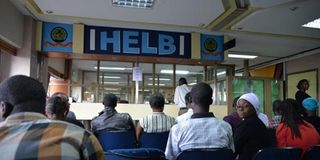
More than 64,000 former beneficiaries of government student loans who have defaulted on repayment have been blacklisted.
The move by the Higher Education Loans Board (HELB), to list them with the Credit Reference Bureau (CRB), effectively cuts them from accessing credit facilities such as loans and mortgages.
Mr Geoffrey Monari, the CEO of HELB, has further revealed that about 300,000 former students are collectively holding Sh32 billion in unpaid loans.
Higher Education Loans Board Chief Executive Officer Geoffrey Monari on May 14, 2025.
Photo credit: Dennis Onsongo | Nation Media Group
The agency has, in the last 30 years, advanced Sh195 billion in student loans that many depend on for tuition, meals, and books.
“Last year alone, we collected Sh5.2 billion, which supported 50,000 university students and 114,000 students in technical and vocational training institutions,” said Mr Monari.
The HELB model is designed as a revolving fund where money recovered from past beneficiaries is ploughed back to support current students. At least 708,000 students are enrolled in Kenyan universities while over 100,000 graduated this year alone.
Without consistent loan repayments, the sustainability of the scheme is strained. Employers are legally required to report graduates they employ, within 30 days, and start deductions which they then remit to HELB.
“I want to pay, but without a stable job, it’s just impossible,” said 25-year-old Harrison Okumu who graduated from a public university two years ago.
To tackle the rising tide of defaulting, HELB has devised a multi-pronged strategy. One is the establishment of a self-protection fund, where 0.037 per cent of every loan is set aside to cover beneficiaries who die before repayment. So far, about 2,000 have died with unpaid loans.
“We have also intensified inspections of employers to ensure they are remitting deductions. This year alone, we carried out 236 inspections and billed 28,000 past students who had not started paying,” said Mr Monari.
Students apply for Helb loans in Nairobi.
Photo credit: File | Nation Media Group
Others are being pursued through debt collectors and guarantors. Hardcore defaulters—some dating back 20 years—are among the first batch to face CRB blacklisting.
Mr Monari noted there are graduates in steady jobs but who have refused to pay, even as he called on those earning too little to spare any money for repayment. Then there is a third category, of those who are willing but unaware of the repayment process.
“If someone is surviving on Sh5,000 a month in a casual job, it is unfair to expect consistent loan repayment,” admitted Mr Monari. “But we are encouraging even small, regular contributions to keep their accounts active.”
For those unemployed, the situation is direr. Some are stuck in the cycle of job hunting, with repayment demands hanging over their heads. HELB is also pushing for legal reforms to tighten compliance.
Proposed amendments include freezing accounts of graduates who are able but unwilling to pay, and penalties for employers who deduct but fail to remit loan payments.
“Currently, employers owe us Sh34 million in unremitted deductions. We are working with the Attorney-General’s office to recover this money. We want the proposed laws to strengthen our hand,” said Mr Monari.
HELB has also turned its attention to pursue loan applicants living abroad. With the help of the Ministry of Foreign and Diaspora Affairs, they pursue graduates working overseas. Last year, the effort yielded Sh100 million in collections. This financial year, Sh20 million has been collected from diaspora repayments.
“It’s a promising stream, and we want more Kenyans abroad to honour their obligations,” Mr Monari said.
To encourage compliance, HELB occasionally runs penalty waiver campaigns to allow defaulters settle their principal loans without the heavy burden of accumulated fines.
“Waivers are a carrot, while blacklisting is the stick,” Mr Monari said. “We are balancing both approaches to ensure the sustainability of the fund.”
For many students from low-income backgrounds, the loans are the only bridge to higher education. However, Mr Monari says, “Without repayment, the bridge weakens for the next generation.”