Principals of some of Kenya’s prestigious public schools are caught between parents’ demands for better services and government rules requiring the Ministry of Education approval for any additional fees.
The dilemma emerged after the Auditor-General flagged the schools for collecting fees above the approved Sh53,580 annual charge for Cluster 1, despite parents agreeing to additional payments to help institutions meet rising operational costs.
The National Assembly Public Investments Committee on Governance and Education (PIC-G&E) has now resolved to engage Education Cabinet Secretary Julius Ogamba over the predicament facing the school heads.
“We need to have a serious discussion with the CS of Education on this matter because we see that it is a challenge across board. So the question we are asking is that is the Sh53,000 they are charging realistic given inflation,” posed PIC-G&E chairman Dick Maungu,
Education Cabinet Secretary Julius Ogamba during the national meeting with principals of public TVET institutions at the Kenya School of TVET in Gigiri, Nairobi, on July 6, 2026.
Photo credit: Lucy Wanjiru | Nation Media Group
Principals of Mang’u High School, Limuru Girls High School and Alliance High School yesterday told the watchdog committee they had sought the support of parents because the government allocation was insufficient to maintain the standards expected at the institutions.
The Auditor-General Nancy Gathungu flagged Limuru Girls for charging Sh73,580 per student annually against the approved Sh53,580, while Mang’u High School charged Sh46,082 per student under its Parent Association Support Programme without approval from the Ministry through the County Education Board.
At Alliance High School, minutes of the parents’ Annual General Meeting held on March 22, 2025 showed that parents had agreed to contribute Sh26,000 to support the school budget.
The additional charges were contrary to a June 16, 2021 Government Circular on implementation of the Free Day and Secondary Education programme, which provides that parents should only meet the cost of school uniforms, boarding-related expenses reflected in the approved boarding fee structure and lunch for day scholars.
But the principals said the additional contributions were driven by a widening gap between government funding and the cost of running large institutions.
Mang’u High School principal Dr Benard King’ah said the school has about 2,800 students on a 209-acre campus, with 137 teaching staff and 79 non-teaching employees.
He said the government allocation was increasingly difficult to stretch across the school’s needs, including feeding students and supporting the Competency-Based Education curriculum.
“As a school, we may not be able to survive the entire year with the Sh53,000 because of the enhanced meals for the students,” Dr King’ah told the committee.
He said the new curriculum had also brought additional demands, particularly the need to equip workshops and provide materials required for practical learning.
The school’s expansive land also meant it required additional employees and casual workers to maintain its facilities and serve its large student population, he said.
Bishop Gatimu Ngandu Girls High School Chief Principal Jane Njuguna (left) and school bursar Rachael Wambui appear before the National Assembly's Public Investments Committee on Governance and Education, chaired by Luanda MP Dick Maungu Oyugi, at Bunge Tower in Nairobi on Tuesday, September 15, 2026.
Photo credit: Dennis Onsongo | Nation
At Limuru Girls, principal Susan Kariuki said the school had 2,200 students on a 60-acre campus.
She said parents agreed to the additional amount after realising that the government allocation was inadequate to meet the school’s recurrent expenses.
“The Sh53,000 we receive from the Ministry of Education is not enough to service the workforce, diet for the students, BOM teachers and utility bills of water and electricity,” Ms Kariuki said.
She said parents met and agreed that the additional amount should be raised, a decision endorsed by the school’s Board of Management.
The school then wrote to the County Director of Education seeking to have the proposal forwarded to the Ministry for approval.
However, Ms Kariuki said the school never received the required authority.
Alliance High School principal David Kamau similarly told the committee that the approved Sh53,000 could not sustain the school’s operations and the standards expected of the institution.
“The Sh53,000 per year cannot sustain the operations we run as an institution and the standards,” Mr Kamau said.
He added that parents wanted to provide budgetary support so that the school could maintain the standards associated with it over the years.
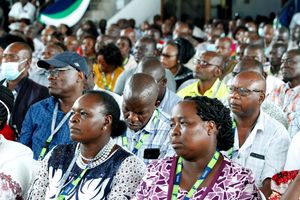
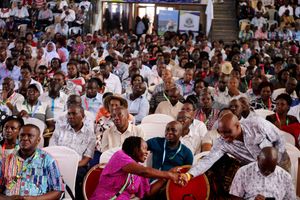
Principals follow proceedings during the 48th Kenya Secondary Schools Heads Association Annual National Conference in Mombasa on June 24, 2025.
Photo credit: Kevin Odit | Nation Media Group
Alliance also wrote to the Ministry seeking authority for the additional contribution, but the approval had not been received.
The explanations, however, left the principals exposed to audit queries because the additional payments had been implemented without the required formal approval.
PIC-G&E chairman Mr Maungu said the issue required a broader discussion with the Education Cabinet Secretary, noting the tension between government regulations and parents’ expectations.
“We need to have serious discussion with the CS of Education on this matter because we see that it’s a bit of a challenge,” said the Mr Maungu who is also MP for Luanda.
He noted parents wanted their children to receive better meals and services, while principals were struggling to obtain the formal letters of authority needed to implement additional charges.
Central Imenti MP Moses Kirima said schools should complete the approval process after parents agree on additional contributions.
He said parents’ involvement in decisions affecting their children was consistent with public participation, provided schools documented the decisions and sought the necessary authority.
Lunga Lunga MP Mangale Munga, noted the principals were caught between maintaining school standards and complying with the law.
“All said and done, you have done contrary to the law because approvals from the CS have to be there,” Mr Munga said.
“You are stuck between a rock and a hard place because you have to meet the standards as a principal, but then again there is the law which you have to adhere to,” he said.