University student enrolment rose by 78,719 to 707,150 in 2025, crossing the 700,000 mark as staffing growth lagged behind demand, according to the Commission for University Education’s 2025 University Statistics Report.
The increase represents a 12.5 per cent rise from 628,431 students in 2024 and a 26.4 per cent increase over three years. In contrast, academic staff numbers grew by only 6.4 per cent, from 15,383 to 16,434.
The report warns that continued expansion without corresponding growth in staffing and facilities could affect teaching and learning quality, particularly in large public universities.
“The expansion of enrolment has not been matched by a proportional increase in resources and staffing,” the report says, noting increasing reliance on adjunct staff and worsening student-staff ratios in public universities.
Non-teaching staff also declined by 7.5 per cent, placing additional pressure on administrative and student-support services.
Public chartered universities continued to absorb the largest share of students, with enrolment rising from 469,688 in 2024 to 534,942 in 2025 — an increase of 65,254 students, or 13.9 per cent.
Male enrolment rose from 269,910 to 297,722, while female enrolment increased from 199,778 to 237,220. Women consequently accounted for 44.3 per cent of students, up from 42.5 per cent. Private chartered universities recorded slower growth, with enrolment increasing by 9,092 students, or 6.3 per cent, from 144,007 to 153,099.
Their share of national enrolment fell from 22.9 per cent to 21.7 per cent, although women remained the majority, accounting for 51.1 per cent of students in 2025.
The report attributes the slower growth in private universities partly to the New Higher Education Funding Model, under which government scholarships are reserved for students in public institutions. State support can cover up to 93 per cent of fees for needy learners, lowering the eventual out-of-pocket cost in public universities.
Public constituent colleges recorded the fastest growth, with enrolment rising 36.6 per cent from 10,731 to 14,663 students.
Male enrolment increased from 5,809 to 6,420, while female enrolment jumped from 4,922 to 8,243. Women consequently became the majority, accounting for 56.2 per cent of students in 2025 compared with 45.9 per cent in 2024.
Private constituent colleges, however, recorded a 21 per cent decline, from 547 students to 432. Female enrolment fell sharply from 353 to 134, while male enrolment increased from 194 to 298. Women’s share consequently dropped from 64.5 per cent to 31 per cent. The report says financial constraints may be among the factors limiting enrolment.
Institutions operating under Letters of Interim Authority recorded a 16.1 per cent increase, from 3,458 students in 2024 to 4,014 in 2025. Male enrolment fell slightly from 1,860 to 1,834, while female enrolment rose from 1,598 to 2,180.
The report says male students remained the majority overall, but the gender gap narrowed.
First-year students report for admission at Egerton University in Nakuru County on August 18, 2025.
Photo credit: Boniface Mwangi | Nation Media Group
Male students accounted for 55.6 per cent of total enrolment in 2024 compared with 53.9 per cent in 2025, while the female share rose from 44.4 per cent to 46.1 per cent.
University enrolment rose from 559,620 in 2023 to 628,541 in 2024 and 707,150 in 2025. Growth was 12.3 per cent between 2023 and 2024, 12.5 per cent between 2024 and 2025, and 26.4 per cent over the three years.
Male enrolment rose from 321,778 to 381,165, while female enrolment increased from 237,191 to 325,985.
The report says the faster growth in female enrolment is narrowing the gender gap and improving access. It also notes that public chartered universities account for most students, academic programmes and research output.
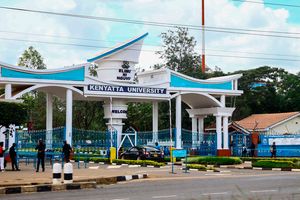
Mount Kenya University had the highest enrolment at 49,294 students, followed by the University of Nairobi with 45,526, Jomo Kenyatta University of Agriculture and Technology with 44,944, and Kenyatta University with 43,358.
Other universities with more than 20,000 students were Maseno University (29,134), Masinde Muliro University of Science and Technology (27,459), Moi University (23,469), Egerton University (23,397), Chuka University (20,365) and Kisii University (20,252).
The report describes the distribution as “highly expanded and unevenly distributed across institutions”, saying a small number of universities absorb a disproportionately large share of students.
It attributes the concentration to the “massification of higher education in Kenya”, with demand growing rapidly and large public universities expanding to accommodate more students.
The report says Mount Kenya University’s position at the top also highlights the growing role of private universities in expanding access.
First-year enrolment increased from 196,161 in 2024 to 224,165 in 2025, a 14.28 per cent rise.
Second-year students increased by 9.10 per cent, from 155,365 to 169,509, while third-year enrolment rose 16.21 per cent, from 103,593 to 120,389. Fourth-year students increased by 10.20 per cent, from 160,081 to 176,415.
The sharpest percentage growth was among fifth-year students, whose numbers rose 49.90 per cent, from 6,682 to 10,015.
Across Years One to Five, enrolment increased by 77,280 students, or 12.4 per cent, to 702,684.
The report notes that this figure is 4,466 below the overall enrolment because students in sixth and seventh years are included in the overall total but excluded from the first-to-fifth-year table.
The report says the pressure is especially evident as the university population grows through the lower years of study, creating a pipeline of students who will require teaching, facilities and support as they progress. It warns that enrolment growth must therefore be matched by investment in human resources and infrastructure.
In private chartered universities, male enrolment rose from 71,846 to 74,891, while female enrolment increased from 72,161 to 78,208. Women accounted for 50.1 per cent of students in 2024 and 51.1 per cent in 2025.
The report further says private universities are expanding steadily in staffing and innovation, although their contribution remains smaller than that of public institutions. It says the concentration of students in the largest universities reflects strong demand for higher education and the expansion of institutions seeking to accommodate it.
Across Years One to Four, the report says growth could put pressure on teaching capacity, infrastructure and student-support services. The trend is particularly significant for universities carrying the largest student populations, where staffing and facilities will need to expand alongside enrolment.
The report says the increase in student numbers demonstrates strong demand for university education and improved access, particularly among female students, whose numbers grew faster than those of male students.