Public schools cannot impose blanket financial penalties on students or make payment a condition for returning to class after unrest, the High Court has ruled, quashing a Sh50 million penalty imposed on Ambira High School parents after students’ strife.
Justice David Kemei said only the County Education Board can set readmission conditions. He struck down a Sh33,000 levy imposed on each of the 1,515 Ambira High School students, totalling nearly Sh50 million, after a riot in May.
The court held that the blanket charge amounted to unconstitutional collective punishment and violated students’ rights to education and fair administrative action, declaring that “the decision cannot stand.”
“A family required to pay part of an unlawful levy and to bind itself to pay the rest before its child may resume class has been made to purchase access to a constitutional right,” the court said.
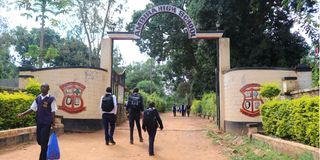
The judgment arose from two consolidated constitutional petitions filed by parents after Ambira High School in Ugunja, Siaya County, demanded that every student pay Sh33,000 before returning to school following widespread destruction during unrest on the night of May 18 and early May 19.
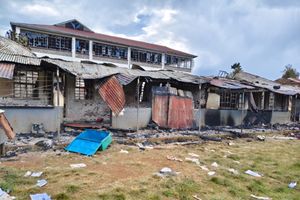
School administrators said the unrest destroyed the principal's office, bursar's office, staffroom, computer laboratory, classrooms, dormitories, perimeter fence and other facilities. The school was subsequently closed indefinitely.
The Department of Public Works estimated the repair bill at Sh50 million, prompting a special board of management and multiagency meeting to spread the cost equally among all students.
The BoM resolved that each of the 1,515 students would pay Sh33,000 as a “penalty on damage” to cover the cost of repairs.
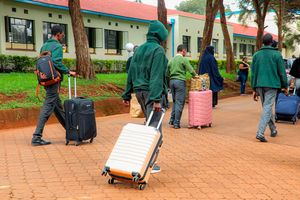
This decision was communicated to parents through a circular dated May 30, which made payment of the levy a mandatory precondition for readmission of students to the school.
Parents challenged this levy in court, arguing that it was imposed without lawful authority, consultation or due process.
They said making payment a condition for readmission amounted to collective punishment because no effort had been made to establish which students participated in the destruction.
The school defended its decision, saying the destruction happened at night after students damaged lighting infrastructure, making it impossible to identify those responsible.
It argued that the levy was compensation for damaged public property rather than punishment and said students were later readmitted after making full or partial payments and signing commitment forms.
The aftermath of a dorm fire at Ambira High School in Siaya County.
Photo credit: File | Nation Media Group
Justice Kemei rejected that position after examining the Basic Education Regulations governing school closures and readmission after mass indiscipline.
He ruled that while a board of management may temporarily close a school, the law reserves the power to determine readmission conditions to the County Education Board.
“It is clear that the power to determine conditions of readmission after mass indiscipline is vested in the County Education Board, not in the board of management,” the judge said.
The court found no evidence that the County Education Board had considered the school's report, conducted the required inquiry or approved the levy before it was imposed.
Justice Kemei also noted that the levy amounted to unconstitutional collective punishment because every student was required to pay regardless of individual responsibility. He said the school admitted that it could not identify those responsible for the destruction, yet still decided to charge every learner equally.
“If the respondents were unable to identify the culpable students, they could not lawfully impose a punishment on all students,” Justice Kemei said.
“The blanket, undifferentiated imposition of the Sh33,000 levy on every student regardless of individual culpability constitutes unconstitutional collective punishment.”
The court further found that the levy breached constitutional guarantees on fair administrative action because parents and students were never given an opportunity to challenge the decision before it took effect.
The amount was fixed at a meeting held on May 29, eight days after a volatile parents' meeting, without parents or their association participating in the final decision.
Students salvage what is left of their property after an evening fire gutted down a dormitory at Ambira High School in Siaya County.
Photo credit: File | Nation Media Group
Justice Kemei said the respondents “made the decision without notice, without a hearing, without disclosure of material relied upon and without providing written reasons capable of being challenged”.
He, therefore, held that the levy violated Article 47 of the Constitution and the Fair Administrative Action Act.
On the right to education, the court said that attaching a financial demand to readmission unlawfully restricted children's constitutional rights.
“Conditioning students' readmission to Ambira High School on payment of the said levy constitutes an unlawful interference with the constitutional right to education guaranteed under Articles 43(1)(f) and 53(1)(b) of the Constitution,” he said.
“The rights of the students of Ambira High School, including those who may have participated in the destruction of property, must be respected.
“The denial of access to education for whatever reason is a serious matter that must be justified by law and by due process.”
The court declared the levy unconstitutional, quashed the circular requiring payment before readmission, and ordered the immediate and unconditional readmission of affected students.
It also permanently barred the school from imposing the charge or any similar penalty. However, it declined to order the appointment of a new board of management, finding that parents had not first pursued the administrative process provided by law.