When the government introduced a new funding model for higher education in 2023, it promised to achieve two goals: ensure that no deserving student was denied access to university because of poverty and rescue public universities from a financial crisis that had pushed many to the brink.
Three years later, the model is facing a critical test. On Tuesday, President William Ruto announced that the government is developing another funding framework that will provide universal financing for students in the tertiary education sector.
The announcement amounts to an admission that the student-centred funding model, which replaced the Differentiated Unit Cost (DUC) model in 2023, has fallen short of its objectives.
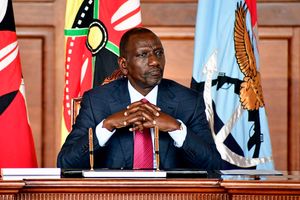
President William Ruto at State House, Nairobi on June 23, 2026. He has said that a "final version" of a new funding model proposal was before Parliament and urged MPs to fast-track its approval.
Photo credit: File | Nation Media Group
While the model was introduced as a more equitable, student-focused system, many learners have instead been forced to defer their studies, change courses, drop out, work between lectures, borrow money or even skip meals to remain in school. President Ruto acknowledged the shortcomings during his address on Tuesday.
“We tried the Differentiated Unit Cost. It didn’t work because it made most of our universities almost close down; because while we promised 80 per cent funding, we went down to 40 per cent and most universities suffered. We’ve worked on what we thought was equity where we said parents will contribute a small portion and then [government] will give a small portion of loan, a small portion of scholarship; that creates equity but it’s not good enough. Now we’re moving to universal under the amendments we’ve taken to Parliament,” he said. The financial position of public universities also reflects the strain.
In 2023, universities had cumulative pending bills of about Sh61.8 billion. Three years after the student-centred funding model was introduced, the figure has grown to more than Sh100 billion, suggesting that it has not rescued the institutions it was designed to stabilise.
Under the DUC model, all university students received government sponsorship covering up to 80 per cent of tuition costs, although universities often received less than the promised allocation. The student-centred model instead priced courses according to their cost and required students to apply for a scholarship, tuition loan and upkeep loan.
Applicants were then assessed using a Means Testing Instrument (MTI), which considered various socio-economic indicators before placing them in funding bands. Previously, students mainly applied for upkeep loans, while tuition attracted a standard government-supported fee of Sh16,000, alongside relatively affordable administrative charges.
However, the MTI attracted criticism after many students complained that it misclassified applicants and excluded deserving learners from adequate support.
For many families, the required household contribution proved unaffordable, making university education significantly more expensive.
Some students admitted to universities never reported because their families could not raise the required contribution, opting instead for alternative pathways to higher education. Others deferred their studies, switched to less expensive programmes or dropped out altogether.
Those who remained in school adopted various survival strategies. Some joined work-study programmes, balancing classes with employment to pay for food and accommodation. Others skipped meals, borrowed costly loans to meet the family contribution or relied on relatives for support.
For Brenda Achieng, admission to university was meant to mark the beginning of a brighter future. Instead, the new funding model turned her academic journey into a daily struggle.
Ms Achieng was among thousands of students who expected the student-centred funding model to ease the cost of higher education. Instead, she struggled to raise the family contribution, lacked basic necessities while on campus and was eventually forced to defer her studies.
“Getting admission to university was supposed to be the beginning of a better life for me, but instead I found myself constantly worrying about where the next fee payment would come from. My family could not afford the contribution required under the new funding model, and I had to go without basic needs just to stay in class. At some point, I was forced to defer my studies. The dream of university became a struggle to survive,” she said.
More than 400,000 students are currently receiving government scholarships under the student-centred funding model. According to the Universities Fund’s February 2026 newsletter, scholarship beneficiaries stood at 437,648. However, the rapid growth in university enrolment has exposed a financing system struggling to keep pace with demand.
Annual university enrolment has increased from about 70,000 students in 2017 to approximately 258,000 in 2025, representing an increase of more than 300 per cent in less than a decade.
The number of students funded under the model has also grown from 122,634 admitted in 2023 to 134,889 in 2024 and 180,125 in 2025.
In the 2025 KCSE examination, 268,700 candidates attained the minimum C+ grade required for university admission, up from 244,563 the previous year. The Kenya Universities and Colleges Central Placement Service (KUCCPS) subsequently placed 293,869 students in degree, diploma and certificate programmes, including 202,133 in degree courses. The growing enrolment has significantly increased the financing burden on a government already struggling to support students currently in the system.
For the 2026/27 financial year, the Higher Education Loans Board requires Sh112.1 billion to finance about 1.38 million university and TVET students through loans and scholarships.
The National Treasury has allocated only Sh56.3 billion, leaving a funding gap of Sh55.8 billion.
The Universities Fund requires Sh47.36 billion for scholarships and institutional support but has received an allocation of Sh31.1 billion, creating a further shortfall of Sh16.26 billion.
“Now we have in Parliament the final version of how we are going to make higher education universal. It will not matter the background of any child in Kenya, it will matter how good they are. Going into the future, we’ve been trying to grapple with how do we fund our higher education,” President Ruto said on Tuesday at State House.
“It takes us back to the question we’ve raised forever. DUC failed because of government not fulfilling its commitment. The new funding model is facing the same issue. This means that the issue is lack of government funding, not the model,” said a senior Ministry of Education official who requested anonymity because they were not authorised to speak publicly.
On Thursday, President Ruto responded to the criticism but did not explain where the additional resources for universal funding would come from.
“Mimi si wazimu, mimi si mlevi! Hakuna mtoto wa Kenya atakosa nafasi ya kusoma kwa sababu ya kukosa pesa,” (“I’m neither mad nor drunk. No Kenyan child will miss an opportunity to study because of lack of money”), he said while hosting a delegation of youths at State House, Nairobi.
According to a policy brief by Education Cabinet Secretary Julius Ogamba, the proposed Tertiary Placement and Funding Bill, 2026 seeks to overhaul the current financing framework by guaranteeing funding for all qualified students joining tertiary institutions.
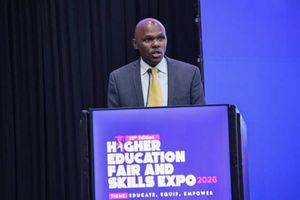
Education Cabinet Secretary Julius Ogamba during a past event.
Photo credit: Wilfred Nyangaresi | Nation Media Group
“The Bill does this by defining tertiary education to mean all formal post-secondary education offered in tertiary institutions. Tertiary institutions mean universities, colleges, and technical and vocational education and training institutions recognised by the relevant regulatory authorities. The financing will cover the full spectrum for tuition fees, accommodation and living expenses,” the brief states.
It further says the proposed law will establish a Tertiary Funding Authority with powers to mobilise resources beyond the Exchequer, including private capital and other non-traditional sources of education financing, while consolidating public bursary and scholarship schemes.
“One of the recommendations under the Bill is that we will need to relook at all the funds that are available that we are utilising in the education sector and have them in one pot that we can then use to distribute and support our students,” Mr Ogamba said on Thursday.
Responding to questions about the Bill, he said: “How do you expect to view a Bill that is yet to be tabled in Parliament? MPs are currently on recess. Common sense dictates that the Bill will be tabled once legislators resume their sittings.”