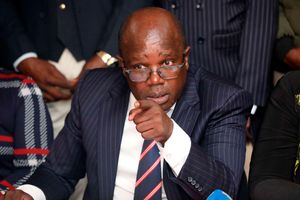
Higher Education Loans Board CEO Charles Ringera answers questions from journalists at State House in Nairobi on May 3 after the announcement of the new university education funding model.

Stakeholders have raised issues with the proposed new funding model for higher education, including a lack of clarity on the provision of scholarships, the fate of continuing students, and the restriction of the fund to a loan.
The funding model is contained in the Tertiary Education, Placement and Funding Bill, 2026, which is currently undergoing public participation spearheaded by the National Assembly Education Committee.
The Bill proposes a major restructuring of university students' financing mechanisms in Kenya.
The Bill proposes to establish a new Tertiary Education Funding Authority (TEFA), consolidating the functions currently undertaken by the Higher Education Loans Board (HELB), Universities Fund and TVET Funding Board.
The Bill establishes two central institutional functions: placement and student financing. It proposes a Kenya Universities and Colleges Central Placement Service and TEFA.
The authority will assume functions now distributed among HELB, the Universities Fund and TVET Funding Board. Student funding is connected to placement, and the Bill provides that funding under the proposed framework is for students placed by the Placement Service.
“The purpose of the fund shall be to provide funds to be granted as education loans under this Act,” reads Clause 44 of the Bill.
It is this provision that stakeholders are against, saying it is silent on the provision of scholarships to extremely needy cases.
“Our proposal is that it should be amended to include full government funding to eligible students and trainees in form of grants, scholarships and or loans according to the need and nature of the cost,” reads a proposal from the Kenya Union of Post Primary Education Teachers (KUPPET).

The Ministry of Education headquarters at Jogoo House in Nairobi.
The initial draft Bill from the Ministry of Education stated that the purpose of the fund was to provide loans and scholarships to eligible students.
However, Clause 44 of the Bill as published states that the purpose of the Fund is the provision of education loans alone.
The stakeholders are concerned that, as currently drafted, the Bill risks adding more burden to students from poor families whose children will leave universities with more debt.
Under the current model, a student in the neediest band receives 70 per cent of the degree programme cost as a scholarship.
The Presidential Working Party on Education Reforms had recommended 82 per cent for vulnerable students and 70 per cent for the extremely needy, with no household contribution for either category.
The stakeholders are concerned that if the Bill is passed and implemented in its current form, where the fund is predominantly a loan-based system, then the debt of students from the poorest households will be higher.
The move, stakeholders say, is inconsistent with the President’s intention of making education accessible to all for the youth.
If passed in its current form, the stakeholders also warn that it will be against Article 55 (a) of the Constitution on access to education and Article 20 (5) (b) of the Constitution, which requires the State to be a vulnerable group where resources are limited.
The union has also pointed out that Clause 48 of the Bill on the application of the funding has no clarity, leaving new students and continuing beneficiaries uncertain of what support they qualify for and whether it will continue.
“On admission to a tertiary institution, a student or a trainee wishing to be funded shall apply to the Authority in a prescribed manner for the grant of an education loan,” reads Clause 48 of the Bill.
According to the Bill, the authority shall review the application and communicate its decision to the applicant within a prescribed period.
Universities’ Academic Union (UASU) has also recommended that the Bill should not be enacted in its current form without substantive amendments addressing the financing and sustainability of public Universities.
“The Bill is principally a student financing statute. It should not be interpreted as a complete law on the financing of public universities. Parliament should make this boundary explicit,” says UASU.
On the proposed repayment framework, including commencement within one year after completion and payroll deductions capped at 25 per cent of emoluments, the Unions say the Bill should distinguish completion of studies from commencement of gainful employment, and provide a grace period for unemployment and underemployment.
The Kenya Union of Technical and Vocational Education Trainers (KUTVET) has also complained about the new funding model, saying it does not sufficiently recognise differences in programme costs.
The union argues that training a learner in welding, automotive engineering, mechatronics, electrical installation, building technology or mechanical engineering cannot reasonably cost the same as delivering a largely classroom-based programme.
“Funding must reflect the actual reasonable cost of delivering each occupational programme,” The union told the committee.
“KUTVET therefore recommends a hybrid, ring fenced and differentiated TVET funding model consisting of guaranteed government institutional funding,” the union said.
The Education Committee is expected to table its report to the House for consideration on the education Bills.
Follow our WhatsApp channel for breaking news updates and more stories like this.