Eight months after supervising and marking Kenya's national examinations and assessments, thousands of teachers are still waiting to receive their allowances, raising the prospect of a boycott that could disrupt the 2026 examination cycle.
What began as complaints over delayed payments has escalated into a labour dispute, with teachers' unions threatening to advise members against attending training by the Kenya National Examinations Council (Knec) or invigilating and marking this year's examinations unless the government honours its promises.
During the presentation of the 2026/27 Budget Speech on June 11 2026, Treasury Cabinet Secretary John Mbadi assured Parliament that Sh1.5 billion owed to examination supervisors and invigilators would be released before the close of the 2025/26 financial year on June 30.
Earlier, National Assembly Budget and Appropriations Committee Chairman Samuel Atandi had announced that Supplementary Estimates II had set aside the funds for the payment.
A senior Knec official, speaking on condition of anonymity because they are not authorised to comment publicly, said the council cannot pay funds it has not received.
"If we had received the money from Treasury, we would have paid," the official said.
The delay affects thousands of teachers who supervised the 2025 Kenya Certificate of Secondary Education (KCSE), Kenya Primary School Education Assessment (KPSEA) and Kenya Junior School Education Assessment (KJSEA).
According to budget documents, Knec required Sh12.7 billion to administer the examinations during the 2025/26 financial year but received only Sh5.9 billion in the original budget.
More than Sh1 billion from that allocation was first used to clear pending obligations from the previous year's examinations, leaving inadequate resources for the current cycle.
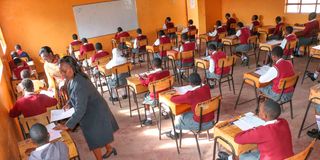
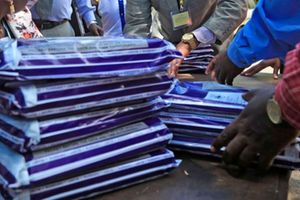
An invigilator distributes KCSE English paper one question sheets at Kakamega National School on November 3, 2025.
Photo credit: Isaac Wale | Nation Media Group
Although Treasury later provided an additional Sh3.1 billion through supplementary estimates, a funding gap of about Sh4.76 billion remained.
For teachers on the ground, however, the budgetary explanations and empty promises from government offer little comfort.
Ogoro Miruka, a teacher at Lang'ata West Primary School, supervised both KPSEA and KJSEA for 12 days at a daily allowance of Sh500.
"To date, not a coin has been received despite the numerous promises from government, the latest being that we would be paid by June 30," he said.
In his opinion, teachers are being misused and should consider boycotting the 2026 examinations, noting that the allowance itself is too little considering the workload and transport costs.
Another primary school teacher, who requested anonymity to avoid victimisation, said delayed payments have eroded teachers' willingness to participate in future examinations.
"In previous years, we were paid soon after results were released by the Minister for Education but this time no teacher has been paid despite repeated promises," she said.
The teacher notes that many of her colleagues travelled long distances to their duty stations, with some being ill-treated at the stations.
“Many teachers are saying they do not want to invigilate the 2026 examinations," she said.
Evans Ochieng' a teacher at Riruta Satellite Junior School said even some examination markers are yet to receive their full dues.
"There is no point waiting almost a year to be paid because it now looks like the money is being used as bait to make teachers cooperate," he said, noting that the rates are also not commensurate with the workload and should be reviewed upwards.
The growing frustration has now found expression through teachers' unions. The Kenya Union of Post Primary Education Teachers (Kuppet) deputy secretary-general Moses Nthurima described the eight-month delay as unacceptable.
“The government is commercialising and privatising education and that is why it is not servicing a critical function like this. It should strive to be proactive otherwise the quality of education will be watered down,” he said.
Deputy Secretary General of the Kenya Union of Teachers (Knut) Hesbon Otieno (left) with the Secretary General of Kenya Union of Post-Primary Education Teachers (Kuppet) Akelo Misori at the 48th Kenya Secondary School Heads Association in Mombasa on June 27, 2025.
Photo credit: Kevin Odit | Nation Media Group
His counterpart at the Kenya National Union of Teachers (Knut) Hesbon Otieno said the union had sought assurances directly from the National Treasury ahead of reading of the national budget on June 11 2026.
"We spoke with Treasury Cabinet Secretary John Mbadi before the Budget reading and he promised payment would be made," he said, noting prolonged delay is unwelcome and that government should come up with a workable solution to expedite payments."
More pointed warnings have come from branch officials. KNUT Nairobi Executive Secretary Mugwe Macharia said members have been calling union offices demanding action.
"If the examiners' money is not paid, we will advise our members not to attend KNEC training in preparation for the national examinations and are considering discouraging them from invigilating," he said.
Mr Macharia argued that teachers are increasingly questioning why they should continue accepting examination duties when payments are delayed and the daily allowances remain low.
"The Treasury CS has continued giving empty promises, yet we are not interested in political statements. Teachers want action, which is payment of their dues," he said.
Knut Murang'a South Executive Secretary Njata John echoed the concerns, saying teachers feel betrayed after fulfilling their responsibilities.
"The worrying thing is that money for examiners had already been budgeted for, yet teachers have not been paid," he said.
Mr Njata warned that the union will not allow its members to attend Knec meetings or trainings until they receive their dues.
The standoff highlights a deeper challenge in financing Kenya's examination system, where budget allocations have increasingly fallen short of actual funding needs. But beyond immediate dispute lies a broader question about the sustainability of the country’s examination system.
National examinations depend on tens of thousands of teachers who serve as supervisors, invigilators, centre managers and examiners.
Widespread withdrawal from the exercise could complicate preparations for the 2026 examinations and force Knec to find alternative personnel at short notice.
The row also revives long-standing complaints over remuneration. At Sh500 per day for some assessment assignments, many teachers argue that the allowance barely covers transport expenses, particularly for those deployed away from their home stations.