For years, Kenyans have watched scandal after scandal dominate headlines, from billions allegedly lost in the Eurobond saga, the stalled Arror and Kimwarer dam scandals, questions surrounding the Standard Gauge Railway (SGR), the ghostly shadow of the National Youth Service (NYS) scandal, concerns over the Social Health Authority (SHA) and many more.
Yet, despite the outrage, parliamentary investigations and audit reports, young Kenyans still struggle to understand where public money goes, how loans are acquired and why the country’s debt continues to rise.
It is within this landscape of contested public spending, audit gaps, and unresolved scandals that Ellen Kawila, a 25-year-old Gen Z civic educator from Kilifi County, is driving change. She is spearheading a digital tool designed to make sense of Kenya’s national debt in real time.
The Kenya Debt Clock is an innovative tool that visualises the country’s debt burden using publicly available data from institutions such as the Central Bank of Kenya (CBK), the National Treasury, the International Monetary Fund (IMF) and the World Bank.
In an interview with the Nation , Kawila explained that she created the Kenya Debt Clock, an online platform that tracks Kenya’s national debt in real time, due to a growing interest in public finance and accountability.
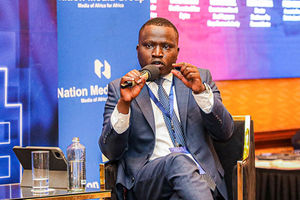
Ellen Kawila, a civic educator and innovator who has created an online system to help track Kenya’s national debt in real time, during an interview at Nation Centre .
Photo credit: Bonface Bogita | Nation Media Group
It visualises debt accumulation, interest growth, debt per citizen, and debt-to-GDP ratios. The Kenya Debt Clock is a public website that tracks Kenya’s national debt and updates projections based on fiscal data trends.
It displays debt accumulation rates, interest estimates, and historical borrowing patterns dating back several decades.
Some of the major national projects referenced on the platform, and the controversies surrounding them, include the SGR, the Eurobond, the Arror and Kimwarer dams, the NYS and the SHA, as well as other publicly debated expenditures.
According to its methodology, the system operates as a mathematical projection model rather than a live government feed.
“The Kenyan Debt Clock is a real-time visualisation of Kenya’s national debt,” said Kawila. “It provides estimates based on publicly available macro data. It is a projection, not a live feed.”
Kawila explains that the baseline data is drawn from the CBK and includes both domestic and external debt.
Domestic debt comprises treasury bills and bonds, while external debt comprises Eurobonds, IMF loans, World Bank financing, and bilateral loans, such as those from China Exim Bank.
She estimates Kenya’s total baseline debt to be about Sh12.75 trillion. She then calculates the fiscal deficit based on national budget figures.
“For example, if the budget is Sh4.5 trillion and revenue is Sh3.3 trillion, the deficit is about Sh1.1 trillion,” she said.
This deficit is then converted into a per-second increase. “That equates to around Sh37,392 per second,” said Kawila.
Ellen Kawila, a civic educator and innovator who has created an online system to help track Kenya’s national debt in real time, during an interview at Nation Centre .
Photo credit: Bonface Bogita | Nation Media Group
The platform also accounts for project-specific borrowing tied to infrastructure such as the Talanta Stadium, the SGR, the Thika Road and other national developments. She says her goal is to simplify complex financial systems and make them understandable to the public.
Kawila says she built the Kenya Debt Clock just two months ago. The platform is hosted on a US-based server, which she says was a deliberate decision.
“The server is in the US due to fears that someone in Kenya might try to interfere with it or bring it down,” she says.
Despite these security measures, she claims that there have been attempts to access and interfere with the system’s programming, though none have succeeded.
She initially paid more than Sh100,000 for hosting, with friends contributing, and now pays around Sh10,300 ($80) monthly to maintain the server.
Hackers have attempted to attack the system but have been unable to do so, she said. Kawila completed her high school education in 2017, achieving a B+. She had long dreamed of studying medicine, but this ambition was cut short by financial constraints.
Despite this setback, Kawila says she has continued to work hard, holding onto the belief that she will one day achieve her goals. Since leaving high school, her life has been defined by survival and resilience. She has moved between informal jobs and small-scale enterprises to make a living, even selling the local brew, ‘chang’aa’.
“I have been surviving, moving from one household to another,” she said.
“At one point, I even sold chang’aa to make ends meet.”
Kawila currently earns an income by selling beauty products online, all the while continuing her civic education work through digital platforms.
Kawila’s civic engagement online, especially on TikTok, began during the Finance Bill protests, when young Kenyans mobilised digitally against tax measures they considered excessive.
She was driven to enter the field of civic education by frustration over what she describes as ‘crazy taxes’, and by a desire to help young people understand government policy and public finance.
Ellen Kawila, a civic educator and innovator who has created an online system to help track Kenya’s national debt in real time, during an interview at Nation Centre .
Photo credit: Bonface Bogita | Nation Media Group
She started her civic work online, particularly on TikTok, around the time of the Finance Bill protests, when she sought to address what she calls “the crazy taxes the government wanted to impose on its people”.
She quickly developed an interest in public finance issues, particularly government borrowing, taxation and expenditure patterns, which she says are rarely explained in accessible language for ordinary citizens.
In November 2024, Kawila says her interest in public finance deepened after an incident in Parliament involving Isiolo Governor Abdi Guyo, in which a parliamentary committee questioned how a county could spend Sh1 million on a crate of soda.
“I had heard about cases of money being stolen,” she said.
“What really caught my attention was when the Isiolo governor was summoned by the Public Accounts Committee of Parliament in November and December 2024.”
She says that before this, she had a limited understanding of national debt, but she began to read about the Eurobond controversy and developed a better grasp of the issue. Valued at approximately $2 billion (Sh302 billion), the Eurobond was intended to support Kenya’s economy. However, amid claims of misallocation and missing funds, it became the subject of public scrutiny.
“According to audit reports, much of the money never reached the Treasury,” she said. ”It was already missing before it even reached the Treasury.”
She also referenced broader debt concerns and major public projects, such as the SGR, the Arror and Kimwarer dams, the NYS, among others.
Her first area of investigation was the 2023/24 county audit reports, in which she examined allocations from the national government to counties, as well as locally collected revenue.
According to Kawila, one of the most alarming findings was that many county governments were spending almost 70 per cent of their funds on salaries, leaving just 30 per cent for development projects.
“We elected leaders to help us develop our communities and improve living standards,” she says. “But instead, we have elected international travellers.”
She cites Mombasa County in the 2023/24 financial year as an example, alleging that Sh13 million was spent on domestic and international travel. Out of this amount, she says, Sh3 million was unaccounted for. “There were no receipts,” she said.
She also draws attention to audit documents detailing unsupported expenditure, property acquisitions and legal fees for which there is insufficient documentation.
In Mombasa County alone, she claims that unsupported expenditure totalled Sh157,990,472, while the value of unsupported property and equipment was about Sh2,079,927,000.
She points out that legal fees totalling Sh158 million were paid to four law firms, which, she claims, lacked accompanying court documentation. “The figures were just stated.”
For Kawila, these findings reflect deeper structural accountability challenges in public finance management.
In the Arror and Kimwarer case alone, more than Sh63 billion was linked to the two multi-purpose dams in Elgeyo Marakwet.
The Italian contractor CMC di Ravenna reportedly received Sh7.8 billion in advance, yet no construction work was carried out. Despite the projects being cancelled, concerns have persisted over how interest obligations continued on a non-existent project.
“The interest was paid and is still being paid for a project that does not exist,” she said. “I view this as systemic weaknesses in accountability.”
Beyond the platform, Kawila is part of a growing wave of Gen Z digital activists who use social media to promote civic education, particularly during debates about taxation and governance.
She argues that many young people are becoming increasingly frustrated with the management of public resources and the handling of accountability.
According to her, some political actors resist scrutiny because they do not want to be held accountable for public funds.
“The government and politicians are delusional to be against the youth uprising in matters of civic education,” she says. “They don’t want to be held accountable for taxpayers’ money, yet they are destroying the future of this generation.”
Her mission is simple: make public finance understandable, visible and harder to ignore.
“I just want people to understand where the money goes,” she said, adding, “and why debt keeps rising every second.”