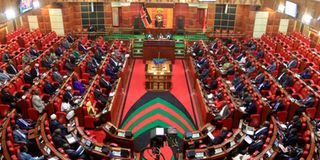
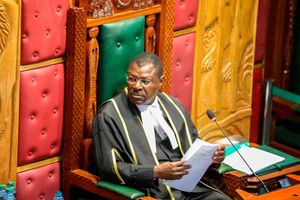
The National Assembly will resume its regular sittings on Tuesday next week, with the consideration of the National Dialogue Committee (Nadco) Bills among the key priority agendas for the lawmakers.
After its two-week recess, the House resumes for the final part of the fourth session with a number of Bills lined up for consideration before it breaks again for its long recess in December.
Among the businesses listed for consideration are the pending Bills that emanated from the Nadco bipartisan committee that was formed by President William Ruto and the late Raila Odinga.
The Nadco Bills primarily seek to give effect to some of the recommendations and views of the public that were submitted to the Nadco committee at Bomas to facilitate dialogue and consensus building, and thereafter recommend appropriate constitutional, legal, and policy reforms on issues of concern to the people.
President Ruto has already assented to two Bills from the Nadco report — the Independent Electoral and Boundaries Commission (Amendment) Bill, 2024, and the Ethics and Anti-Corruption Commission (Amendment) Bill, 2024.
Coming up for debate will be the Political Parties (Amendment) Bill, 2024, which seeks to give effect to some of the recommendations and views on issues of electoral justice and related matters, fidelity to political parties/coalitions, and the law on multiparty democracy.
The Bill aims to amend the Political Parties Act, Cap 7D, to, among other things, replace the Office of the Registrar of Political Parties with the Independent Political Parties Regulatory Commission.
It also seeks to repeal the provisions on when a member may be deemed to have resigned from a political party.
The Bill further seeks to transfer the jurisdiction of hearing and determining disputes on decisions made by the Commission from the Political Parties Disputes Tribunal to the High Court.
The Bill has already been passed by the Senate and was forwarded to the National Assembly for consideration. It was read for the first time in February and will be coming up for debate.
In its observation, the Justice and Legal Affairs Committee pointed out that establishing the Independent Political Parties Regulatory Commission to replace the Office of the Registrar of Political Parties would enhance independence and neutrality, as outlined in the Nadco report.
The Election Offences (Amendment) Bill, 2024, which seeks to amend the Election Offences Act, Cap. 66, to give effect to recommendations and views of the public on electoral justice and electoral integrity as submitted during the national dialogue discourse, was passed by the National Assembly in August and transmitted to the Senate for consideration.
Among the proposals contained in the Bill is a five-year jail term or a Sh5 million fine, or both, for election officials found guilty of delaying election results.
The House is also expected to continue with the debate on the Legal Affairs Committee report of the multi-sectoral working group on the realisation of the two-thirds gender principle in both Houses of Parliament.
The Draft Opposition Bill, 2024, which is yet to be published, is also expected to be introduced in the National Assembly for the first reading.
The Legal Affairs Committee, in its report on the consideration of the Constitution (Amendment) Bill, 2024, noted that entrenching the Office of the Leader of the Opposition in the Constitution relates to the supremacy of the Constitution, sovereignty of the people, and national values and principles of governance, hence requires a referendum.
“The Constitution does not envisage a member of the Executive sitting in Parliament as implied in the proposed Nadco Leader of Opposition Bill. This will result in a change in the system of government, a decision reserved for the people,” reads the report.
Speaking during the burial of Odinga in Bondo on October 19, Minority Leader Junet Mohamed said that when they resume, the House will give priority to the Nadco Bills.
“I have my colleagues Kimani Ichung’wah and Aaron Cheruiyot, who are part of the Nadco committee. We have decided as Parliament that when we go back in a week’s time, we will implement the Nadco report fully,” Mr Mohamed said.
Other key Bills lined up for consideration include the Public Participation Bill (National Assembly Bill, 2025), which will address the key question of what constitutes adequate public participation—a factor that has led to the nullification of various laws passed by the House.
The courts have often nullified laws, accusing Parliament of failing to conduct adequate public participation.
The County Assemblies Pensions Scheme Bill, 2024, seeks to provide for a contributory pension scheme for members of county assemblies and establish a County Assemblies Pensions Fund for the payment or granting of pensions or retirement benefits to members of county assemblies.
The lawmakers will also consider the Tea (Amendment) Bill, 2023, which seeks to amend the Tea Act, 2020, to protect the proceeds of tea growers from mismanagement by factories. It also aims to incentivise value addition of tea by exempting value-added tea from payment of the tea levy and providing for direct sales of tea overseas.
The House will also consider the Judges’ Retirement Benefits Bill, 2025, which seeks to provide for pensions and other retirement benefits to judges of superior courts.
Education Cabinet Secretary Julius Ogamba and Health CS Aden Duale are also scheduled to appear before the House on Wednesday to answer various questions from the lawmakers.