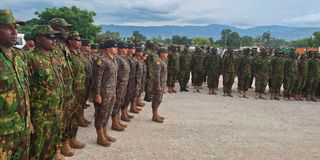
In Port-au-Prince, Haiti
It poured heavily overnight, until around 6:10am, delaying by one hour the departure to the airport by the Nation crew, who are part of a visiting Kenyan group.
A few minutes after 7am, the weather cleared and we were quickly rushed to the Port-au-Prince Toussaint Louverture International Airport, which had been forced to close due to repeated gang violence, and is now partly reopened. Operations here are timed and sudden, which is a tactical security measure.
We arrived at the airport and were quickly processed by military officers from El Salvador serving in the ongoing Kenya-led Multinational Security Support (MSS) mission in Haiti.
Our luggage was weighed and loaded onto a second Bell Huey helicopter that would fly with its doors wide open, with two air force men manning mounted gunships serving as our air escorts as we flew in the first Bell Huey for 55 minutes to Hugo Chavez International Airport. This is the second largest airport in Haiti and serves the country’s second city of Cap-Haïtien, which is currently handling all international flights.
Journalists aboard a Bell Huey helicopter during a flight from Port-au-Prince to Hugo Chavez International Airport in the country’s second city of Cap-Haïtien.
Photo credit: Duncan Khaemba | Nation Media Group
While airborne, the surveillance helicopter kept engaging our pilot, who would in turn vary the flight height — either dipping or flying higher. Travelling in a conflict or war zone is never easy.
All four airmen in our chopper had their guns at the ready, including the two pilots, as six of us civilians watched every step. Our hearts would skip every moment the helicopter either dipped in turbulence or struggled to shoot up the skies further as the escort kept changing its position, flying a distance ahead or retreating sideways to our right.
One of us fixed his eyes on the floor of the chopper until we touched down. He said his thoughts were on his passport, which was in the other helicopter. What would happen to him, he wondered, if something went amiss and he could no longer access the crucial travel document? He had been moved to our helicopter at the last minute and there was no time to reach for his tiny hand luggage.
In a war zone, and where security personnel are involved, there is usually little time for niceties.
Haiti is a jungle and Port-au-Prince is a capital of sharp contrasts. Sections like Pétion-Ville are as calm and organised as they come. This is the green zone that houses international organisations, embassies and consulates. But other parts like Delmas, where notorious gang leader Jimmy Chérizier, aka Barbecue, hails from, are blighted by chaos and insecurity. The MSS troops have largely pacified the area, but due to its overcrowded nature and the guerrilla tactics of the repulsed criminal gangs, we are informed attacks can occur anytime because the criminals are living within the community.
As the Kenyan contingent took us to the recaptured port of Haiti, driving through the narrow and crowded roads within the town, we were told to be on high alert.
The armoured security convoy occasionally vied for space with the ramshackle public service vehicles — the equivalent of Kenya’s matatus — each squeezing into the little space left by pedestrians and traders selling wares.
On this day, we spotted and drove past a decomposing body lying on the road with dogs eating part of it as locals passed by unperturbed. Apparently, it’s normal in Haiti, a country seemingly numbed by violence and murders, for bodies to be left uncollected for a long time.
We are told the bodies remain untouched as per the “orders” from the numerous gangs that have been ruling the zone, and true to their instructions, as we returned heading back to the main MSS camp, the body was still there.
More than a million people are reported to have been forced to flee their homes in a never-ending cycle of horrendous, senseless and indiscriminate killings, kidnappings, gang rapes and torching orchestrated by the tens of gangs that have infested Haiti, coalescing under the Viv Ansanm coalition, which means “Live together.” Their leader is Barbecue, a former police officer turned gang leader.
Apart from opening up the initially blocked roads, facilitating schools and businesses to reopen, and retaking the port, the MSS has also recaptured the Haiti Police headquarters that had been taken over by the gangs.
While addressing a high-level side event on the multinational support mission in Haiti in New York during the 80th UNGA meeting, President William Ruto expressed his frustrations over the Kenyan-led mission. He said the MSS has been operating at 40 per cent capacity given that out of the 2,500 security personnel promised to be available, only 936 boots are on the ground, of whom 735 are from Kenya.
“It was expected there would have been force multipliers, armoured vehicles and logistical support to make the mission successful,” President Ruto said.
While he commended the United States for giving vehicles to the mission, he added: “Unfortunately, most of them were second-hand and they broke down, putting the officers in grave danger when it happened in hostile areas. We did not get any useful support from any quarters.”
He was referring to the incident that caused the death of Corporal Kennedy Nzuve on August 31, 2025 in a road accident. This happened during a recovery operation along the Kenscoff-Pétion-Ville road when two armoured vehicles developed mechanical problems. Nzuve was in a second vehicle being towed uphill when it overturned. Despite prompt response from the MSS medical teams, the officer was pronounced dead at Lambert Santé Hospital.
An overturned truck belonging to the Multinational Security Support (MSS) mission in Haiti.
Photo credit: Pool
Apart from Nzuve, other Kenyan officers who have lost their lives on duty in Haiti are police constables Samuel Kaetuai and Benedict Kabiru. Kaetuai died on February 23, 2025 after sustaining injuries, which included a gunshot wound.
Kabiru went missing on Tuesday, March 25, 2025 during a heavy gunfight between MSS forces and the criminal gangs. The mission had maintained he was a missing person since they had not found his body, even after his family took legal action in their search for answers.
But an announcement by President Ruto in New York that named him among the dead was taken as confirmation. His family has, however, faulted the handling of the situation by the authorities.
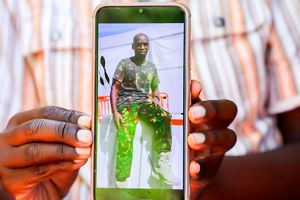
A picture of Benedict Kabiru Kuria, the Kenyan police officer who went missing in Haiti, is displayed during an interview at his home in Thamande, Kikuyu on March 27, 2025.
Photo credit: Lucy Wanjiru | Nation Media Group
The bodies of the two officers who have died in the mission were taken to neighbouring the Dominican Republic for preservation and autopsy before being flown back home. There are no mortuary experts or pathologists in the crime-ravaged Haiti and as such post-mortem examinations are forced to be undertaken in the Dominican Republic. Corporal Nzuve’s body arrived in Nairobi on Friday, September 26.
Security is another reason why the dead are moved to the Dominican Republic, since it is feared Haiti is highly volatile and the gangs can take advantage to seize the body in case it is preserved there.
Transporting the bodies back to Kenya remains a big challenge, with the process making repatriations lengthy. The process of getting the right documents takes long in Haiti due to a lack of centralised government services.
A dilapidated, poorly motivated and ill-disciplined public service also makes basic tasks and processes take longer than usual in Haiti.
Repatriation rules are very strict since all necessary paperwork must be in place before a body is moved, including a signed death certificate that must be done in Haiti.
President Ruto has told the international community that the situation in Haiti can and must be solved.
“If security teams are sent, the mandate must be clear and supported by a predictable resource package, not what Kenya has gone through — a game of guesswork. The people of Haiti may be of African descent, but for heaven’s sake, they are members of the human race like us, and they deserve as much, not less.”
Haiti’s main international airport, Toussaint Louverture in the capital Port-au-Prince, is yet to be fully reopened. Hugo Chavez in Cap-Haïtien is the current port of entry where visitors pay a $10 visa fee. They are then given a leaflet accompanied by a filled and stamped card indicating departure clearance, which must be safely kept, otherwise one might be stranded — a situation made more difficult by the language barrier, since most people speak Creole.
The majority of Kenyan officers have mastered the language, making it easier to engage locals.
Apart from the rough and tumble of the 15-month operation now, MSS security personnel say the food and facilities they have access to are of good standards. When not on patrol shifts, officers engage in activities such as playing football and volleyball, running and improvised open gym sessions.
We found many donning Kenyan football and rugby jerseys. Such moments of little leisure mean a lot in a country facing many battles.