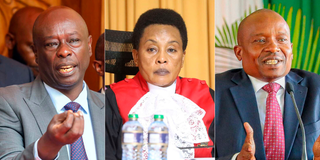
Former Deputy President Rigathi Gachagua and the National Assembly clashed before the Supreme Court on Thursday over whether Deputy Chief Justice Philomena Mwilu had constitutional authority to appoint the judges who first heard challenges to his impeachment.
Backed by Deputy President Prof Kithure Kindiki, the National Assembly urged the court to declare that the Deputy Chief Justice may empanel constitutional benches when discharging the Chief Justice's functions.
Mr Gachagua’s legal team asked the court to dismiss the case, arguing the dispute became academic after Chief Justice Martha Koome regularised appointment of the bench that later heard and determined the impeachment petitions.
This even as his lawyers maintained that Mwilu’s decision was constitutionally irregular and without authority.
The dispute stems from Ms Mwilu's October 2024 decision to assign Justices Eric Ogolla, Anthony Mrima and Fredah Mugambi to hear consolidated petitions challenging Mr Gachagua's impeachment.
That bench later lifted conservatory orders blocking his removal, clearing the way for Prof Kindiki's swearing-in before the Court of Appeal nullified the empanelment in May 2025 and directed the Chief Justice to constitute a fresh bench.
The National Assembly’s petition to the Supreme Court seeks to overturn Court of Appeal judgment that found Ms Mwilu lacked authority to constitute the three-judge bench.
In the judgment dated May 9, 2025 the appellate court held that Article 165(4) reserves the power to assign judges to the Chief Justice, although it recognized exceptional circumstances could arise.
Appearing for the National Assembly, lawyer Moses Kipkogei told the five-judge Supreme Court bench that the Court of Appeal left a critical constitutional question unresolved. The Supreme Court bench comprised Justices Smokin Wanjala (presiding), Njoki Ndung'u, Isaac Lenaola, William Ouko and Mohammed Warsame.
Mr Kipkogei said the appellate court failed to clarify who exercises the power when the Chief Justice is on leave, temporarily incapacitated or otherwise unavailable.
He argued that assigning judges under Article 165(4) is an administrative rather than judicial function and can therefore be exercised by the Deputy Chief Justice while deputizing the Chief Justice.
Lawyer Kenson Mutethia, appearing for Prof Kindiki, supported that position. He argued that the Court of Appeal created unconstitutional conditions by requiring "exceptional circumstances" and public disclosure before the Deputy Chief Justice could act.
He said the Constitution "imposes no such restrictive conditions" and warned that the decision would invite endless litigation over what qualifies as exceptional circumstances.
Mr Gachagua's lawyers Dudley Ochiel and Kamotho Njomo urged the court to reject the appeal, saying it had become moot because Chief Justice Koome subsequently regularized empanelment of the bench, whose judgment ultimately determined the impeachment petitions in June 2026.
They argued the Supreme Court should avoid deciding an abstract constitutional question after the Court of Appeal's orders had already been implemented.
Mr Ochiel further argued that Article 165(4) deliberately assigns the function to the Chief Justice alone unless the Deputy Chief Justice is formally acting in that office under the Constitution.
Allowing concurrent exercise of the power, he said, could create confusion by permitting different judicial leaders to constitute competing benches.
“Let us put aside the personalities of the current Chief Justice and the current Deputy Chief Justice. Suppose this Court were to hold that the power may be exercised interchangeably. Imagine a confrontational Deputy Chief Justice exercising the power while the Chief Justice is simultaneously exercising the same power.Or imagine the senior-most judge also claiming authority to exercise it. Without consultation, one could easily end up with parallel benches being empanelled over the same matter. That cannot have been the intention of the Constitution,” said Mr Ochiel.
Lawyers George Sakimpa and Teresia Kimotho, also opposing the appeal on behalf of other co-respondents, maintained that the Constitution expressly names the Chief Justice and that no written delegation had been produced authorizing Ms Mwilu to exercise the power.
Ms Kimotho argued that "the bench shall be constituted by the Chief Justice, not the Deputy Chief Justice."
Replying for the National Assembly, Mr Kipkogei rejected the mootness argument, saying the Court of Appeal itself acknowledged unanswered questions about what happens when the Chief Justice is absent or incapacitated.
He urged the Supreme Court to provide authoritative guidance because conflicting decisions had emerged from the superior courts on whether the power is administrative and delegable.
After hearing submissions from both sides, the Supreme Court reserved its judgment and said the decision would be delivered on notice.