Nearly 37 years ago, in July 1989, Justice Norbury Dugdale delivered a ruling that still haunts Kenya’s constitutional history. He held that the Bill of Rights in the old Constitution was effectively inoperative because the chief justice had not made procedural rules for its enforcement. It was a strange and troubling judicial moment: the Constitution had created a right, but the Judiciary, the very custodian of that right, allowed absence of procedure to defeat its substance.
That is why Dugdale’s ghost has never really left the courtroom. For students of Kenya’s constitutional history, Dugdale represents one of the darkest moments in the judicial treatment of the Bill of Rights. It was the period when the courts appeared to accept that Kenyans had rights but then denied them the road through which those rights could be enforced. While the Constitution promised liberties, the courts, on the other hand, said the promise could not be effected. A citizen could knock on the constitutional door, but the judge would say the key had not been cut.
That was the judicial scandal of 1989 when Justice Dugdale in the Joseph Maina Mbacha & Others v Attorney General, held that section 84 which was the enforcement clause of the old Bill of Rights was effectively “inoperative” because the chief justice had not made the procedural rules contemplated under the law.
It was a strange ruling. On one hand, the Constitution had created a right. On the other, the judiciary — the very custodian of that right — allowed the absence of procedure to defeat its substance. It was like telling a thirsty man that water exists in the tank, but he cannot drink because no one has written the rules on how to open the tap.
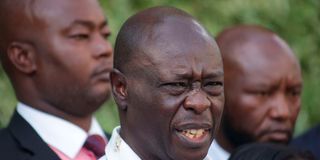
Former Deputy President Rigathi Gachagua addresses journalists at his Karen home in Nairobi on June 9, 2026.
Photo credit: Evans Habil | Nation Media Group
The 2010 Constitution was written partly to bury that ghost, and it is why Article 22 was drafted in emphatic language. It says every person has the right to institute court proceedings where a right has been denied, violated, infringed or threatened. Then, as if the framers were speaking directly to the Dugdale era, Article 22(4) declares that the absence of rules does not limit the right of any person to institute proceedings and to have the matter heard and determined.
This was not accidental drafting. It was historical correction of the Dugdale ghost. The people who wrote the 2010 Constitution understood what had happened before. They knew that procedure had once been used as a coffin for rights. They, therefore, made it clear that the Bill of Rights does not wait for administrative convenience. Article 23 went further: It gave the courts authority to uphold and enforce the Bill of Rights. It allowed them to grant appropriate relief, including declarations, injunctions, conservatory orders, compensation, declarations of invalidity and judicial review. In other words, the Constitution did not merely say that rights exist. It armed the courts with remedies.
This is where the ghost returns, and a new danger has emerged: a court finds that rights were violated but then allows the result of that violation to survive. That is the troubling question raised by the Gachagua impeachment ruling. The High Court found that former Deputy President Rigathi Gachagua’s right to a fair hearing was violated when the Senate declined to adjourn proceedings despite his request for time on medical grounds. The court awarded him Sh50 million in damages. Yet it declined to overturn the impeachment.
This creates a constitutional contradiction. If the process was unfair, how did it produce a fair result? If the hearing was constitutionally defective, how did the decision born from that hearing acquire legitimacy? If a man was denied a fair chance to defend himself, can the state simply pay him and keep the political benefit of the violation?
That is where we must be careful. A right to fair hearing is not a decorative right. It is the foundation of lawful decision-making. It is the bridge between accusation and consequence. Remove that bridge, and the decision collapses into naked power.
This principle is well understood in ordinary life. An employer cannot dismiss a worker through a sham disciplinary process, then say the dismissal stands because damages have been paid. A tribunal cannot condemn a person after locking him outside the room, then defend the outcome as administratively convenient.
Impeachment is not a casual political argument. It is the constitutional death penalty for an elected office-holder. It removes from office a person who came into power through the vote. It cancels a public mandate and changes the structure of government. That is why the process must be as clean as the process that elected the same person. The higher the office, the greater the obligation to observe fairness. The more serious the consequence, the more jealously the Constitution must guard the process. The Supreme Court in the Raila Odinga petition against Uhuru Kenyatta held that a constitutionally defective process cannot be cured merely by pointing to the final numbers. If the process is not lawful, transparent and verifiable, the result cannot stand.
If an impeachment process violates the right to fair hearing, the violation does not sit at the margins. It goes to the root. Kenyan courts understand this logic very well in land cases. They have repeatedly said that where title is acquired through fraud, illegality or a corrupt process, the later transfers cannot sanitise the original sin. A fraudulent root title poisons the mutations that follow. You cannot build a clean chain from a rotten root. You cannot launder illegality through paperwork.
The same principle should apply to public office. If the constitutional process leading to removal from office is soiled by violation of rights, the resulting decision cannot be treated as pure. Public power, like land title, must have a clean root. If the root is unconstitutional, the tree cannot bear legitimate fruit.
DCP leader Rigathi Gachagua addresses journalists at the party's headquarters in Nairobi on May 25, 2026.
Photo credit: Billy Ogada | Nation Media Group
This is not about Gachagua as a person. It is about the architecture of constitutional government. Many Kenyans may like him. Many may dislike him. Some may believe his impeachment was politically deserved. Others may believe it was engineered. But constitutional principle cannot depend on political sympathy. Rights are tested most severely when they protect people we dislike.
That is why the issue is larger than one former deputy president. Today it is Gachagua. Tomorrow it may be a governor, a judge, a senator, a county speaker, a vice-chancellor, a police officer, a civil servant, or an ordinary citizen. If the State learns that it can violate the process, obtain the desired outcome, and later pay damages from public funds, then rights become a cost of doing political business.
That is dangerous because it would mean that unconstitutional conduct can be budgeted for. It would mean that Parliament, the Executive or any state organ can rush through a flawed process, achieve its political objective, and leave the taxpayer to pay compensation. The violator keeps the prize. The victim gets money. The Constitution loses authority.
This is Dugdale’s ghost in a new costume. Dugdale’s formula said: you have rights, but there is no procedure. The modern formula risks saying: you have rights, and they were violated, but the result will remain. In both cases, the citizen walks away with a constitution that speaks loudly but acts weakly.
The 2010 Constitution was supposed to end that culture. It was born out of detention without trial, torture chambers, political assassinations, ethnic violence, land grabbing, executive arrogance and judicial timidity. It was the people’s answer to a state that had long treated law as an instrument of control rather than a shield for citizens.
The court’s task is not only to recognise violation, but to prevent the state from profiting from it. Compensation may be appropriate in some cases, especially where restoration is impossible. But where the direct product of an unconstitutional process remains alive, money alone cannot be enough.
This is the lesson from history. The old Bill of Rights failed not because it lacked beautiful words, but because institutions failed to give those words force. The new Constitution will suffer the same fate if courts become generous in declarations but timid in remedies.
We should not return to the age where rights were trapped in procedure. Nor should we enter a new age where rights are converted into damages while unconstitutional outcomes are preserved.
John Kamau is a PhD candidate in history, University of Toronto. Email: [email protected] ; X: @johnkamau1