Motorcycle theft in Kenya has quietly evolved from an opportunistic street crime into a sophisticated enterprise that is steadily eating into one of the country’s most critical economic lifelines.
Valued at an estimated Sh360 billion annually and supporting more than two million livelihoods, the boda boda sector is now under sustained pressure from organised theft networks exploiting porous borders, weak enforcement systems and the industry’s deeply informal structure.
What was once petty theft has morphed into a coordinated ecosystem involving riders, financiers, transporters, mechanics and cross-border syndicates, an underground economy stretching from Nairobi’s streets to remote border crossings.
At the Mutindwa stage in Kawangware Satellite, 63-year-old rider Peter Magena has watched that transformation unfold.
“I have been in this trade for 41 years. Back then, we only had Suzuki and Kawasaki. If it is riding, I know what it is all about,” he says.
“It is widespread, from Nairobi to rural areas and even across borders. It does not affect one person or one area,” he says.
Days earlier, riders at his stage tried to trace a stolen bike. The effort was compromised from the beginning. The owner had been drunk at the time of the theft and failed to report the incident immediately.
“That is a very dangerous thing. Once your bike is stolen, you must report it at once. Delay complicates everything,” he says.
His warning cuts to the heart of a pattern emerging across the sector: riders operating late into the night, sometimes intoxicated, often chasing higher fares, unknowingly walking into traps.
“You carry two or three men at night, where do you think you are going? You are offered Sh700 for a Sh200 trip. When the deal is too good, think twice,” he says.
For Magena, the danger is not theoretical. He recalls a pursuit from Riruta to Waithaka that had to be abandoned after word spread that the thieves were armed.
Even as riders adapt by sharing intelligence, reporting to nearby stations like Riruta Satellite, which is near Magena’s boda boda stage, and organising themselves into Saccos, the theft networks are evolving faster.
For Erick Massawe, a county manager at Watu, one of the country’s leading motorcycle financiers, the scale of the crisis is impossible to ignore.
“Motorcycle theft is a big problem not just for our customers, but every player in the sector ... The challenges differ depending on the location and circumstances,” he says.
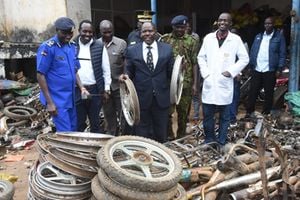
Uasin Gishu County Governor Jonathan Bii (left) and Uasin Gishu County Police Commander Benjamin Mwanthi (centre) inspect stolen motorcycles following their recovery at Eldoret Police Station on September 20, 2024.
Photo credit: Jared Nyataya | Nation Media Group
At the centre of the crisis are Kenya’s borders. From northern corridors into Ethiopia and Somalia, to western routes into Uganda and southern crossings into Tanzania, stolen motorcycles are moved with speed and precision. Once a bike is taken, the clock starts ticking.
Within hours, it can be out of the country, beyond the reach of Kenyan authorities, and will require the intervention of Interpol, which takes weeks, if not months, to respond. By then, the bike is long gone, never to be traced.
Stolen motorcycles rarely remain intact for long. Some are resold quickly at throwaway prices. Others are dismantled almost immediately, their parts fed into sprawling informal markets. In more complex operations, chassis and engine numbers are altered, allowing the bikes to re-enter circulation.
“You find engines being repurposed for fishing boats,” Massawe says, recalling cases from Tanzania. “It shows how adaptive this network has become.”
The system is highly structured. One group identifies and targets riders, often at night or on isolated routes. Another handles transportation, navigating both official and unofficial crossings. A third layer manages resale, either as whole units or stripped parts.
Certain models are consistently targeted. In Nairobi, the Boxer 100cc is highly sought after. Honda and TVS models also dominate the Nairobi market.
“If a red Boxer disappears in Nairobi and the last signal is Eastleigh, we already know where to focus,” Massawe says.
Every market has its brands. If you go to Central Kenya, brands such as Captain are very desirable. The TVS model is very common in the Busia border area in Western Kenya, while Honda and Haujin are very popular in the Coast region.
Technology has offered some protection. Motorcycles financed through formal lenders are fitted with GPS trackers, enabling real-time monitoring. On average, about 54 per cent of stolen bikes are recovered within four to eight days by Watu.
“As long as the tracker is intact, recovery is possible. But once it is removed or tampered with, it becomes very difficult,” Mr Massawe says.
Criminals know this and act fast. In many cases, trackers are disabled within minutes. In others, bikes are dismantled so quickly that by the time recovery begins, there is little left to trace. That reality played out for Livingstone Ndalalio in December 2025.
A signpost on the outskirts of Oloitokitok town in Kajiado County on April 18,2026. Authorities believe stolen motorcycles are ferried through the nearby border into Tanzania.
Photo credit: Evans Habil | Nation Media Group
He had taken a motorcycle on credit and was working to keep up with repayments. One evening, along Kirinyaga Road, he picked up a customer who requested multiple trips to transport pig feed. On the third trip, he was told to wait. While Ndalalio stepped away briefly, his cousin, whom he had left with the bike, was lured away by acquaintances, drugged and unknowingly handed the wrong key. By the time Ndalalio realised what had happened, the motorcycle was gone.
“We searched the whole night until 2am,” he said.
A tracker later pointed to Thika, briefly raising hope. But confusion over whether the device was still active delayed the response. It took more than a week, multiple police stations and intervention from the financier before the bike was finally recovered.
James Naro lost two motorcycles in separate incidents in Lower Kabete, both stolen at night, both never recovered.
“I have a wife and three children,” he says. “Now I depend on my father. It makes me feel very bad.”
Once part of Nairobi’s bustling boda boda economy, Naro has since retreated to Rumuruti in Laikipia.
His story highlights a quieter consequence of the crisis: displacement. Riders are not just losing assets; they are being pushed out of the sector altogether.
Introduced stricter controls
Even as external theft dominates the narrative, another dimension is emerging—insider fraud.
“There are cases where customers hide their own motorcycles and report them stolen,” Massawe says. “They want insurance payouts or new loans.”
To counter this, lenders have introduced stricter controls, including recorded verification processes and multi-level approvals. Still, the system remains vulnerable.
At the ground level, informal practices continue to undermine accountability. Motorcycles are frequently sold without proper documentation. Logbook transfers are skipped. Buyers rely on trust rather than verification. When theft occurs, proving ownership becomes difficult.
“A simple logbook transfer can make a big difference. But many people ignore it,” Massawe says.
Back in Nairobi, the consequences of this informality are most visible in places like Kirinyaga Road, where stolen motorcycles are dismantled within hours. Other places Magena flagged as dangerous include Kibondeni, towards Uthiru, where he says: “Do not joke around there”.
“There is Ndonyo, that is a no, Dandora is a no, parts of Embakasi towards Mukuru, that is a no. Those are very dangerous areas. But in Nairobi City Centre, Kirinyaga Road is a no-go zone. Once a bike gets there, forget it,” he says. “It is already in pieces.”
According to riders, some of these operations of stealing, dismantling and selling of motorbike spare parts run in plain sight, raising questions about enforcement. “That question should go to the police. We know these places exist, why are they doing nothing?” Massawe poses.
Beyond the city, the picture becomes even more complex.
At the southern border near Oloitokitok, a police officer stationed at Illasit Police Station, who sought anonymity, describes a steady flow of stolen motorcycles crossing into Tanzania.
“Some still have trackers, and we recover them,” he says. “But others use signal jammers. Once they get Tanzanian number plates, tracing them becomes very difficult.”
Traffickers rely on informal routes, “panya routes” through areas like Ikeilelwa, Kiwaru and deeper into Isinet, where surveillance is minimal.
“If you wait at the border, you will miss them. You have to intercept them before they get there,” he says.
Authorities use digital systems that feed chassis and registration data into national databases and work with investigators to trace ownership. Hundreds of bikes have been recovered this way.
“I cannot cross into Tanzania. I am a marked man,” he says.
For riders like Magena, the stakes remain deeply personal.
“My bike means everything: breakfast, lunch and supper. I have educated my children with it,” he says.
That dual reality of survival and vulnerability defines the sector. It is an industry that has lifted millions out of poverty, but also remains exposed to an evolving criminal underworld. Informality, weak enforcement and economic pressure continue to create fertile ground for theft networks.
Even emerging solutions, such as electric motorcycles, may only offer temporary relief.
“As they grow, the same problems will catch up,” Massawe warns.
For now, the sector sits at a crossroads. Without coordinated action, stronger regulation, better enforcement, formalised systems and behavioural shifts among riders, the boda boda economy will remain both a pillar of livelihoods and a prime target for organised crime, Magena cautions.
“This sector needs a quick surgical cleaning. If the government does not act now, at this particular time, we are stepping on a landmine, and we will not be able to contain these boys. It is going to be unruly because of the economic situation in Kenya,” he says.
For thousands of riders across the country, the difference between stability and ruin will continue to hinge on a single moment; one passenger, one decision, one night on the road.
“In Nairobi, the most loved models are Boxers, Hondas, TVS and particularly red ones, they are hot cakes. To prevent your bike from being stolen, work on your timing to work. We also have apps we can utilise to turn off our phones or credit card companies’ technologies to monitor. Have your own tracker alongside the one given by the creditor,” he said.
Tomorrow: We find out how the cross-border theft operates, the challenges faced by security officers and efforts being made to recover stolen bikes.