The security sector is among the notable winners, with an additional Sh45 billion in the reorganised budget that saw the national government’s expenditure for the year ending June 30 skyrocket by Sh316.7 billion.
The revised Supplementary Estimates I for the fiscal year 2025/26 were approved by the National Assembly after it adopted a report of its Committee on Budget and Appropriations (BAC), chaired by Alego Usonga MP Samuel Atandi, even as questions emerged over whether some of the additional allocations were warranted.
Defence (Sh24.4 billion), the National Intelligence Service (Sh10 billion), the National Police Service (Sh7.5 billion), and an additional Sh3bn for internal security constitute the biggest allocations to a single sector in the mini-budget.
Notably, the additional allocations are coming with three months remaining before the end of the current financial year, as questions over whether the funds will be properly absorbed and appropriately utilised abound.
For instance, the additional resources to the security sector are meant to “support enhanced national security operations and address operational requirements,” as well as salaries, which MPs believe are issues that should have been adequately included in the budget passed in June 2025 or the budget for the next fiscal year.
Article 223 of the Constitution, which was used to prepare the estimates, allows the national executive to incur expenditure “not previously approved by Parliament where unforeseen and urgent needs arise.”
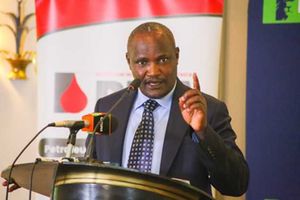
Interior Cabinet Secretary Kipchumba Murkomen addresses the media at the National Police College Embakasi, Nairobi on January 29, 2026.
“The committee noted that while these expenditures are important, some were not truly unforeseen and could have either been incorporated in the original estimates at the start of the financial year or scheduled for inclusion in the next financial year’s budget,” reads the BAC report.
The Atandi-led committee noted that continued abuse of Article 223 for expenditures that are not warranted “would disrupt budget implementation and worsen expenditure pressures.”
Homa Bay Town MP Peter Kaluma is among legislators who have spoken against the misuse of Article 223 of the Constitution.
“This is the overuse of the supplementary budget to address matters that can be handled during the planning of the main budget,” said Mr Kaluma, with Saku MP Dido Rasso also weighing in.
“How do some of these expenditures become an emergency to be factored into the supplementary budget?” posed the Saku legislator, adding, “for me, who understands the supplementary budget, this does not qualify for emergency expenditure.”
A supplementary budget is therefore meant for unforeseen emergencies like drought, floods, war and pandemics, among others.
Still, with these emergencies, the national government does not really require Article 223 of the Constitution to finance them, as it can comfortably do so under the Contingency Fund, which is allocated funds every fiscal year.
However, because of the stringent safeguards under the Contingency Fund, which require the approval of the Controller of Budget (CoB), it offers the executive the easier route under Article 223 of the Constitution.
Interestingly, this is happening under the watch of National Treasury Cabinet Secretary John Mbadi, who previously warned the National Treasury mandarins against reliance on supplementary budgets as they foster fiscal indiscipline in budget-making.
Cabinet Secretary for National Treasury and Economic Planning John Mbadi before the National Assembly Public Debt and Privatisation Committee at Continental House Nairobi on November 28, 2024.
Photo credit: Dennis Onsongo | Nation Media Group
“We have institutionalised supplementary budgets because of the serious fiscal indiscipline at the National Treasury. This is a clear sign of incompetence in the management of our economic affairs,” Mr Mbadi, the former nominated MP, said in 2024.
At the time, CS Mbadi was the chairperson of the National Assembly Public Accounts Committee (PAC).
When contacted yesterday, Mbadi said supplementary budgets are provided for in the Constitution. “In fact, the Constitution provides that where a need has arisen and the budgeted funds are insufficient or not provided at all, the National Assembly shall approve the allocation. However, we are trying as much as possible to limit supplementary budgets. You will realise that some of the allocations in the supplementary budget are for personnel emoluments arising from Collective Bargaining Agreements (CBAs) that were concluded after the budget had been approved,” said the CS.
At the time, Mr Mbadi specifically faulted the National Treasury for introducing Supplementary Budget Estimates I for the 2024/25 financial year, barely a month after the start of the new fiscal period.
The former MP argued that the introduction of numerous supplementary budgets disrupts the implementation of development projects and warned that the country will likely end up having more supplementary budgets in a year, “unless the National Treasury dedicates its energies to serious planning.”
The mini-budget saw the Ministry of Defence allocated an additional Sh24.4 billion on top of its Sh202.3 billion budget, “primarily for salary adjustments and strengthening defence capabilities.”
There is also Sh10 billion for the National Intelligence Service (NIS) to enhance intelligence gathering, with the National Police Service (NPS) getting Sh7.5 billion “to cover operational needs”, including insurance costs for police officers and their dependants.
This includes Sh2 billion, which was provided to the National Police Service to address shortfalls in group life and medical insurance schemes for officers.
The BAC has also approved an additional Sh3 billion allocation towards personnel emoluments, operations, maintenance and other security-related operations by the NPS.
The revised estimates also propose reductions in certain development partner-funded initiatives “due to adjustments in donor commitments and project reprioritisation.”
They include reductions of Sh4 billion from ICT infrastructure, Sh3.9 billion from water and sanitation projects, and Sh3.5 billion from energy sector programmes, among other reductions. It should not be forgotten that the 2025/26 financial year budget was presented with a focus on supplementary budgets to accommodate the unfunded areas, which State House Comptroller Mr Katoo Metito recently acknowledged.
Despite the budgetary increase in the security sector, the BAC report shows significant reductions in ICT infrastructure, water and sanitation, and energy of about Sh11.4 billion.
The budget committee notes that the enhanced budgetary allocation represents a 7 per cent rise from the Sh4.3 trillion budget approved in June 2025 to Sh4.62 trillion.
This, as the committee warned, is the variation that reflects the “fiscal pressures that have emerged during the financial year, including the need to accommodate rising expenditure demands across key sectors.”
“This indicates a shift towards greater reliance on domestic borrowing,” reads the BAC report, adding, “this underscores the need to balance fiscal sustainability with the pressing economic, political and social priorities.”
The revised budget pushes the fiscal deficit in the year’s budget to Sh1.2 trillion from Sh933.3 billion approved in the 2025/26 estimates.
BAC notes that the deficit financing will be largely driven by net domestic borrowing, which is expected to increase by Sh323.1 billion to hit Sh947.8 billion, with net foreign financing projected to decline by Sh60 billion to Sh227.7 billion.
The National Treasury prepared the mini-budget while projecting that the Sh2.8 trillion ordinary revenue, as approved by the National Assembly in June 2025, would increase by Sh29.7 billion.
However, the BAC report reveals that the “moderate upward revision in ordinary revenue contrasts with the Sh316.7 billion increase in the national government’s cumulative expenditure” for the current financial year.
The National Treasury Building in Nairobi.
Photo credit: Pool
“This indicates that revenue growth is not keeping pace with rising spending pressures. This imbalance has widened the overall fiscal deficit in the approved 2025/26 estimates,” the BAC report reads.
Other than the security sector, the education sector also got an additional allocation to “support key priorities.”
This includes Sh21.2 billion towards the Teachers Service Commission (TSC) “to address shortfalls in personnel emoluments and employer contributions to compulsory health insurance schemes.”
There is also Sh15.4 billion to the State Department for Higher Education, “primarily to support” the Higher Education Loans Board (HELB), the University Funding Board (UFB), and Moi University.
The State Department for Technical and Vocational Education and Training gets Sh6.8 billion, “largely reflecting additional” Appropriations-in-Aid (AiA) collected by Technical and Vocational Education and Training (TVET) institutions.
The health sector has additional resources to strengthen service delivery and support ongoing health reforms.
This includes Sh6 billion to the Primary Health Care Fund to enhance access to essential services at the community and primary care levels, Sh1.28 billion to support the coordination and implementation of Universal Health Coverage (UHC) initiatives, and Sh5.4 billion to cater for health sector interns.
However, the sector also experienced some reductions, primarily in development partner-funded programmes supporting TB and malaria interventions.
To boost agricultural productivity and enhance food security, the agriculture sector has been allocated Sh10 billion to support the fertiliser subsidy programme, Sh7.8 billion for reforms in the sugar sector, of which Sh5.8 billion arises from Appropriations-in-Aid collected through the sugar levy.
There is Sh2 billion for the production and distribution of seeds and seedlings to promote crop diversification and improve farm productivity, and Sh1 billion to the Agricultural Finance Corporation (AFC) to expand access to affordable credit for farmers and agribusiness enterprises.
The revised estimates also have additional allocations to support key transport infrastructure projects across road, rail and marine sectors.
Specifically, Sh23 billion has been earmarked for the roads subsector to expand and upgrade major road networks, Sh14.9 billion for rail transport, including the Nakuru–Kisumu–Malaba Standard Gauge Railway (SGR) extension, and Sh6.3 billion for marine transport, “with a focus on developing the Dongo Kundu Special Economic Zone.”