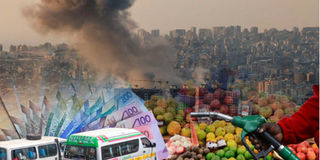
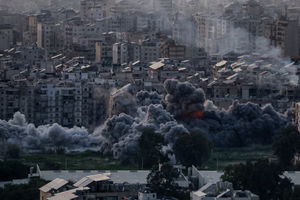
Top government officials have been holding a series of emergency meetings as the escalating war in the Middle East threatens to deliver the most severe economic shock Kenya has faced since the Covid-19 pandemic.
The Nation has established that a series of emergency meetings has been underway across the National Treasury, the Ministry of Energy, the Central Bank, Foreign Affairs and the Ministry of Trade as the war between the United States, Israel on one side and Iran on the other sends shockwaves through an economy that depends on the Gulf for almost everything — from the fuel that moves the country to the fertiliser that feeds it.
Think of it as five supply chains, each one a cord running from the Persian Gulf straight into a Kenyan household. Cut any one cord and something in your daily life gets more expensive, scarcer, or disappears. The Iran war is cutting all five at once.
The Middle East crisis threatens to deliver the most severe economic shock Kenya has faced since the Covid-19 pandemic.
Photo credit: NMG
No single cord would be catastrophic on its own. Kenya survived the 2022 Russia-Ukraine shock. But this war hits all five simultaneously, and the 2026 crisis is substantially larger — the 1973 embargo removed approximately 5 million barrels per day from global markets; the Hormuz closure has removed approximately 20 million barrels per day, four times the volume.
The chain reaction looks like this: Hormuz closes → fuel price spikes → Matatu fares rise → food transport costs rise → fertiliser doesn't arrive → planting season is compromised → shilling weakens under pressure → import costs climb → remittances falter → household spending contracts → export earnings drop → fewer dollars enter Kenya → shilling weakens further.
Officials are watching the crisis unfold in real time. There are daily briefings on fuel reserves, and President William Ruto is kept in the loop. Hourly updates on the shilling. Calls to oil suppliers in Saudi Arabia and the UAE who are themselves under fire. And at the heart of every meeting, a question that has no good answer: what do we tell Kenyans is coming?
“We have enough fuel supplies and are working with regional and external partners to ensure constant supplies and therefore ensure that the war in the Middle East does not negatively affect our economies. We have enough supplies now and the government will not entertain artificial shortages caused by profiteers. Oil marketers must continue working within the confines of their licenses,” President Ruto said on Thursday.
President William Ruto addresses the nation at Eldoret State Lodge on December 31, 2025 moments before Kenyans ushered in the New Year.
Photo credit: PCS
“We’re looking for alternative markets to cushion the country from the shocks of the war. We’ve just had a delegation from China led by their Vice President Han Zheng and we’ve signed a zero tariff-zero quota to China to take care of produce that might be stranded because of the ongoing war. We’re building a resilient and diverse market across the world,” Trade CS Lee Kinyanjui told Nation .
Kenya does not produce a single drop of the petroleum it uses. Every litre of petrol, diesel and kerosene is imported — most of it from the Gulf, under long-standing deals with three state-owned oil companies: Saudi Aramco, Emirates National Oil Company and Abu Dhabi National Oil Company.
Those deals were supposed to guarantee steady supply at stable prices. But the guarantee depends on ships being able to sail through the Strait of Hormuz, a narrow stretch of water between Iran and Oman through which a fifth of the world's oil passes every day
Stung by the urgency of the matter, UN Secretary-General António Guterres weighed in on Wednesday.
“The conflict in the Middle East has gone too far. My message to the US & Israel is that it’s high time to end the war – as human suffering deepens, civilian casualties mount & the global economic impact is increasingly devastating. My message to Iran is to stop attacking their neighbors that are not parties to the conflict,” he said
UN Secretary-General Antonio Guterres. The 69th session of the Commission on the Status of Women on March 10, 2025, adopted a political declaration that could change the course of future UN nominations to the top leadership.
Photo credit: Photo | Pool
That strait is now, for all practical purposes, closed. Iran has warned it will set ablaze any vessel that attempts passage. Tanker owners have pulled back. The International Energy Agency has called this the largest oil supply disruption in history.
And Kenya has two choices. Source fuel from alternative, more expensive suppliers — and pass the cost to you. Or hold out on current reserves and watch the supply shrink week by week.
"The options on the table are not good options," a senior official familiar with the discussions told the Nation , asking not to be named. "Either the price goes up or the supply goes down. There is no middle ground."
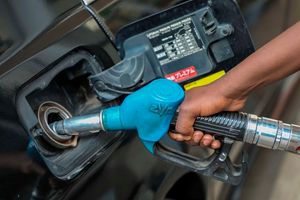
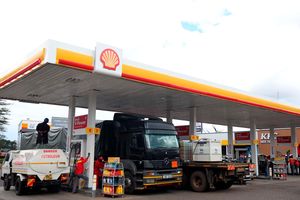
The effects are already showing. This week, the Petroleum Outlets Association of Kenya said about one in five independent petrol stations is running short. Dealers, expecting a steep price jump when the energy regulator EPRA announces new pump prices in April, have begun holding back stock.
The government insists the country has enough fuel to last through the end of April but officials privately admit the cushion is thin. Energy CS Opiyo Wandayi is already accusing marketers of hoarding fuel in anticipation of price increase.
“All licensed marketing companies are strongly reminded of their legal obligation to maintain continuous supply and release products at gazetted prices,” the CS said
On Thursday, Skyward airlines announced a review of ticket prices from next week what the management attributed to rising global fuel costs.
“Please note that effective April 1, 2026, a fuel surcharge will apply to all Skyward Airlines ticket prices due to the sustained rise in global fuel costs affecting the aviation industry,” the management said in a press release.
Photo credit: Skyward Express
The price of Murban crude — the specific type of oil Kenya buys — has shot up from Sh9,857.20 ($76) a barrel before the war started to nearly Sh15,174.90 ($117). At one point it touched Sh20,362.90 ($157), higher than the record set during the 2008 global crisis.
When that price works its way through EPRA's monthly calculation, the number that appears on the petrol station board will be unlike anything Kenyans have seen in recent memory.
And diesel is the one that matters most. Not because you drive a diesel car — but because everything you buy was brought to you by a diesel engine.
The Matatu you ride. The truck that carried rice from Mombasa to your local shop. The tractor on the farm. The generator at the factory. When diesel costs more, everything costs more. That is not a theory. It is how this economy works.
The Nation has learnt that emergency sessions have been convened by boardrooms across the country, including those in the tea industry, the flower sector, banking, logistics and manufacturing, to assess the implications of the war on their businesses, workers and supply chain, a war triggered last month by the pronouncements of US President Donald Trump in Washington, DC, and Israeli Prime Minister Benjamin Netanyahu in Tel Aviv, 7,558 km and 5,245 km away from Nairobi, respectively.
In the tea sector, executives are staring at a map of their export markets and seeing closed doors. Iran bought 13 million kilograms of Kenyan tea last year. Saudi Arabia and the UAE are significant and growing buyers. With Gulf airports shut and shipping frozen, those buyers cannot be reached. At the Mombasa tea auction — the world's largest for black tea — the absence of international bidders is expected to push prices down.
That might sound like a problem for men in suits. It is not. When the auction price drops, the payment to the KTDA factory drops. When the factory payment drops, the bonus to the smallholder farmer in Kericho or Nandi or Nyeri drops. The chain between a boardroom in Nairobi and a tea picker in Litein is shorter than most people think.
In banking, the mood is watchful. Lenders exposed to agriculture, trade and the energy sector are running scenarios — what happens to their loan books if the shilling weakens sharply, if export earnings dry up, if borrowers across the economy start struggling to make repayments.
The Institute of Economic Affairs has warned that the shilling could lose between eight and 30 per cent of its value if the war drags on. That would push the exchange rate from today's 129 to somewhere between 140 and 168 shillings to the dollar. Every Kenyan who buys anything imported — which is almost every Kenyan — would feel that immediately.
In the flower industry, the arithmetic is brutal and the clock is fast. A rose cut in Naivasha has 48 hours before it wilts. It needs to be cold-chained to the airport, loaded into the belly of an international flight, and delivered to a buyer in the Netherlands or Dubai.
Kenya Airways has suspended flights to the UAE. Emirates and Qatar Airways are grounded. The planes are not flying. The flowers are dying. And the workers — mostly women earning between ten and fifteen thousand shillings a month — are facing shorter shifts or no shifts at all, through no fault of their own or their employer's.
Kenya Airways planes at the Jomo Kenyatta International Airport parking bay.
Photo credit: File | AFP
The livestock sector is in the same bind. The Kenya Meat Commission had been building a pipeline to sell goat and sheep meat to Kuwait, Saudi Arabia and the UAE — real money reaching pastoralist communities in Garissa, Isiolo and Wajir that have historically been locked out of international markets. That pipeline is now frozen.
The crisis that worries agricultural experts most is not the one happening now. It is the one that will arrive in six months.
About a third of all the fertiliser traded in the world passes through the Strait of Hormuz. The Gulf states — Saudi Arabia, the UAE, Kuwait, Iran — are among the world's largest producers of fertiliser and the raw materials used to make it. Unlike oil, there are no strategic reserves of fertiliser anywhere. When the supply stops, it simply stops.
Kenya's long rains planting season is underway right now. Maize, beans, potatoes, wheat — the staple crops that feed the country — need fertiliser in the ground today. The government has distributed subsidised fertiliser stocks and allocated eight billion shillings to the effort. But if the pipeline from the Gulf stays shut, the next shipment will not arrive.
The Food and Agriculture Organisation has named Kenya among the East African countries most immediately at risk. Its chief economist did not mince words: there are no substitutes and no stockpiles.
A bumper harvest is expected in Ndaragwa, a traditionally dry area that relies on food relief. The maize crop was also planted in March. Photos taken on July 6, 2025.
Photo credit: Wailkwa Maina | Nation
History tells us exactly what happens next. When Russia invaded Ukraine in early 2022, fertiliser and grain supplies were disrupted during the planting season. By the end of that year, East Africa was in a food crisis. The pattern is the same. The scale this time may be larger.
If yields fall short in September and October, the two-kilogram packet of unga maize flour — already one of the most politically sensitive prices in Kenya — will climb again. And the government will be forced to import emergency grain at global prices that have been inflated by the same war.
There is another supply chain that runs from the Gulf directly into Kenyan homes, and it carries not goods but money.
About half a million Kenyans work in the Middle East — 300,000 in Saudi Arabia, 70,000 in Qatar, up to 80,000 in the UAE. They are domestic workers, drivers, hotel staff, security guards.
Every month, they send money home. In the twelve months to February, diaspora remittances totalled more than five billion dollars. Saudi Arabia alone accounted for Sh39.17 billion ($302 million) last year according to estimates by the Central Bank of Kenya.
That money does not sit in investment accounts. It pays school fees in Embu. It covers rent in Ruiru. It keeps a small shop open in Kisii. It builds a house room by room in Meru.
In March, remittances dropped by 21.6 billion shillings. The war has not even fully disrupted Gulf economies yet. If it does — if workers are displaced, if banks are disrupted, if the countries that employ these Kenyans slide into their own economic crises — the families waiting for that monthly M-Pesa transfer will be on their own.
There is one more supply chain at risk, and most people have never thought about it.
Kenya's internet arrives through fibre-optic cables that lie on the ocean floor, entering the country at landing stations in Mombasa. These cables — with names like SEACOM, TEAMS and EASSy — run through the Red Sea, the same waterway where Houthi militants have resumed attacks on shipping.
At least 17 undersea cables pass through the Red Sea. The Strait of Hormuz carries another set. Both are now war zones. Meta's massive 2Africa cable project, which was supposed to connect the Gulf to Africa and go live this year, has been halted after the company laying the cable said it could no longer safely operate in the Persian Gulf.
One cable — SEACOM — has already gone down on the stretch between Mombasa and Egypt. Traffic was rerouted and services continued, but the margin for error is thin. If several cables are cut at once, repair ships cannot enter a war zone, and restoration could take months.
What would that mean? Slower internet. Longer M-Pesa processing times. Disruptions to online banking, cloud services, government platforms and the call centres that employ thousands of young Kenyans. The digital economy that earned Nairobi the name "Silicon Savannah" is built on infrastructure that runs through a conflict zone.
The instinct, when you see footage of missiles over the Persian Gulf, is to think it is far away. A problem for other countries, other people. The Gulf is 3,000 kilometres from Nairobi.
But the fuel that takes you to work comes from there. The fertiliser that grows your food comes from there. The money your sister sends from Riyadh comes from there. The cables that carry your internet come from there. The ships that carry your wheat, your cooking oil, your medicine — they all pass through waters that are now on fire.
The war is 3,000 kilometres away. The supply chains are in your kitchen, your Matatu, your M-Pesa, your child's school. The distance, for all practical purposes, is zero.