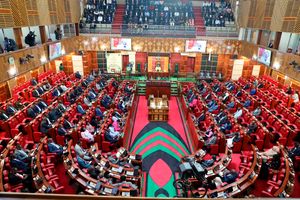
Lack of coordination, poor execution and interpretation of the clauses deemed offensive largely led to the failure by opposition allied Members of Parliament losing the fight to reject the Finance Bill, 2026
The Bill was approved by the House on Thursday night with all the amendments as proposed by the Finance committee through an electronic vote.
When the final tally was done, a total of 122 MPs voted in support of the legislation while only 40 opposed it.
The Nation has learnt that while the broad-based allied MPs were well organised and well-armed with responses to the clauses they knew their counterparts would use to reject the Bill, those opposing appeared disjointed.
From the onset when Deputy Minority and Kathiani MP Robert MP took to the floor of the House shouting how the Bill would increase the cost of second hand clothes popularly known as mitumba.
“This Bill is going to tax clothes that cannot afford new clothes. We are introducing a tax on mitumba,” Mr Mbui
However, Majority leader Kimani Ichung’wah rising on a point of order immediately countered the narrative terming it propaganda being propagated in the social gatherings.
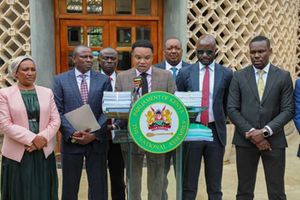
Leader of Majority in the National Assembly Kimani Ichung'wah during a media briefing at Parliament Buildings in Nairobi on June 17, 2026.
Photo credit: Dennis Onsongo | Nation Media Group
“I want to challenge Robert Mbui to substantiate and show the House and the country where in this Bill the tax proposal on mitumba is because the Bill as published has no such tax proposal,” Mr Ichung’wah rebutted.
Cornered to provide evidence, Mr Mbui only managed to fumble without giving any solid anchor to his claims.
“This a huge Bill, I will have to go through this clause by clause so that I can find it,” Mr Mbui said.
“I think the opposition were stuck with the old Bill that some people at the treasury leaked to the public. They were not referring to the Bill published by the finance committee,” said a source in parliament.
Kiharu MP Ndindi Nyoro during an interview outside the National Assembly on June 11, 2026.
Photo credit: Wilfred Nyangaresi | Nation Media Group
It was also not clear from the opposition side on who was leading the charge-whether it was Mr Mbui who is allied to the united opposition side or MPs from the Lind Mwananchi side who were also opposing the Bill.
The disjointed coordination gave the broad-based government side a field day to push through the amendments with ease.
According to sources in Parliament, it was also clear that the Bill appeared technical to most of the lawmakers who were opposed to it. While they would point to an offensive clause, interpretation was a challenge.
Kitui Central MP Makali Mulu however appeared very knowledgeable and understood the Bill well but he was a lone ranger and could not do much.
Majority of the opposition lawmakers appeared to be playing to the gallery instead of addressing contents of the Bill.
Majority of MPs kept off the debate
Whenever they were given an opportunity to speak on the Bill, they would seize the opportunity to attack the government hence ruled out of order on rule of relevance as espoused in the House of Standing Orders which stipulates that a speaker should speak to the subject matter.
It also emerged that the opposition were not well acquitted with the amendments published in the supplementary order paper hence were not able to prepare adequately to debate with those that were supporting the Bill.
Despite starting well during the second reading of the Bill, the opposition fizzled out on the final day where only 40 people voted against the Bill.
The Sunday Nation has learnt that majority of MPs kept off the debate, final voting and even coming to parliament over fears that the House might have been invaded by protester as it happened in 2024
According to the source majority of MPs especially the female lawmakers are yet to fully heal from the June 25, 2024 incident and did not vote either yes or no for the Bill.
The Finance and National Planning Committee chairperson Kuria Kimani (centre) addresses the press when the National Assembly leadership defended the Finance Bill at Parliament Buildings in Nairobi on June 17, 2026
Photo credit: Dennis Onsongo | Nation Media Group
There was also fear from the lawmakers that voting either way for the Bill would expose them to the public as a list of how they voted would be circulated online the following day.
To mitigate this, speaker of the National Assembly Moses Wetang’ula directed that voting would be done electronically-this makes it difficult to know the identities of those who voted for or against unlike the manual voting which is public and anyone can see how an MP has cast his vote on a particular matter.
The rejection of various amendments proposed by Deputy Minority leader Robert Mbui, Embakasi West MP Mark Mwenje and Yatta MP Robert had various amendments to the Bill which were knocked out on technicality for failure to conform to Article 114 of the constitution also threw the opposition off balance.
In rejecting the proposed amendments, Mr Wetang’ula said they touch on the definition of a money Bill pursuant to Article 114 (2) of the constitution hence cannot be considered by the House before consultations with the finance committee and the National Treasury.
“The amendments that were submitted and for which a disclaimer under Article 114 (2) of the constitution has been made will only be proceeded with if there is there consultation with the National Treasury through the committee of finance and national planning,” ruled the speaker.
“In the absence of the evidence that they were processed in the manner contemplated in Article 114 (2), the speaker is left with no choice but to direct that the committee of the House shall not consider any of the amendments that have been published in the Order Paper,” he added
“The Bill will proceed without referring to the proposed amendments and will be considered as though the amendments have been withdrawn,” Mr Wetang’ula said.
This Finance Bill was also largely addressing tax administration issues- and the mostly affected corporates and not common man, a move that locked out many opposing from finding low hanging fruits to oppose the Bill.
“Unlike previous approaches that focused on introducing new taxes, this Bill emphasises simplifying tax laws, addressing ambiguities, strengthening enforcement and aligning Kenya’s tax framework with international standards,” said Finance committee chairman Mr Kimani Kuria.
“It further reflects the governments’ commitment to modernising tax administration through technology, data analytics and risk based compliance mechanisms,” he added.
In its report to the House, the committee rejected treasury proposals to reclassify several essential goods and services from VAT zero rated to tax exempt status.
The rejection affected items such as transportation of sugarcane from farms to mills, raw materials used in animal feed production, locally assembled mobile phones and renewable energy products such as electric motor cycles, buses, and bicycles.
“Reversing this position would increase production costs, discourage investment and undermine predictability in the tax system,” reads the committee report that was adopted by the House.
The committee warned in its report that moving the selected goods and services from zero rated to tax exempt status would deny businesses the ability to recover input VAT, an additional cost which it says would be passed on to consumers through higher prices further burdening the already overburdened taxpayers.