The National Assembly was on Tuesday plunged into heated exchanges and interruptions as debate on the contentious Finance Bill, 2026 got underway.
The Bill seeks to raise Sh120 billion to partly finance the Sh4.8 trillion national budget. Proceedings, marked by tension and vocal opposition, began immediately after the report of the Departmental Committee on Finance and National Planning, tabled by its chairperson Kuria Kimani (Molo), was presented.
With political alignments and the 2027 General Election looming, lawmakers clashed over the proposed tax measures and the committee’s recommendations.
MPs clash in Parliament over Finance Bill 2026 fiasco
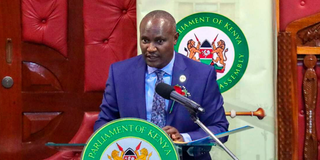
Deputy Minority Leader Robert Mbui (Kathiani) set the tone for opposition shortly after what had appeared to be a supportive opening by the Molo MP.
At one point, as tempers flared, Deputy Speaker Farah Maalim (Dadaab), who was presiding, cautioned members against disorder, warning that he would not allow attempts to gain political mileage through disruptions.
“I know some of you want to be thrown out of the Chamber on account of disorder to gain political mileage. I will not do that,” he said.
Mr Mbui questioned the government’s failure to exempt Kenyans earning below Sh30,000 from Pay-As-You-Earn (PAYE), as had previously been proposed.
“They told Kenyans they would exempt those earning below Sh30,000. But this Bill has no such proposal,” he said, arguing the Bill would increase the tax burden on citizens.
President William Ruto had earlier indicated that workers earning below Sh30,000 would be exempt from PAYE, but the proposal did not feature in the Finance Bill, 2026 as published by the National Treasury.
The matter, however, was taken up by National Treasury Cabinet Secretary John Mbadi, but the exemption was not included in the Bill as published.
Cabinet Secretary for the National Treasury and Economic Planning John Mbadi displays his briefcase before reading the 2026/27 budget at Parliament Buildings, Nairobi, on Thursday, June 11, 2026.
Photo credit: DENNIS ONSONGO | NATION
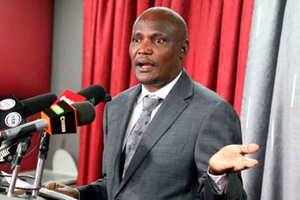
Committee chairperson Kuria Kimani said: “We have told the National Treasury to go back to the drawing board and relook at the possibility of overhauling all the PAYE tax bands.”
The remarks drew criticism from Opposition MPs. However, Mr Mbui’s claim that Clause 4 of the Bill would unfairly burden tenants was rejected by Majority Leader Kimani Ichung’wah (Kikuyu).
The clause proposes changes to non-resident income tax provisions, shifting responsibility for remitting tax on rent from tenants to landlords.
“This amendment will be transferred to the tenants,” Mr Mbui said. But Mr Ichung’wah disagreed: “The proposed changes seek to shift the burden of paying taxes from tenants to landlords who are non-residents.”
“Currently, tenants withhold tax from rent and remit it directly to the Kenya Revenue Authority. Under the proposal, that responsibility shifts to owners of residential properties,” he added.
Committee chairperson Mr Kimani said the House team had not taken a firm position on moving some goods and services from the zero-rated category to tax-exempt status.
Cabinet Secretary for the National Treasury and Economic Planning John Mbadi (centre), with chairperson of the National Assembly Budget and Appropriations Committee Samuel Atandi (right), and chairperson of the National Assembly Finance and National Planning Committee Kuria Kimani at Parliament Buildings, Nairobi on June 11, 2026 before the presentation of the Financial Year 2026/27 budget highlights.
Photo credit: Dennis Onsongo | Nation Media Group
“We are proposing that if the National Treasury wants to make a product tax-exempt, then the raw materials used in its production should also be tax-exempt,” he said.
The committee has also agreed with the National Treasury to impose taxes on imported mobile phones at the point of activation, with the main dispute being the timing of implementation.
It further backed proposals requiring individuals to file tax returns with the Kenya Revenue Authority six months after the end of the financial year, while businesses will file at the end of each financial year.
The committee also supported a proposal to tax imported helicopters, but exempted helicopter spare parts to reduce maintenance costs for operators.
However, it declined to overturn Treasury’s proposal to impose taxes on digital and card transactions. During the Finance Bill, 2026 hearings, professional bodies are pushing for a framework that lowers the marginal Pay-As-You-Earn (PAYE) rate to 25–30 per cent and widens income tax bands to restore disposable income.
Kenya Bankers Association (KBA) chief executive Raymond Molenje said the current PAYE structure is narrow and steep, with high marginal rates applied at relatively low income levels compared to peer economies.
“A five per cent PAYE cut expands the economy, creates jobs and increases tax revenue,” he said.
The proposals are driven by concerns that employees are facing multiple levies on gross income, including the Social Health Insurance Fund (SHIF), the Affordable Housing Levy and enhanced National Social Security Fund (NSSF) contributions, which have eroded real wages.
SHIF attracts 2.75 per cent of gross pay monthly, the housing levy 1.5 per cent (matched by employers), while enhanced NSSF contributions rose to Sh6,480 in February 2026.
A KBA simulation shows a uniform five per cent PAYE reduction across bands would release Sh28.1 billion annually, generate Sh42 billion in GDP output, create 36,000 jobs and unlock Sh140 billion in formal lending capacity.
Institute of Certified Public Accountants of Kenya (ICPAK) Public Finance and Taxation Committee convenor FCPA Robert Waruiru said reducing marginal PAYE rates and widening tax bands would align with government objectives under the Medium-Term Revenue Strategy (MTRS).
He said higher statutory deductions over the past two years make a more progressive tax structure necessary to protect disposable income.
“This would enhance purchasing power, savings and investment capacity, and ultimately spur economic growth,” he said.
ICPAK also argues the proposal would align Kenya’s PAYE regime more closely with peers such as Ghana and South Africa.
It notes that Ghana’s tax bands range from 0 to 35 per cent, with wider thresholds, where the 30 per cent rate applies to incomes above about Sh255,000 monthly, compared with Sh32,333 in Kenya.
The Bill has also been criticised for moving some goods and services from the zero-rated category to tax-exempt status, a shift stakeholders say could raise consumer prices.
Kenyans have also called for the removal of proposed taxes on mobile phones at activation, digital financial services and withholding tax on card transactions, proposals the committee has not adopted.
Clause 34 of the Bill seeks to amend the Excise Duty Act to shift taxation on imported or locally manufactured phones from importation or manufacture to the point of device activation.
Clause 31 proposes amendments to the VAT Act, including deleting certain exemptions while introducing new ones covering items such as dialysers, worn clothing, scrap metal, pharmaceutical inputs, public-private partnership projects and bioethanol stoves.
Stakeholders warn that removing sugarcane transport from the zero-rated category will raise sugar production costs and, ultimately, consumer prices.
Under VAT rules, zero-rating allows input tax claims along the supply chain, while exemption disallows input tax recovery, with costs passed on through embedded pricing.