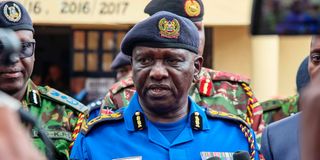
Inspector-General of Police Douglas Kanja has introduced four new police formations in an amended structure that he says is aimed at enhancing efficiency, coordination, accountability and operational effectiveness.
The new formations are the Nairobi Metropolitan Police, Judiciary Police Unit, Quick Response Unit and Kenya Police Marine Unit
The changes, contained in Legal Notice No. 138 published in the Kenya Gazette of July 30, 2026, also amend the National Police Service Standing Orders and reorganise the Kenya Police Service, Administration Police Service and the Directorate of Criminal Investigations (DCI) in what is expected to significantly reshape police command and specialised operations.
Under the new Standing Orders, the Inspector-General is empowered to organise the National Police Service into formations, units and components at the national level. No formation, unit or component may be established, varied or abolished without the approval of the Inspector-General.
"The Inspector-General shall organise the national level into formations, units and components. No formation, unit or component shall be established, varied or abolished except with the approval of the Inspector-General," reads the gazette notice.
The amended orders also give the Inspector-General powers to issue written directives to the Deputy Inspectors-General and the Director of Criminal Investigations to integrate, merge or reorganise formations, units, bureaus, investigative commands and components where necessary to improve operational efficiency.
Where conflicts arise over the mandates of different formations, the Inspector-General will have the authority to issue binding directions to resolve them.
"Where a conflict arises concerning the mandates or functions of different formations, units, bureaus, investigative commands or components, the Inspector-General shall issue such directions as may be necessary to resolve the conflict," it adds.
The Office of the Inspector-General will comprise the National Police Service Headquarters, the National Police Air Wing, the National Police Reserve and the National Police Referral Hospital.
The reforms establish an expanded structure for the Kenya Police Service comprising specialised formations and units designed to respond to evolving security threats.
Among the newly recognised formations are the Nairobi Metropolitan Police, Judiciary Police Unit, Quick Response Unit and Kenya Police Marine Unit, alongside other specialised operational and support components.
The Nairobi Metropolitan Police, which Kenya hopes to model on police services in New York, London and Tokyo, will be tasked with crime prevention, public order management, protection of critical infrastructure, intelligence-led policing and traffic management in the capital.
The establishment of the Judiciary Police Unit signals a move to create a dedicated security formation responsible for protecting courts, judges, judicial officers, witnesses, court users and judicial infrastructure. The specialised unit is also expected to support the enforcement of court orders, secure high-profile trials and strengthen security within the country's justice system, functions that have previously been handled by officers drawn from regular police stations.
The Kenya Police Marine Unit, on the other hand, is expected to bolster policing in the country's territorial waters, lakes, rivers and other inland waterways. Its officers will be responsible for combating crimes such as smuggling, illegal fishing, human trafficking, piracy, narcotics trafficking and other cross-border offences while supporting search-and-rescue operations and protecting Kenya's maritime assets and blue economy.
The Quick Response Unit is designed to provide a rapid deployment capability for emerging security incidents. The unit is expected to respond swiftly to armed attacks, hostage situations, public order emergencies, terrorist incidents and other high-risk operations requiring immediate police intervention before reinforcements from other specialised formations arrive.
For the Administration Police Service, the Deputy Inspector-General will determine the command structure of formations, units and components in consultation with the Inspector-General and oversee their deployment across the country.
The Deputy Inspector-General will also issue general, special and routine standing orders, together with standard operating procedures governing Administration Police operations.
The legal notice requires Administration Police formations to implement decisions of the Deputy Inspector-General, enforce National Police Service policies, coordinate police and security operations, promote internal and external oversight mechanisms and operate in accordance with approved operational guidelines.
The Directorate of Criminal Investigations has also undergone significant reorganisation. Its formations will comprise the Directorate of Criminal Investigations Headquarters, the National Police Service Forensic Laboratory, the Counter-Terrorism Bureau, the National Anti-Narcotics Investigations Bureau, the Crime Research and Intelligence Bureau, the Kenya Airports Criminal Investigations Unit and the Kenya Railways and Ports Criminal Investigations Unit.
The Director of Criminal Investigations will, in consultation with the Inspector-General, determine the command structure of DCI formations, oversee their deployment, and issue operational guidance and standard operating procedures.
The reforms further establish ten investigative commands responsible for criminal investigations and forensic services. These include the Investigations Bureau, Operations Bureau, National Police Service Forensic Laboratory, Crime Research and Intelligence Bureau, Counter-Terrorism Bureau, Homicide Investigations Bureau, National Anti-Narcotics Investigations Bureau, INTERPOL National Central Bureau, Kenya Airports Criminal Investigations and Kenya Railways and Ports Criminal Investigations.
The Director of Criminal Investigations is empowered to organise these commands into specialised units, sub-units, sections or desks and may review, merge or integrate them from time to time to enhance operational effectiveness.
The amended Standing Orders also formally anchor the Internal Affairs Unit within the National Police Service structure, reinforcing internal oversight and disciplinary mechanisms as part of broader efforts to improve accountability and professionalism within the police service.