A confidential report handed over to President William Ruto cautions that Inspector General of Police Douglas Kanja faces difficulties running the National Police Service, a situation likely to affect security preparations ahead of next year’s General Election.
The warning is contained in a brief by a Technical Working Group that assessed the implications of a protracted power struggle between the police boss and the National Police Service Commission, led by Dr Yuda Komora.
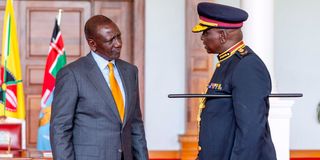
Mr Amani Yuda Komora.
Photo credit: Billy Ogada | Nation Media Group
“The prolonged dispute has the potential to adversely affect career progression, succession planning and leadership continuity within the service by delaying the filling of vacancies arising from retirement, death, resignation, incapacity or other forms of attrition, with potential implications for operational effectiveness and command stability, “states the report.
“Stay of promotion functions may result in prolonged vacancies at critical command levels with attendant implications for operational efficiency, command effectiveness and national security, “it adds.
The 12-page document formed part of the agenda of a crisis meeting chaired by Deputy President Kithure Kindiki at his Karen residence on June 18 that, however, failed to strike a deal between the warring parties.
The deputy president had summoned the civilian and uniformed commissioners of the NPSC to find a solution to the impasse that threatens to disrupt police operations.
Among the unresolved issues is a case pending before the Court of Appeal, which, on February 27, suspended a judgment by the Employment and Labour Relations Court that granted the Inspector-General exclusive power over the promotion and dismissal of police officers.
Inspector-General of Police Douglas Kanja.
Photo credit: File | Nation Media Group
The Employment and Labour Relations Court had ruled that the NPSC does not have constitutional authority over recruitment, promotion and dismissal of members of the NPS, which comprises the Kenya Police Service, the Administration Police, and the Directorate of Criminal Investigations.
The NPSC and the Independent Policing Oversight Authority (Ipoa) have supported the appeal by the Law Society of Kenya, which sought the suspension of the lower court’s judgment.
Police commanders and civilian commissioners of the NPSC are also tussling for control of the Sh60 billion police payroll.
Interior Cabinet Secretary Kipchumba Murkomen, Interior Principal Secretary Raymond Omollo, all service commanders and the civilian commissioners of the Dr Komora-led commission attended the meeting.
Among those present were Mr Kanja and his two deputies, Mr Eliud Lagat (Kenya Police) and Mr Gilbert Masengeli (Administration Police), who are members of the commission.
Prof Collette Suda (vice Chairperson), Ms Angeline Yiamiton, Ms Peris Muthoni, Mr Benjamin Juma Imai, and Mr Edwin Cheluget are the other commissioners.
The commission’s chief executive officer is Peter Leley, who has often clashed with Mr Kanja in official letters.
Co-opted members include Amin Mohamed, the DCI director, and Bernice Sialaal, the Secretary Administration/Accounting Officer, NPS.
During the meeting, concerns were raised that the court case was taking too long to conclude and creating confusion as crucial timelines had lapsed.
The report notes that a 90-day period, within which the orders of the lower court had been suspended, had lapsed on May 27.
“The ninety (90) day period contemplated for the expeditious resolution of the dispute lapsed on May 27, 2026, without the substantive appeals being heard and determined,” the report observes.
“As at 19th June, 2026, the Court of Appeal had not constituted a substantive bench to hear and determine the appeals, prolonging uncertainty regarding the exercise of critical human resource management functions within the National Police Service,” says the report.
After the lower court handed over the powers to the IG, LSK moved to the Court of Appeal seeking to suspend the judgment, arguing it disrupted the constitutional balance between the Inspector-General and the NPSC.
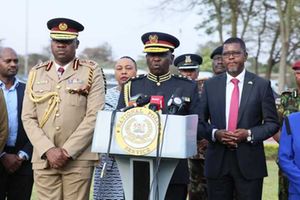
From left: Deputy Inspector General of Police Gilbert Masengeli, Inspector General of Police Douglas Kanja and National Police Service Commission chairperson Amani Yuda Komora address journalists on police recruitment on October 1, 2025.
Photo credit: Bonface Bogita | Nation Media Group
An independent commission established under the Constitution 2010, the NPSC took over, among other functions, the human resource management function of the police service that previously was being handled by the Public Service Commission.
LSK argued the matter raises serious constitutional questions that require full appellate consideration.
IPOA and the NPSC supported the application, telling the court that the dispute affects police reforms and has wide public interest implications.
But Mr Kanja and the NPS opposed the application, arguing that the constitution grants the IG independent command. Further, the police boss said another disputed issue- the recruitment of 10, 000 police constables- had been overtaken by events as the recruits were already undergoing training.
A source familiar with the deliberations told the Nation that the meeting at the DP’s office ended without reaching an agreement.
“We hope that they (NPSC civilian commissioners) will agree to have the matter withdrawn. Many issues are not moving on because of the court case,” said the source who spoke on condition of anonymity.
The report proposes that while awaiting the outcome of the court case, the AG should advise on how to navigate two Acts that give the NPS and the NPSC conflicting powers.
“This will ensure that legislative reforms are guided by the court’s authoritative interpretation of the constitution, preserve the integrity of the judicial process and mitigate the risk of enacting provisions that may subsequently be rendered inconsistent with the court's final determination,” says the report.
The report also recommends that all matters that are pending before the Court of Appeal should be left out.
“While avenues for consensus were explored, the TWG (Technical Working Group) concluded that the dispute raises fundamental questions of constitutional interpretation, including the delineation of mandates between the NPSC and NPS and the identity of the employer of police officers,” the report observes.