It starts with a distress call. Much as Kenyans are not top among those being targeted by anti-immigrant mobs in South Africa, some have found themselves in trouble.
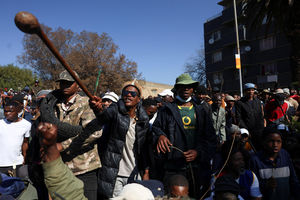
One of them is Anthony Waweru, who has been in South Africa since 2022 – working as a bus driver – and whose house was recently torched. He heard a group approach at night, chanting words to the effect that foreigners should leave and without any assets.
“I left that place about two weeks ago and went to another place to hide,” he said.
Mr Waweru was among 55 Kenyans who landed at the Jomo Kenyatta International Airport (JKIA) at 5pm on Thursday last week. He was a beneficiary of government-supported evacuations in coordination with the Kenyan Diaspora in South Africa (Kedasa) – a body of about 12,000 members. By Saturday, a government official told the Nation , 266 Kenyans had returned home through the programme.
Such evacuations, according to the Ministry of Foreign and Diaspora Affairs, will conclude on Thursday when the final repatriation flight will depart from Johannesburg.
“Kenyans requiring evacuation are advised to register with the Kenya High Commission in Pretoria by Tuesday,” the ministry said in a statement on Friday evening.
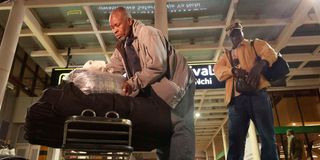
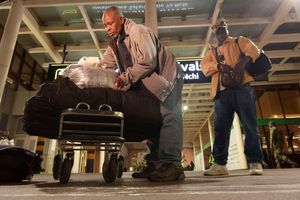
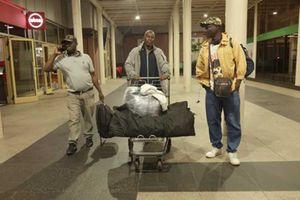
Joseph Gichini (left), Anthony Waweru and Nelly Onyango who were repatriated from South Africa following escalating anti-migrant protests at JKIA after landing on July 2,2026.
Photo credit: Evans Habil | Nation Media Group
A Foreign Affairs ministry official said that after the Kenyans land at JKIA, they go through a debriefing before they go into personalised counselling sessions.
“Some people break down during the one-on-one counselling,” the official added.
Our interviews with various stakeholders revealed a process of evacuation that has seen the government negotiate for the welfare of some Kenyans, especially those whose immigration papers are not in order, and foot bills for those in need.
Starting with providing a name, the process concludes with a form of counselling after processing at JKIA. Some of the returnees told the Nation that they had been promised some form of cash support to help them establish themselves. However, there was no official confirmation of such support being given.
Ms Ruth Wambui, a businesswoman who returned with her two children, said the Kedasa leadership had asked those who felt threatened to submit their names.
“They had told us that if you’re experiencing anything- threats or anything- your life is in danger, come forward, list your name,” she told NTV. She was in a dilemma on whether to leave or stay, but after consultations, she provided her name.
“I was torn apart because I had hope that maybe this thing will pass then we carry on. But having in mind that I’ve lost so much, I didn’t have much to hold on,” she said, recalling the burning of her house last year in a mysterious fire as she was away at her business.
That was what Mr Waweru, the bus driver, did, and he eventually found himself in Kenya.
“I put down my name, and after that they organised [transport] from Cape Town, and then we travelled to Johannesburg,” he said. “They then processed our documents.”
“When you get there, they take you to a hotel. There’s food and all. For that, the government has played a very big part. The Kedasa team, I salute you. They have helped us,” she said.
Kenyan Diaspora in South Africa chairperson Bernard Maina speaking at JKIA in Nairobi on July 2, 2026.
Photo credit: Evans Habil | Nation Media Group
Mr Bernard Maina, who chairs Kedasa, told the Nation that thanks to the efforts of the high commission, Kenyans have not had to huddle in camps like people from other countries.
Kedasa, he said, has been the first point of contact for Kenyans fearing for their lives. Once a Kenyan alerts Kedasa – which has leaders in various areas in South Africa – their plight is escalated to the embassy and finally to the State Department for Diaspora Affairs.
Said Mr Maina: “Kedasa has also been identifying people on the ground and just making sure that even those who are deep in the villages have been identified and help provided. The coordination has been excellent. Nobody suffered; you never saw us being bunched into refugee camps like other communities. We were able to handle our crisis smoothly.”
He praised Ms Jane Ndurumo, Kenya’s High Commissioner to South Africa, and Diaspora Affairs Principal Secretary Roseline Njogu.
“These ladies have done a wonderful job,” said Mr Maina. “They have made it work silently, efficiently and perfectly.”
“We didn’t have the drama that you’re seeing with other communities. We handled them [returnees] with their dignity, and they still hold their dignity,” said Mr Maina.
“By and large, we have a huge community that is not threatened,” he noted, saying those under threat were the ones doing business in the low-resource areas of South Africa.
However, Kenyans like Mike Mwita, who have witnessed mobs killing people, are of the view that every Kenyan will eventually be forced to leave.
Mike Mwita, one of the Kenyans repatriated from South Africa following escalating anti-migrant protests speaking at JKIA after landing on July 2,2026.
Photo credit: Evans Habil | Nation Media Group
“I don’t think there’s anyone who is planning to stay more than this because almost all Kenyans are coming back here. Even though you have papers and you still want to stay there, the police will come, you’ll show them the papers, and they will go. What about those [mobs]? They don’t care whether you have papers or not,” he said on Thursday.
“I will never go there even to greet someone or to buy something. I don’t even want to see that country. It is very dangerous. You have to constantly look behind your back,” he said. “If you see about three people, they will approach you to ask for something. If you don’t produce it, they will want to rob you in broad daylight. When you take the issue to the police, they don’t even take foreigners’ matters seriously.”
“The police are against the foreigners. That is the biggest problem,” he added.
Some of the Kenyans have been arriving without passports or with expired visas, and their travel was only possible following negotiations. Mr William Thageya, the Kedasa secretary-general, said that after consultations between Kenyan and South African authorities, it was agreed that anyone found to be in South Africa illegally but without a criminal record could be allowed out.
“Everyone without any criminal record has been processed successfully. And they are being repatriated without going through the court processes or being put in the deportation camp,” he said on Thursday.
He added that for Kenyans in remote parts, the high commission has been offering monetary support.
“We would still like to request the Kenyan embassy not to tire up. Some of these people have lost their livelihood. They don’t have transportation given the distances of 1,000 kilometres, others 600 kilometres,” added Mr Thageya.
Joseph Gichini, one of the Kenyans repatriated from South Africa following escalating anti-migrant protests speaking at JKIA after landing on July 2,2026.
Photo credit: Evans Habil | Nation Media Group
Without government support, returnees like Joseph Gichini would have had it rough. He was reeling from having his bank account frozen when he was told not to return to his residence in Mount Frere.
“The government paid for me. I had no money in my pocket. I only had money to eat and drink. I never expected that I would find my bank account blocked,” he said.