Shortly after Nelson Mandela and his Rivonia co-accused were sentenced to life imprisonment on June 12, 1964, Jomo Kenyatta led a huge rally at Kamukunji, where a coffin bearing the name of South African Prime Minister Hendrik Verwoerd was symbolically buried.
The Rivonia trial had sent eight anti-apartheid activists, among them Mandela, Walter Sisulu, and Govan Mbeki, to prison for life. In Nairobi, the burial of Verwoerd’s symbolic coffin was Kenya’s declaration that apartheid was morally dead, even if it still commanded prisons, police, and courts.
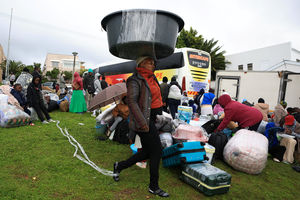
Sixty-two years later, as memory fades, a bitter paradox has arrived, and Kenyans are no longer looking at South Africa as the land of Mandela and the long struggle against white minority rule. Some are now looking at it as a place from which they must flee. By July 2026, more than 200 Kenyans had reportedly expressed interest in returning home, and dozens had already been evacuated as anti-migrant protests escalated in South Africa.
The tragedy today is that the country whose freedom once stirred Kenyan crowds, shaped Kenyan diplomacy, cost Kenyan athletes Olympic dreams, and turned apartheid into a matter of national conscience has now become, for some Kenyans, a place of fear. South Africa was once a moral question for Kenya, but has now become a migrant question. And behind that shift lies one of the most painful reversals in Africa’s post-liberation history.
For decades, South Africa occupied a special place in Kenya’s political imagination. The country’s ties with South Africa ran through education, church networks, nationalist politics, sport, diplomacy and the anti-apartheid struggle.
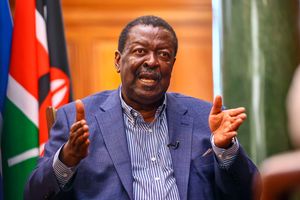
Fort Hare University, where many African nationalists were shaped, was part of that connection. It was at Fort Hare that future Kenyan leaders such as Dr Njoroge Mungai, Masinde Muliro, Charles Njonjo, and Dr Munyua Waiyaki met the intellectual and political world that later informed Kenya’s foreign policy towards apartheid.
That is why Kenya’s anti-apartheid position was not accidental. It grew from memory, proximity and political education. Waiyaki’s Pan-African radicalism, now barely remembered, came partly from that South African experience.
He understood apartheid not as a distant racial arrangement, but as a system that sought to make black people foreigners in their own land. Kenya’s stand against apartheid was therefore not only diplomacy. It was a claim about African dignity.
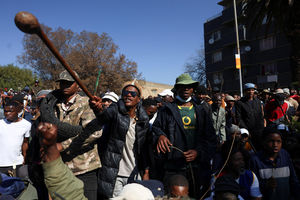
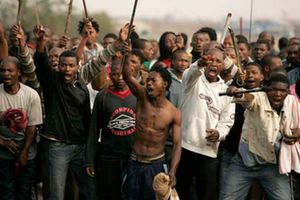
Anti-immigrant protesters take part in a demonstration on the day of an unofficial deadline set by anti-immigrant groups for all undocumented migrants to leave, in Johannesburg, South Africa, June 30, 2026.
Photo credit: Reuters
After the Rivonia sentences, Kenya joined the chorus condemning Pretoria. It banned South African goods, closed its airspace to South African Airways, and denied South African vessels and passport holders easy access to Kenyan facilities.
South African Airways itself acknowledges that, from the 1960s, many African states opposed to apartheid denied it overflight rights, forcing costly detours around the continent. In that airspace, politics lay a simple message: apartheid would not fly freely over a continent it despised.
Sport became another battlefield. In 1976, Kenya withdrew from the Montreal Olympics after the International Olympic Committee refused to ban New Zealand, whose rugby team had toured apartheid South Africa. Foreign Minister James Osogo gave Kenya’s position in a phrase that still rings with moral clarity: “principles are more precious than medals.” He argued that allowing New Zealand to compete would give comfort and respectability to South Africa’s racist regime.
That boycott was costly because Kenyan athletes who had trained for years lost their Olympic moment. The same politics returned in 1980 when the University of Nairobi’s Mean Machine rugby team opposed the visit of the London Metropolitan Police rugby side after British rugby contacts with apartheid South Africa. The controversy was not just about a game.
It was about whether Kenya could condemn apartheid in official speeches while tolerating sporting networks that helped Pretoria escape isolation. The University of Nairobi campaigners insisted that the boycott had to mean something beyond slogans. A London-based rugby team’s Kenya tour was seen by student activists as a betrayal of Kenya’s anti-apartheid principles.
But Kenya’s anti-apartheid story was never pure. Inside the public morality lay private contradiction. And no figure captures that contradiction more sharply than Charles Mugane Njonjo, the attorney general.
Njonjo was one of the most powerful men in post-colonial Kenya. As A-G and later Minister for Constitutional Affairs, he stood close to the centre of State power. He was also a man of elite networks: British, settler, corporate, aristocratic and security networks. In public, Kenya claimed solidarity with oppressed black South Africans. In private, some members of the Kenyan elite maintained relationships that made the anti-apartheid posture look less clean than the speeches suggested.
In the early 1980s, Njonjo was accused of allowing South African nationals and members of the apartheid regime to enter Kenya, in violation of the country’s official policy. The allegations formed part of the wider political case that destroyed him. President Daniel arap Moi appointed a Judicial commission of inquiry in 1983 to investigate Njonjo’s conduct, and the report was submitted in 1984.
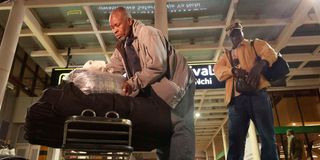
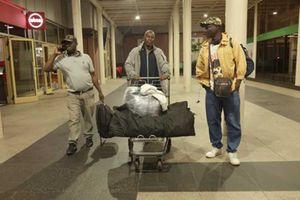
Joseph Gichini (left), Anthony Waweru and Nelly Onyango who were repatriated from South Africa following escalating anti-migrant protests at JKIA after landing on July 2,2026.
Photo credit: Evans Habil | Nation Media Group
The most explosive shadow was the Seychelles coup attempt of November 1981. South African mercenary Col Michael “Mad Mike” Hoare led a group of armed men disguised as rugby tourists in a failed attempt to overthrow the government of President France-Albert René and restore former President James Mancham. The plot had South African fingerprints and Kenyan embarrassments.
Nairobi was alleged to have been used as part of the logistical network, including aircraft arrangements linked to figures in Njonjo’s circle. Several prominent Kenyans, including Njonjo, Police Commissioner Ben Gethi and others, were later alleged to have had prior knowledge of aspects of the coup plot.
Joseph Gichini, one of the Kenyans repatriated from South Africa following escalating anti-migrant protests speaking at JKIA after landing on July 2,2026.
Photo credit: Evans Habil | Nation Media Group
This was no small matter since Kenya had no formal relations with apartheid South Africa. That is how scandalous an engagement with South Africa was. Njonjo’s fall was due, partly, to his dealings with South Africa despite a known policy.
While Njonjo’s fall was not caused by South Africa, Pretoria supplied the scandal with a continental sting. It made Njonjo appear not only ambitious but dangerous; not only arrogant but ideologically suspect.
That is why the Njonjo episode belongs in this story. It reminds us that Kenya’s anti-apartheid record was both noble and compromised. At the level of public diplomacy, Kenya stood with Mandela. At the level of sport, students and athletes sacrificed. At the level of rhetoric, apartheid was condemned as an African shame. But at the level of elite politics, there were always men who saw Pretoria not only as a moral abomination, but also as a useful network of money, intelligence, aviation, security and influence.
This is the double history Kenyans must remember as they flee South Africa today. While it was easier for Kenyatta to denounce Verwoerd and to stop the State from doing business with apartheid-linked interests, some elite circles were deeply entangled.
The problem today is that South Africa’s current anti-migrant hostility is driven by real domestic pain but directed at the wrong victim. As pundits have pointed out, lack of jobs, inequality, crime, poor public services and corruption have produced anger, now converted into xenophobia. Reuters reported this week that South Africa has about three million immigrants, roughly four per cent of its population.
In a country where moral memory has collapsed, the migrant has become the explanation for state failure. In the 1960s and 70s, Kenya and Uganda thought the problem was the Indian shopkeeper. Today, the foreign African in South Africa has become the scapegoat of a country’s failure to rescue millions trapped in poverty.
Nelly Ochieng' Onyango, one of the Kenyans repatriated from South Africa following escalating anti-migrant protests speaking at JKIA after landing on July 2,2026.
Photo credit: Evans Habil | Nation Media Group
This does not mean Kenya should speak with self-righteousness. Kenya, too, has mistreated migrants and refugees. We have had our own ugly suspicions towards Somalis, Ethiopians, South Sudanese, Ugandans, Tanzanians and others. We have often spoken of Pan-Africanism abroad while practising exclusion at home.
While the old South Africa denied black people dignity in the name of race, the new South Africa is allowing desperate citizens to deny other Africans dignity in the name of nationality. As history has shown, once a society decides that a category of human beings is responsible for its suffering, violence is never far.
And that is the bitter paradox that will face South Africa. Kenya once helped isolate South Africa so that black South Africans could be free. Today, some Kenyans are leaving South Africa because freedom has not yet learned how to protect the foreign African.
While Apartheid made Black people strangers in the land of their birth, Xenophobia now makes other Africans strangers in the land whose liberation they once celebrated. The coffin buried at Kamukunji in 1964 carried Verwoerd’s name. But the question that many are asking is: what does African freedom mean if it cannot defend African dignity?