When Kevin — a former General Service Unit (GSU) officer from Kenya’s vast Rift Valley region — boarded a plane to Moscow in July last year, he was turning a new leaf in his life, one that would play out against the backdrop of Europe’s most brutal war.
Today, Kevin (not his real name) speaks to the Nation from a military base somewhere in southern Russia. The crackle of a weak phone signal doesn’t hide the calm in his voice. “I’m happy here,” he says. “Back home there was no money, no opportunities. Here, I’m respected, I have a purpose, and the pay is better than anything I ever earned in Kenya.”
Kevin is one of several Kenyans who have found themselves in the ranks of Russia’s army — either by choice or by deception. Some went willingly, drawn by promises of pay and citizenship. Others say they were duped into signing contracts they couldn’t read, believing they were taking up civilian jobs, only to find themselves training for war.
Kevin says he was fully aware of what awaited him. “When I left Kenya in July, I knew that I would be part of the Russian army. This is something that I accepted,” he says. “So far, everything is okay. I even plan to extend my contract.”
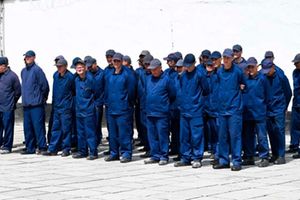
Prisoners of war stand in formation inside a Ukrainian detention facility where foreign fighters are held under strict supervision as part of wartime operations linked to the ongoing Russia-Ukraine conflict.
Photo credit: MFA Ukraine
He says he earns Sh316,000 a month — nearly triple what he once made in Kenya’s disciplined forces. His duties are not on the firing line, he insists; he helps transport meals to soldiers and carries the bodies of those who fall in battle. “I’ve heard some exaggerated stories,” he adds. “When we were leaving Kenya, we were informed that we shall be part of this war. Why should someone lie that they didn’t know?”
Before Russia, Kevin served in some of Kenya’s harshest terrains — Tana River, Baragoi, West Pokot, Turkana, and along the Kenya–Somalia border. He says life in uniform was always tough. Russia, he claims, gives him the respect and pay he always wanted. “I don’t see any reason to go back to Kenya and leave this job. At the end of the day, all we want is money,” he says.
But not every Kenyan recruit knew what they were signing up for. In Nairobi’s Seasons area, Kasarani Sub-county, another victim who spoke to the Nation in confidence says he was duped by an agent who runs a travel agency. He says the agent told him he would get a well-paying job in an Information Technology firm in Russia. “I left Kenya on September 15, 2025, believing I’d be working in IT,” he says. “I even paid Sh60,000 for processing and documentation.”
When he landed in Russia, reality hit. “We found ourselves in a camp with other Kenyans who told us the truth — that we were being enlisted into the army.” He says they met other Africans injured in combat and realised the gravity of the situation. Together with three others, they plotted an escape. “They demanded our phones, but I hid mine,” he recalls. “We had an hour every evening to go shopping, so we used that window to sneak out and reach the Kenyan Embassy.”
From there, embassy officials arranged a taxi to pick them up and help them return home. When the Nation contacted the agent, she denied involvement, claiming it was a case of mistaken identity.
However, the victim’s wife confirmed that she had already lodged a complaint against the agent and her company — to no avail. “They arrested a different group and ignored the main suspect,” said the victim’s wife. She claimed the agent’s husband is a senior officer at the DCI “and has been protecting her.”
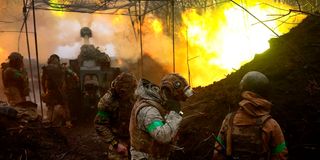
Ukrainian serviceman from mobile air defence unit fires a machine gun towards a Russian drone in Kharkiv region.
Photo credit: Sofiia Gatilova | Reuters
Reports of Kenyans fighting in the Russian army began emerging late last year. According to diplomatic sources, at least a dozen Kenyans have been traced to Russian or occupied Ukrainian territories. Some have surrendered to Ukrainian forces, while others have been repatriated through humanitarian efforts.
Russia, which is now in its fourth year of war with Ukraine, has opened its doors to foreign recruits. A 2022 presidential decree allows foreigners who sign a one-year military contract and take part in combat operations to apply for citizenship without first holding residency. Their families — spouses, children, and parents — also qualify. State-run media frequently feature smiling African recruits speaking Swahili or French, portrayed as proof of “international solidarity.”
But joining the Russian army is far from difficult. Under Federal Law No. 53-FZ “On Military Duty and Military Service”, military service is a constitutional duty — and open to foreigners. “Stateless individuals and foreigners will be able to sign contracts and serve in the military until the end of the mobilisation period, the termination of martial law or the expiration of wartime,” the law states.
Deception and desperation
Kenya’s Ministry of Foreign Affairs (MOFA) says it is aware of a syndicate that recruits Kenyans under false pretences — promising operational or logistics jobs only for them to end up on the battlefield. Principal Secretary Dr Korir Sing’oei confirmed that 29 Kenyans are believed to be held involuntarily in Belgorod, a city near a major Wagner Group base.
“MOFA is in discussion with authorities in Kiev and has raised the issue with the Russian Embassy. The Russian authorities deny any government involvement,” Dr Sing’oei said. He added that no embassy official or Russian government entity has been found complicit in the recruitment schemes. “It is not illegal for a willing participant to join the Russian army — but it must be voluntary,” he stressed.
State Department for Foreign Affairs Korir Sing’oei.
Photo credit: Dennis Onsongo I Nation Media group
For men like Kevin, Russia represents a rare chance to rebuild their lives — even if it means standing on foreign soil, fighting a war that isn’t theirs. For others, it’s a cautionary tale about deception and desperation. As the conflict in Ukraine rages on, the fate of these Kenyans underscores the complex web of poverty, ambition, and global politics — where the promise of a paycheck and a passport can lead straight to the frontlines of someone else’s war.