On November 18, 2026, President William Ruto will deliver his fourth State of the Nation Address (SoTNA) of his first term before a joint sitting of Parliament, a speech that will put his administration’s pledges and last year’s commitments under intense public scrutiny.
However, with the public weighed down by taxes and concerns over rampant corruption within the public service, among other issues, President Ruto will take stock of his administration’s milestones and setbacks over the past year while outlining his key priorities for the country ahead of the August 2027 General Election.
During his previous State of the Nation Address on November 20, 2025, President Ruto framed his administration’s agenda around four priority areas that he said would transform Kenya into a first-world economy, the first of its kind in Africa.
To finance the four priority areas, the President announced a massive Sh5 trillion budget.
To raise the capital without piling more pressure on the national budget and public debt, the President announced the creation of two major financial vehicles — the National Infrastructure Fund (NIF) and a Sovereign Wealth Fund (SWF).
The priority areas were presented as a seven-to-10-year transformation blueprint, with most of the milestones recorded between November 2025 and November 2026 centred on mobilisation and early rollout.
However, governance expert Mr Barasa Nyukuri says Kenyans expect nothing less than a clear scorecard on the promises made last year.
“It will be a dump squib for the president to address the nation without clearly stating the achievements realized on the promises made to the country last year,” says Mr Nyukuri, with city lawyer Mr David Ochami also weighing in.
“Kenyans expect to know the progress made on the promises he made to the country, not just last year, but also on his two previous addresses to the nation,” says Mr Ochami.
In his 2025 address to the nation, which was laden with a mix of harsh and dismissive words against those who questioned his economic agenda, President Ruto committed to four core national priorities designed to turn the country into a net exporter.
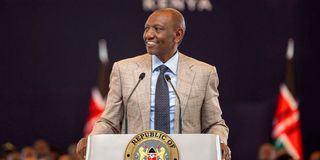
President William Ruto delivers his address during the launch of the Government–UNDP–KEPSA NextGen.Ke Youth Employment Programme at State House, Nairobi, on July 24, 2025.
Photo credit: Wilfred Nyangaresi | Nation Media Group
They included investment in the people, turning around the economy from a net importer to a net exporter, constructing 50 mega dams for irrigation and power generation, expanding power generation by more than 10,000 megawatts and upgrading transport and logistics networks.
He also pledged to revitalise Kenya Airways and modernise Jomo Kenyatta International Airport (JKIA), alongside the ports of Mombasa and Lamu, through public-private partnerships, which are yet to begin due to financing constraints.
During the 2025 address, President Ruto was bullish, delivering a speech in colourful language as he outlined his agenda and presented himself as a determined leader amid mounting criticism from the United Opposition.
“It is a vision to rise from developing to developed status. To rise from potential to reality. To rise from promise to prosperity. To rise from the Third to the First World. To rise, finally, into the Kenya we have long imagined, the Kenya we deserve,” the President said.
“Some may see it as unrealistic, even audacious, for a country like ours,” the President stressed, recalling former US President John F Kennedy’s words in 1962 as he rallied America to reach the moon.
“We choose to go to the Moon in this decade and do the other things, not because they are easy, but because they are hard… because that challenge is one we are willing to accept, one we are unwilling to postpone.”
The opposition specifically sought answers on how the blueprint would be translated into actual projects.
They singled out rampant corruption within the public service, which the President avoided addressing in his 2025 SoTNA, as the biggest challenge.
They also highlighted the rising public debt burden, unfavourable economic policies and an unpopular taxation regime that have resulted in numerous job losses as challenges to the realisation of the President’s dream.
“The numerous industrial actions that have seen teachers, university lecturers and healthcare workers strike also raise questions about whether a nation that cannot address such issues is ready for a first-world take-off,” Bumula MP Jack Wamboka says.
He noted that agricultural production had dwindled and that public sector employees were unable to receive their monthly wages on time, “not forgetting the delayed remittance by state agencies of statutory deductions like pension, among others.”
In the transport sector, Kenya Railways officially commenced construction in July 2026 on the Sh700 billion Naivasha-Kisumu-Malaba Standard Gauge Railway (SGR) extension.
Details from Parliament show that the government continued structuring public-private partnership (PPP) frameworks for the modernisation of JKIA and the ports of Mombasa and Lamu, although major physical expansions remain at the procurement stage.
President William Ruto during the launch of the Government–UNDP–KEPSA NextGen.Ke Youth Employment Programme at State House, Nairobi, on July 24, 2025.
Photo credit: Wilfred Nyangaresi | Nation Media Group
On water harvesting and large-scale irrigation, the government is dragging its feet.
While the broader plan for 50 new mega dams and 2.5 million irrigated acres remains in the financing and planning stages, two flagship inherited projects were nearing completion by late 2026.
The Mwache Dam was more than 90 per cent complete as of October 2026, while the long-awaited Thwake Dam is scheduled to begin reservoir filling in January 2027.
Data from Parliament show that in November 2026, the Ministry of Water and Sanitation initiated public-private partnership (PPP) structuring to close a Sh1.3 trillion water infrastructure funding gap, prioritising upcoming irrigation schemes in Bura and Galana, alongside northern dams such as High Grand Falls, Bute and Daua.
Energy and Petroleum Cabinet Secretary Opiyo Wandayi announced that the 10,000 MW clean energy expansion “is right on course”.
He attributes this to the Ministry’s April 2026 announcement that Kenya had crossed the 1,000 MW mark in installed geothermal generation capacity, ranking sixth globally.
Cabinet Secretary, Ministry of Energy and Petroleum, Opiyo Wandayi.
Photo credit: Dennis Onsongo | Nation Media Group
“We may have financing issues here and there, but the government is committed to achieving the stable supply of electricity in the country to meet the needs of the people,” CS Wandayi says.
He notes that, against a total installed capacity of about 3,000 MW and tightening peak demand, “the government targeted financial close and construction start on 1,112 MW of new power plants in 2026”.
“This includes four major wind projects, while pitching private investors at global summits to bridge the remaining gap towards 10,000 MW over seven years,” says CS Wandayi.
Despite these ambitious targets, independent investigations undertaken by Nation and sector reports reveal that several key promises remain unfulfilled on the ground.
While the NIF and SWF may have been created, mobilisation of the Sh5 trillion to finance the President’s four priority areas remains a pipedream.
National Treasury Cabinet Secretary John Mbadi frames the primary successes of the NIF and SWF around their “historic legislative enactment”, the securing of Sh310.6 billion in initial seed capital and “shifting Kenya away from debt-driven development”.
The seed capital for the fund includes proceeds from the initial public offering (IPO) of the Kenya Pipeline Company (KPC), which was concluded in March 2026 and raised Sh104 billion, as well as Sh206 billion from the 15 per cent partial divestiture of the Government’s stake in Safaricom PLC to Vodacom.
The High Court’s decision to nullify the divestiture of the State’s 15 per cent stake in the telecommunications company has thrown President Ruto’s funding ambitions into uncertainty.
This leaves the bulk of the physical projects reliant on pending appeals and private-sector buy-ins.
“This National Infrastructure Fund is a game-changer for Kenya, transitioning our development model from being debt-dependent to investment-led. By recycling capital through the KPC IPO, we are building a cushion that attracts pension funds and institutional investors,” CS Mbadi said at a previous meeting with MPs.
He went on to state that “a project may be socially important, but if it is not commercially viable, it is not a candidate for NIF”.
“The law shields it from political interference, ensuring investments are driven purely by economic viability. Additionally, the fund is not allowed to borrow on its balance sheet, which protects it from unnecessary financial risks,” said the CS.