Inspector General of Police Douglas Kanja has warned police officers, including their commanders, that they will be held personally accountable for crimes committed in their areas if their inaction or poor supervision contributes to the incidents.
Speaking to senior commanding officers from across the country at the National Police Leadership Academy in Ngong on Wednesday,Mr Kanja said commanders could no longer distance themselves from criminal activities occurring under their watch.
He said commanders must exercise effective supervision and command over their officers, warning that those who fail to act decisively against criminals risk losing their positions.
“Any commander at any level who is found to tolerate goonism or is indecisive in dealing with criminals will be held to account for his or her inaction,” Mr Kanja said.
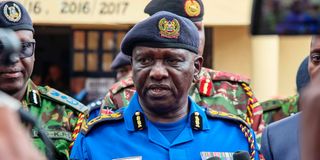
Inspector General of Police Douglas Kanja (left) and Interior Cabinet Secretary Kipchumba Murkomen.
Photo credit: Evans Habil | Nation Media Group
The warning comes as the National Police Service prepares for the electioneering period, with the Inspector General directing commanders to dismantle criminal gangs and groups of goons that could be used to disrupt political activities or intimidate citizens.
Mr Kanja said commanders had a responsibility to ensure their areas remained secure and officers under their command performed their duties professionally.
“I have further directed that I need to be getting returns of all the goons who have been arrested in your respective areas. This is something we must stop,” he said.
He warned commanders who fail to produce results in terms of command and control that they would be relieved of their responsibilities and subjected to disciplinary action.
“We shall ensure that commanders posting poor results in terms of command and control are relieved of command responsibilities and dealt with procedurally,” Mr Kanja said.
The Inspector General's warning extended beyond the fight against gangs to the conduct of police officers themselves.
He said commanders must account for every officer and government equipment assigned to their formations, particularly officers deployed to protect VIPs.
A screengrab of a video shows hooded men brandishing guns and hurling tear gas canisters at residents and journalists during the Ol Kalou by-elections on July 16, 2026.
Photo credit: Pool
Reports of officers attached to VIPs behaving in an undisciplined and unprofessional manner were unacceptable, he said, stressing that no officer was above the law or the disciplinary requirements of the Service.
“Let every commander and every line manager get to account for the officers at all times because it cannot continue that way,” he said.
Mr Kanja also raised concern over deaths occurring in police cells and directed commanders to ensure officers responsible for detainees are held accountable when such incidents occur.
He said the officer responsible for records, the cell sentry and the duty officer should be interdicted immediately whenever a death occurs in police custody, pending investigations.
The Inspector General reminded commanders that police have a responsibility to protect people in custody until they are presented before a court.
Deputy Inspector General Administration Police Service Gilbert Masengeli, Inspector General of Police Douglas Kanja, Interior CS Kipchumba Murkomen and DCI Mohamed Amin at the DCI headquarters during the opening of a police clearance certificate centre.
Photo credit: Francis Nderitu| Nation Media Group
His sentiments were also echoed by Deputy Inspector General of Police, Administration Police Service, Gilbert Masengeli, who told the senior officers that they will be probed for the rising crimes in their areas.
“As commanders, let me remind you one thing: you have a responsibility. I will tell you this without fear of contradiction: the crime going up in your areas of jurisdiction, you as the commander will be the person in question.”
The meeting also focused on the recent restructuring of the National Police Service, including the creation of the Nairobi Metropolitan Police Unit.
The changes have now been formally anchored in law through the National Police Service Standing (Amendment) Orders, 2026, gazetted on July 30.
The amendment repealed and replaced Chapter Seven of the NPS Standing Orders, which deals with formations, units and components. It gives the Inspector-General authority to organise the Service at the national level into formations, units and components and also provides that such structures cannot be established, varied or abolished without his approval.
The Nairobi Metropolitan Police is specifically listed among the Kenya Police Service formations, units and components alongside the General Service Unit, Traffic Unit, Presidential Escort Unit, K9 Unit and other specialised formations.
Under the new structure, command and control of Kenya Police formations and units will be determined by their functions, personnel strength, composition and rank structure.
The Deputy Inspector-General, in consultation with the Inspector-General, will determine their command structure as well as their distribution and deployment across the country.
IG Kanja said the Nairobi Metropolitan Police Unit would be operationalised in phases and would respond to the unique policing demands created by Nairobi's rapid urbanisation, population growth and expanding economic activity.
The unit is expected to cover Nairobi and parts of neighbouring Kiambu, Kajiado and Machakos counties, according to the Inspector General.
Its responsibilities, as outlined by the police boss, will include facilitating the free flow of traffic, maintaining public order, enforcing national and county laws, investigating criminal activities and supporting the Nairobi County City Inspectorate Services.
The gazetted Standing Orders provide that the functions, organisation and command structure of Kenya Police Service formations and units will be set out in the appendices to Chapter Two of the Standing Orders.
Mr Kanja said the restructuring was intended to make the police service more responsive to emerging security challenges.
As the country moves towards the electioneering period, he urged commanders to work with other security agencies to ensure Kenyans can exercise their civic rights in a free and secure environment.
He said police officers who were ready to work professionally would be supported, while commanders who failed in their responsibilities would face consequences.