Russia is still relying on foreign fighters and private military companies to sustain its war in Ukraine and expand influence across Africa and the Middle East, according to recent reports that reveal a growing global recruitment network targeting vulnerable populations.
A report by the International Federation for Human Rights (FIDH), Truth Hounds and the Kazakhstan International Bureau for Human Rights and Rule of Law says Russia has recruited at least 27,000 foreign nationals from more than 130 countries since the start of its full-scale invasion of Ukraine in 2022.
The report states that Moscow shifted to large-scale foreign recruitment after suffering heavy battlefield losses and seeking to avoid another politically unpopular mobilisation of Russian citizens.
“After suffering massive battlefield losses during the first year of its 2022 aggression against Ukraine, the Russian leadership faced a strategic dilemma: how to maintain its military campaign without resorting to another highly unpopular ‘partial mobilisation’,” the report states.
Researchers say the Kremlin responded by building what they describe as an “institutionalised recruitment system” targeting economically vulnerable populations from Africa, Asia and Latin America.
According to the report, many recruits were promised civilian jobs, educational opportunities or non-combat military roles before being deployed to dangerous front-line operations in Ukraine.
“Within weeks of signing their contracts, they are sent to the front lines and assigned to extremely dangerous combat missions, with a high probability of death or serious injury,” the report says.
The findings estimate that between 1,700 and 4,000 African nationals have joined Russian forces, while recruitment from Africa has become a major pillar of Moscow’s strategy since 2024.
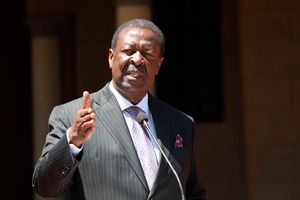
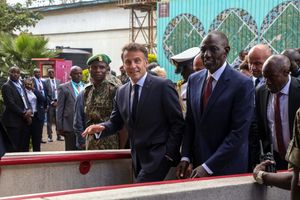
Members of the delegations, led by Russian Foreign Minister Sergei Lavrov and Kenyan Foreign Minister Musalia Mudavadi, hold talks in Moscow, Russia, March 16, 2026.
Photo credit: Reuters
In March, Kenya's Prime Cabinet Secretary Musalia Mudavadi visited Moscow to discuss the recruitment of Kenyans. Officials in Moscow, he said, had agreed to stop deploying Kenyans to the battlefield. But Russian Foreign Minister Sergey Lavrov also said that those with active contracts will have to serve them in full.
Weeks later, however, more Kenyans died on the battlefield, suggesting they had been deployed in spite of Russian promises to stop.
Speaking in Parliament, Prime Cabinet Secretary and Foreign Affairs CS Musalia Mudavadi admitted that the Kenyan government has limited capacity to fully account for or assist Kenyans recruited into the Russian military amid the Russia-Ukraine war.
Mudavadi said many of those involved enlisted voluntarily through unofficial channels, making tracing and intervention difficult.
“The government is unable to confirm the number of Kenyans recruited into Russian military operations,” Mudavadi said.
The government estimates that about 252 to 291 Kenyans have been recruited into Russia’s Special Military Operations. Of these, 19 are reported dead, 42 are injured or hospitalised, 44 have returned home, while others remain active in the conflict zones.
In October last year, Kenyan police rescued dozens of Kenyans in a house on the outskirts of Nairobi. Security agencies believed the men were preparing to travel to Russia. A Russian national initially arrested with the group was later deported, although the Russian Embassy claimed he had been freed to leave on his own.
Researchers say many recruits signed military contracts written entirely in Russian despite not understanding the language.
“Contracts were presented in Russian to individuals who did not read or understand the language, often without any explanation and in circumstances that made refusal impossible,” the report says.
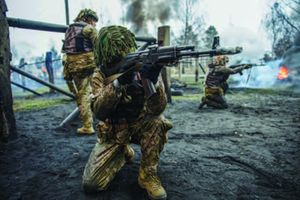
Once deployed, many foreign fighters reportedly ended up in high-risk “meat assaults”, which are large-scale frontal attacks associated with heavy casualties.
According to Ukrainian estimates cited in the report, at least 3,388 foreign fighters have been killed in combat since 2022.
The findings also highlight Russia’s growing dependence on private military companies (PMCs) to maintain influence abroad while limiting the political and financial costs of direct military deployments.
A separate geopolitical analysis titled Russia: Private Military Machine says Moscow increasingly uses PMCs to project power in Africa and the Middle East without relying solely on the Russian army.
“Russia uses private military companies to do what its actual military can’t — or shouldn’t,” the report states.
The analysis says Russia’s model differs sharply from Soviet-era military assistance because many operations are designed to partially finance themselves through commercial deals involving mining rights, fuel distribution and access to natural resources.
“Instead of getting paid in cash, Moscow cuts deals for mining concessions, fuel distribution rights, and access to commodities — gold in particular,” the report says.
The Wagner Group, founded in 2014 by Yevgeny Prigozhin, became the most visible symbol of Russia’s private military strategy, operating in countries including Syria, Mali and the Central African Republic.
However, following Prigozhin’s failed mutiny against Russia’s military leadership in 2023 and his subsequent death in a plane crash, the Kremlin restructured Wagner’s operations into smaller groups operating under tighter state control.
The report says the restructuring solved Moscow’s loyalty problem but may have weakened battlefield effectiveness in regions such as Mali, where Russian-linked forces have struggled against insurgent attacks.
Despite mounting criticism, analysts say Russia continues to attract partners across Africa because it offers military support without the political conditions often attached to Western assistance.
But both reports warn that Moscow’s growing overseas commitments are increasingly stretching its military and financial resources as the Ukraine war drags on.
“The model is more efficient than what the Soviets had. But efficiency has a ceiling — and Russia is getting closer to it,” the geopolitical analysis states.