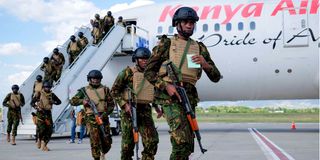
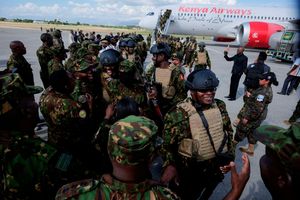
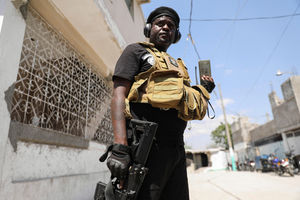
The deadline for the deployment of officers to Haiti under the newly constituted Gang Suppression Force (GSF) falls today, Saturday, February 7, 2025, marking a decisive shift from the Kenya-led Multinational Security Support (MSS) mission that has struggled to tame the country’s entrenched gang violence.
Foreign Affairs Principal Secretary Dr Korir Sing’oei says Kenya has achieved what was unthinkable before they set out for the Caribbean nation.
“We have done our job which was to bring peace and a form of stability. We are in a good place to begin to draw down our deployment at this point in time,” Dr Sing’oei told the Nation in an interview.
He went on: “There was pessimism when we deployed around whether Kenya was overstretching, what were the risks, will we be successful? A year plus later, it is clear that the Kenyan deployment has made a huge difference. The MSS mission was more to build the capacity of Haitian police to be able to respond to gang violence, protect the critical installations and by and large, transition the mission to something that is much more sustainable.”
Though the mission “has not been well-financed and had a narrow mandate”, Dr Sing’oei argues, it had demonstrated a clear credibility to a Haitian-led process.
“(Our mandate) did not include the pursuit of the gangs themselves and that affected the overall ability. The local support area where our team was deployed was limited. What we wanted was the establishment of forward support bases so that we could push away the gangs. Given the limited mandate, that is why we went to the UN General Assembly and Security Council to expand the mandate. We are pleased now there is the GSF (gang suppression force) supported by the UN providing the environment for political discussions in Haiti,” Dr Sing’oei says.
Lessons learnt? Dr Sing’oei says the Kenyan team’s professionalism, questions on clear financing and expansions have come up.
“It is important that peacekeeping financing be prioritised for missions of this nature, missions that are hybrid in nature that combine police and military. We should really look at this at the UN level when it comes to handling conflicts within the state which require a different financing mechanism,” the Foreign Affairs PS said.
The GSF, authorised in late 2025, is a 5,550-strong multinational unit guided by a Standing Group of Partners comprising the United States, Canada, Kenya, The Bahamas, Jamaica, Guatemala and El Salvador.
Unlike the MSS, which was largely structured as a stabilisation police operation, the new force is designed as a hybrid security formation blending policing, counter-insurgency and maritime enforcement capabilities.
“The process of transforming the MSS mission to the GSF mission is ongoing, and officers from various countries are still being deployed to join Kenyan and Haitian officers,” Mr Godfrey Otunge, who has been the MSS Commander, told the Nation .
This week, the escalation became visible on the ground when several United States soldiers landed in Haiti aboard a military aircraft, signalling Washington’s deeper operational involvement.
Simultaneously, American warships moved to the Haitian coastline, creating a maritime security ring intended to cut off weapons smuggling routes that have fuelled gang expansion and fortified heavily armed militias.
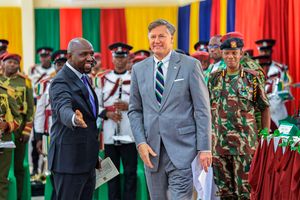
US Deputy Secretary of State Christopher Landau last week visited Kenya to appreciate the first contingent of officers who returned to the country in December 2025.
Kenyan police officers who recently returned from their Haiti peacekeeping mission participate in a guard of honor and parade at Nyayo National Stadium.
Photo credit: Wilfred Nyangaresi| Nation Media Group
He described Kenya as an indispensable partner whose intervention prevented Haiti from collapsing under the control of violent criminal gangs at a moment when the country’s institutions had lost the ability to maintain law and order.
“The government of Haiti would not have survived the onslaught of these gangs without your presence,” Landau said, addressing Kenyan officers who served under the MSS mission, adding:
“Kenya has been an indispensable partner—not only in deploying officers on the ground, but also in shaping what comes next.”
According to him, Kenya was the only country that responded to the call to deploy troops to deal with gangs in Haiti.
“When the international community asked for countries to contribute, only one stepped up — and that was Kenya. It was necessary and proper for me to come here in person, on behalf of the President, the Secretary of State and the people of the United States, to recognise that sacrifice,” he said.
For Haiti’s population, trapped between gangs and collapsing state authority, the change represents both hope and uncertainty.
While international partners believe a stronger force may dismantle gang strongholds, past interventions have shown that security gains remain fragile without a political settlement and functioning governance institutions.
Meanwhile, the US, which is the brainchild of the formation of the GSF, has said that it will continue working with Prime Minister Alix Didier Fils-Aime.
This is despite him facing recent opposition from the Presidential Transitional Council (CPT), the body that elevated him from a citizen to the current highest office in the Caribbean-based nation.
Currently, the CPT team is running against time to ensure that they pick a different Prime Minister as their mandate ends today.
Interior Cabinet Secretary Kipchumba Murkomen and US Deputy Secretary of State Christopher Landau meet Kenyan officers who served in the MSS mission in Haiti at the National Police College Embakasi, Nairobi on January 29, 2026.
Photo credit: Pool
“As the Transitional Presidential Council’s mandate ends on February 7, we support Prime Minister Fils-Aime’s leadership in building a strong, prosperous, and free Haiti,” US Embassy in Haiti chargé d’affaires Henry Wooster said.
The nine members of the CPT include Edgard Fils, Louis Gilles, Laurent Saint, Emmanuel Vertiraile, Fritz Jean, Lesly Voltaire, Smith Augustin, Regine Abraham and Frinel Joseph.
Three CPT members earlier this week adopted a resolution proposing a new executive authority to govern once the council leaves office.
Already, five CPT members and a Haitian Cabinet Minister were hit with US visa restrictions for their attempt to oust the Prime Minister.
Amid the security reconfiguration, Haiti’s political transition is gathering momentum after the CPT launched an exercise in which those interested in the presidency and prime minister positions submitted their candidacies.
The launch took place at the Montana Hotel in Port-au-Prince — a venue that has become symbolic of negotiations over the country’s future governance.
Representatives of political coalitions, civil society groups and transitional authorities converged at the hotel to present nominees in a process intended to produce a consensus leadership structure capable of steering the country toward elections.
The exercise is part of efforts to rebuild constitutional order after years of institutional vacuum following the assassination of President Jovenel Moïse and the collapse of parliamentary authority.
However, a section of political players in Haiti have boycotted the exercise, arguing that the CPT should accept that its time in office is over.
“The contract is over; there will be no renewal,” former Sen. Jean Renel Sénatus said at a January 22, 2025 press conference after refusing to attend the council’s talks. “We have already agreed that the transition will continue with a president from the Court of Cassation to ensure neutral governance.”
The coming weeks will determine whether Haiti can synchronise the arrival of a reinforced international force with the emergence of a credible transitional leadership — a balance many diplomats describe as the country’s last realistic chance to stabilise.
The CPT was created under an April 2024 political accord following the resignation of former Prime Minister Ariel Henry, who could not return to his home country after visiting Kenya to ask the government to deploy its officers as soon as possible.
The CPT was tasked with restoring security, organising elections, reviving the economy and advancing constitutional reforms.