Kenya’s nomination of Supreme Court Judge Njoki Ndung'u for a position at the International Criminal Court has drawn intense scrutiny, with questions raised about the country’s broader strategy ahead of the upcoming international judicial elections.
While legal experts and other stakeholders believe Justice Ndung'u is the best candidate for the ICC position, some have questioned Kenya’s campaign strategy ahead of the December 2026 elections in New York.
Justice Ndung'u, who has so far received strong endorsements from top leaders in the country, is among 14 candidates from Africa and beyond seeking to replace six judges of the Hague-based court whose nine-year, non-renewable terms, which began in March 2018, will expire in March 2027.
The election of new judges will take place during the 25th session of the Assembly of States Parties (ASP), to be held at the United Nations headquarters in New York from December 7 to 17, 2026.
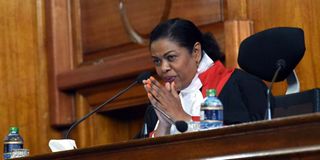
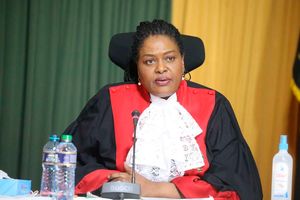
Justice Njoki Ndung’u.
Photo credit: File | Nation Media Group
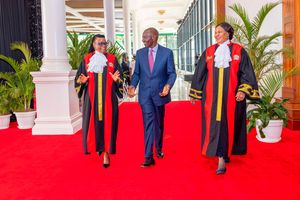
Last Wednesday, President William Ruto launched Justice Ndung'u’s candidature, describing her as not only an accomplished jurist but also a representative of a generation of Kenyan constitutional reformers.
Dr Ruto said the Supreme Court judge was among those who helped guide Kenya through one of the most consequential democratic transitions in the nation’s history.
“Justice Njoki Ndung'u is the best choice for the position of ICC judge. Kenya is presenting to the international community not just a candidate with legal expertise, but a jurist shaped by Africa’s constitutional struggles, democratic transitions, human rights movements and institutional rebuilding,” stated Dr Ruto during the ceremony at State House, Nairobi.
Dr Ruto highlighted Justice Ndung'u’s 15 years of what he described as distinguished service at the apex court and her lifelong contributions to constitutionalism, gender justice and the protection of vulnerable groups.
“Kenya will ensure that the international community recognises her immense value and benefits from her experience, integrity and contribution to the advancement of justice,” he said.
The launch was attended by Chief Justice Martha Koome, Prime Cabinet Secretary Musalia Mudavadi, Supreme Court judges, former ICC judge Joyce Aluoch, who served on the ICC Trial Division between May 2009 and March 2018, among other senior State officials.
Prime Cabinet Secretary and Cabinet Secretary for Foreign and Diaspora Affairs Musalia Mudavadi.
President Ruto has tasked Mr Mudavadi and Principal Secretary Korir Sing'oei with leading the campaigns for Kenya’s candidature.
If elected, Justice Ndung'u will serve at the Hague-based court from 2027 to 2036.
Senior Counsel Ahmednasir Abdullahi questioned Kenya’s broader strategy ahead of the December elections.
Mr Abdullahi questioned whether the State had overreached by simultaneously backing Justice Ndung’u for the ICC and Judge Phoebe Okowa for a full term at the International Court of Justice, with both elections falling within the same diplomatic cycle.
On November 12, 2025, the United Nations General Assembly and the UN Security Council elected Judge Okowa to the ICJ to replace Judge Abdulqawi Yusuf, who resigned effective September 30, 2025.
Judge Okowa, the first Kenyan elected to the ICJ, is expected to serve the remainder of his predecessor’s term until February 5, 2027.
In January 2026, Kenya formally launched Judge Okowa’s candidature for election to a full nine-year term for the 2027–2036 period, with elections scheduled during the 81st Session of the UN General Assembly and Security Council in November 2026.
“Kenya knows it doesn’t have the leverage or political gravitas on the international plane to have two judges at the ICJ and ICC,” Abdullahi warned.
“Of the two good ladies, who is being set up for failure and why?”
However, Senior Counsel Bar chairman Philip Murgor disagreed with Ahmednasir, arguing that Kenya could successfully field candidates for both positions.
“Kenya should approach each race separately and employ different diplomatic strategies for each position. While Kenya arguably possesses greater political gravitas within the region, it has historically not been as aggressive as countries such as Uganda, Rwanda or even Ethiopia, all of which have campaigned unapologetically and consistently for their nationals with considerable success,” stated Mr Murgor, Kenya’s former director of prosecutions.
“Presently, Uganda has both a sitting judge at the ICC and a sitting judge at the ICJ, both of whom are women. Kenya is now increasingly taking its rightful place in the region by frequently nominating and aggressively campaigning for strong candidates as well, each time learning from its experiences to ensure success. It is important to note that the positions are two entirely different elections, each with distinct dynamics and factors affecting success,” he added.
Justice Okowa, whose current term ends in 2027, is also expected to face competition from candidates from Nigeria, Sierra Leone, Korea, Singapore and France.
“We have the commitment of President Ruto that a similar campaign will be mounted to ensure the re-election of Judge Okowa. As leaders in the legal profession, we shall similarly throw in all our support for her re-election,” added Mr Murgor.
The picture is further complicated by nominations from Tanzania and Uganda, which could divide East African diplomatic support rather than consolidate it behind one candidate.
“Both Uganda and Tanzania have candidates for the ICC judgeship. To avoid dividing regional support, the three countries should have agreed to field one candidate. Three candidates will definitely split regional support,” warned lawyer Steve Kabita.
Lady Justice Njoki Ndung'u at the Supreme Court before delivering a full judgment on reasons for nullification of President Kenyatta's re-election. PHOTO | JEFF ANGOTE | NATION MEDIA GROUP
While supporting Justice Ndung'u, Mr Murgor also agreed that East African Community countries should rally behind a single candidate.
“I have known Justice Njoki Ndung’u for approximately 38 years, ever since she took up her first position as a prosecuting counsel in the State Law Office under the Attorney General. She is the best candidate for the ICC job, based on her experience and track record,” Mr Murgor told the Nation .
“Her passion for pursuing justice for victims is unmatched. She would, in my view, be a valuable addition to the ICC while also bringing important Kenyan and broader African perspectives and experience to the court,” added the veteran lawyer and former Director of Public Prosecutions.
Lawyer Philip Murgor. Philip Murgor has threatened to sue the NCBA Bank for erroneously listing him as a loan defaulter over a disputed Sh1,300 Fuliza loan.
Photo credit: Pool
According to Mr Murgor, Kenya, Uganda and Tanzania should front one formidable candidate.
“My take is that the stronger and more strategic move would be for EAC member states to sit down, engage seriously and agree on rallying behind one candidate — the one with the strongest profile and best chance of success. On that front, Justice Njoki makes a compelling case,” he said.
“What sets her apart from the other regional candidates is her direct background as a criminal prosecutor, hands-on experience that is central to the court’s mandate, and one that none of her regional competitors appear to match at the same level.”
Mr Murgor noted that Uganda currently has a sitting judge at the ICC whose term is ending, creating grounds for Uganda to step back and support another East African candidate.
Law Society of Kenya President Mr Kanjama also said Justice Ndung'u is the most qualified candidate for the ICC role.
“Justice Ndung'u presents a bold and principled vision for the future of international justice — anchored on courage, pragmatism, efficiency, victim-centred justice and Africa-focused jurisprudence,” stated Mr Kanjama.
“As the Bar, we recognise Justice Njoki as a focused legislator who championed the Sexual Offences Act, a committed member of the Committee of Experts that guided the final phase of constitution-making from 2008 to 2010, and a founding judge of the Supreme Court who has given 15 years of dedicated service to Kenya’s apex court from 2011 to 2026,” he added.
Law Society of Kenya president Charles Kanjama during an interview at his office in Nairobi on February 24, 2026.
Photo credit: Bonface Bogita | Nation Media Group
“Chief Justice Martha Koome has clearly indicated that the Judicial Service Commission carried out an internal process of advertising among judges, followed by a review and selection from those who expressed interest. So the selection process, which was internal to the Judiciary, was fair and transparent,” he explained.
Chief Justice Koome also pledged full support for Justice Ndung'u’s candidature, describing her as courageous and principled.
“Njoki Ndung'u has been very courageous and has demonstrated leadership even in difficult situations. We are strongly behind her candidature,” stated CJ Koome.
This, even as lawyer Danstan Omari questioned the process of arriving at Judge Ndung’u’s name.
“Kenya did not follow its national procedures in nominating its candidate, who is Justice Ndung'u. There was no advertisement and applications for people interested in the position. Njoki Ndung'u did not apply and was not picked on merit as required by ICC laws. Kenya has also not submitted its national nomination procedures as required by ICC laws before one’s candidature is accepted,” explained Mr Omari.
Professor Masibo Lumala, a gender equality champion, said Justice Ndung'u brings strong judicial, legislative and international legal credentials to the race.
“Justice Ndung'u is widely recognised for her contribution to gender justice and constitutionalism in Kenya, particularly through her role in sponsoring the Sexual Offences Act during her tenure in Parliament,” Prof Lumala told the Nation.
“Her subsequent service at the Supreme Court has further strengthened her profile as a jurist with experience in constitutional interpretation, human rights and complex legal adjudication. She is therefore fit for the job.”
Prof Lumala argued that Kenya appears keen to project renewed engagement with international legal institutions despite its historically difficult relationship with the ICC during the cases involving President Ruto and former President Uhuru Kenyatta.
University of Nairobi’s Prof XN Iraki also believes Justice Ndung'u has a realistic chance of winning.
“It’s part of Kenya enlarging her international stature, and from past experience, having one of our own at the ICC would make a big difference, especially given the widely held belief that the ICC is always against Africa,” argued Prof Iraki.
Over the years, several high-profile Kenyans, including Cabinet Secretaries, have sought continental and international positions but either lost or withdrew.
The most recent was former Prime Minister Raila Odinga, who in February 2025 lost his bid to become chairperson of the African Union Commission.
Despite Kenya mounting an intensive campaign, he was defeated by Djibouti’s former Foreign Affairs Minister, Mahamoud Ali Youssouf.
Parliamentary data showed Kenya spent at least Sh523.85 million on Mr Odinga’s unsuccessful campaign.
According to international relations experts, the bid failed due to factors including geopolitics, religion and the influence of Southern African Development Community voting blocs.
In 2017, former Foreign Affairs Cabinet Secretary Amina Mohamed also lost the AUC chairperson race to Chad’s then Foreign Affairs Minister Moussa Faki.
Justice William Ouko also failed to secure election to the African Court on Human and Peoples’ Rights.
Other unsuccessful international bids by Kenyans include those by Monica Juma for Commonwealth secretary-general and Raychelle Omamo for president of the International Fund for Agricultural Development.
Despite these setbacks, there is renewed optimism around Justice Ndung'u’s candidature.
According to Mr Murgor, the ICC election dynamics differ from previous international contests because six vacancies are available, with regional representation and gender balance being key considerations.
“At least two of those six seats are reserved for African candidates. The Kenyan candidate will therefore not be competing for seats designated for Europe, Asia or the Americas, but rather with other African candidates for the two African slots,” explained Mr Murgor.
He added that language considerations and regional balance between West and East Africa would likely influence voting patterns.
“President William Ruto has already embarked on campaigning for Justice Njoki Ndung’u and recently did so during engagements with several African presidents at the African Forward Summit. This will certainly play a key role in garnering support for the Kenyan candidate among African states,” he said.
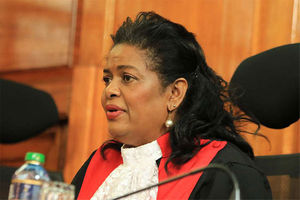
Supreme Court Judge Lady Justice Njoki Ndung'u.
Photo credit: Wachira Mwangi | Nation Media Group
Prof Lumala also argued that Justice Ndung'u’s candidature should not be judged through the lens of Kenya’s previous failed bids.
“Kenya’s previous unsuccessful bids for international positions should not necessarily be interpreted as predictors of failure in this case. Each election has its own dynamics,” he noted.
They include Justice Njoki Ndung’u (Kenya), Rosette Muzigo-Morrison, Deo John Angela, Evelyn Ankumah, Abdoulaye Seye, Veronic Wright, Tujilane Chizumila and Ezéchiel Amani Cirimwami.
The other nominees are Mette Knudsen, Lev Kyshakevych, Guénaël Mettraux, Yoshimitsu Yamauchi, Diana Carolina Olarte Bácares and Ana Peyró Llopis.
The candidates hope to replace Tomoko Akane, Rosario Salvatore Aitala, Reine Alapini-Gansou, Luz del Carmen Ibanez Carranza, Solomy Balungi Bossa and Kimberly Prost, whose terms end in March 2027.
Interestingly, women dominate the list of African candidates seeking the ICC positions for the 2027–2036 term.
According to the Coalition for the International Criminal Court, ICC States Parties are required to consider representation of the world’s legal systems, equitable geographical representation and fair gender representation when electing judges.
African States were among the key architects of the 1998 Rome Statute that established the ICC. However, several African countries have since clashed with the court over sovereignty concerns.
In 2009, the ICC issued an arrest warrant against Sudanese President Omar al-Bashir for war crimes and genocide in Darfur.
The African Union criticised the move, arguing that it undermined peace negotiations and violated customary Head-of-State immunity.
Then Deputy President William Ruto (right) when he appeared at the International Criminal Court in the Hague in 2013.
Photo credit: File | Pool | AFP
The court also faced backlash during cases involving former President Kenyatta and then Deputy President Ruto over the 2007–2008 post-election violence.
Although both cases eventually collapsed because of witness interference and non-cooperation, they fuelled political resistance to the court across Africa.
In October 2017, Burundi controversially withdrew from the ICC amid investigations into political violence.
The ICC has also experienced tensions with South Africa and Gambia, both of which at one point threatened to leave the court.