President William Ruto could easily be running Kenya’s most expensive presidency, with cash spent on running key offices expected to hit Sh100 billion at the end of the current financial year.
Analysis of disclosures by the National Treasury, Controller of Budget and Auditor-General by the Nation indicates that Dr Ruto’s presidency has spent Sh88.8 billion in under four years, rivaling the Sh89.9 billion Uhuru Kenyatta spent in his 10-year tenure.
The analysis tracked spending by offices under the presidency, and compared Mr Kenyatta’s 2013-2022 tenure with Dr Ruto’s reign between 2022 and March 2026.
In the current administration, the presidency constitutes the Executive Office of the President, Office of the Deputy President, Office of the Prime Cabinet Secretary, State House and the state departments for Parliamentary and Cabinet Affairs.
Under former President Kenyatta, the presidency constituted the Executive Office of the President, Office of the Deputy President, Office of the First Lady and the Office of former presidents.
In Mr Kenyatta’s second term, he entered into a cooperation agreement with Nairobi City County, then under Governor Mike Sonko, which birthed the National Metropolitan Services (NMS). While the NMS was structured as an independent office, it received funding through the Office of the President.
Dr Ruto’s administration has entered into a similar arrangement with the city county under Governor Johnson Sakaja. The Nation analysis has excluded allocations and planned funds releases for the two cooperation agreements as neither of them are formally listed as offices under the presidency.
In the first year of Mr Kenyatta’s administration, 2012-13, spending by the presidency constituted 0.38 per cent of the national government budget of Sh1.17 trillion.
By the end of his first term in 2017, the presidency’s budget stood at 0.49 per cent of the Sh1.9 trillion national government budget. It then fell to 0.44 percent of the Sh2.9 trillion budget in 2021-22, his final year in office.
In absolute terms, however, spending under the presidency jumped 2.8 times during Kenyatta’s 10-year tenure, from Sh4.5 billion in 2012/13 to Sh12.9 billion in 2021-22.
Under President Ruto’s administration, spending under the big office has jumped two-and-a-half times from where Kenyatta left it in 2021-22, to stand at Sh32.22 billion in the current year budget.
As a proportion of the national government budget, it has moved from 0.44 per cent in 2021-22, to 0.77 per cent of the current year’s national government budget of Sh4.2 trillion.
Overall, national government spending between 2022-23 when President Ruto assumed office and the current financial year 2025-26, has grown by 32.1 per cent to Sh4.2 trillion. Over the same period, spending under the presidency has grown by 38.3 per cent to Sh32.2 billion, based on the latest budget documents with projections to June.
Analysis shows 93.7 per cent of Dr Ruto’s presidency spending has gone to recurrent activities compared to Mr Kenyatta’s 90.7 per cent during the 10 years— starting off with 88 per cent during the first term before rising to 93.4 per cent in the final term.
Ruto’s first three years and nine months
Since the start of the 2022-23 fiscal year in July 2022, the presidency has spent Sh88.8 billion, nearly all the amount being utilised by State House, the president’s and his deputy’s offices.
Of the billions spent by end of March this year, 93.7 percent (Sh83 billion) went to recurrent expenses such as paying salaries, hosting delegations, fuel and per diems for travels by bureaucrats in the high offices— exposing the extravagance of a presidency that campaigned for austerity.
Spending under the presidency during Mr Ruto’s reign has moved from Sh23.3 billion in his first year in office, Sh22.88 billion in 2023-24 and Sh21.14 billion in the year to June 2025.
During the current fiscal year, at least Sh21.5 billion had already been released by end of March, but this will rise to Sh32.2 billion by end of June, after the presidency’s budget was increased by Sh14 billion in the latest budget revision.
“The primary role of the presidency is the organisation and coordination of government business. The effectiveness and efficiency of this office, given its technical leadership role and mandate in policy formulation, review and decision-making, impacts decisively on the performance of all other public sector entities,” the government curates the office on its official website.
With the highest spending of Sh36.3 billion between July 2022 and March 2026, State House has been the true centre of power, with its major activities including hosting of delegations and crowds drawn from different segments and political gatherings.
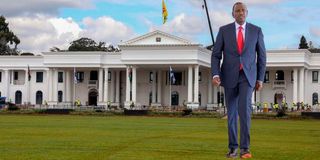
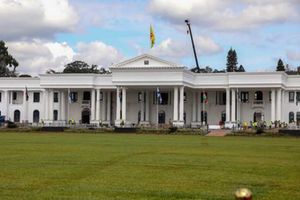
The House on the Hill was also a beehive of construction activities for quite some time after President Ruto entered the office, giving it with a new look. The State House is followed by the Executive Office of the President, which has spent Sh35.1 billion over the three years-and-nine-months, largely on salaries, travel expenses and administrative costs.
The Office of Deputy President has spent Sh12.5 billion during the period, which is expected to rise to Sh13.8 billion by end of June, while Prime Cabinet Secretary Musalia Mudavadi’s office spent Sh3.3 billion by end of March.
The 2025-26 first supplementary budget increased the presidency’s overall budget to Sh32.2 billion, which will see President Ruto close his first four years in office with a spending of Sh99.9 billion.
The budget revision added Sh8.9 billion to the State House, rising its budget to Sh17.5 billion. Of this, State House workers’ salaries will consume Sh3.6 billion.
The president’s office will spend Sh2.27 billion on salaries, including Sh281 million on advisors, the DP’s office will pay workers Sh1.1 billion while Mr Mudavadi’s office will spend Sh200.5 million.
The presidency’s spending under the current administration is the highest on record, and is expected to surpass retired President Uhuru’s 10-year spend before June.
Between July 2012 and June 2022, about two months to the exit of Mr Kenyatta, the presidency had spent a combined Sh89.9 billion.
This included budgets under the Executive Office of the President, Office of the Deputy President, Office of the First Lady and office of Former Presidents.
During his first term to 2017, Mr Kenyatta spent Sh36.2 billion, putting Sh31.9 billion to recurrent activities and Sh4.3 billion to development projects.
This amount rose by a third to Sh49.15 during the second term running over five years to 2022, mainly on account of high expenditures by the State House which scooped more than half of the spend.
At least Sh26.6 billion was spent on the State House between July 2017 and June 2022, followed by a Sh11.6 billion spending on Cabinet affairs and Sh10.6 billion by the DP ‘s office.
The budgets under Mr Kenyatta’s second term presidency exclude a Sh50.9 billion budget that was spent under the NMS, since its mandates fell outside the scope of the presidency.
The NMS was established in 2020 to implement a number of projects across Nairobi, but it has since been scrapped and workers deployed to the Nairobi County Government.
It spent Sh1.9 billion in its first year, followed by Sh24.91 billion in 2020-21, and Sh24.17 billion in 2021-22.
There has not been any budgetary provision for the office since the current administration came into office, and pending bills valued about Sh13.6 billion by June last year remain unpaid.
Former President Uhuru Kenyatta.
Photo credit: Courtesy | PSCU
The presidency has a history of hiring many advisers, sometimes with ambiguous roles ending up gobbling up hundreds of millions paying them.
Mr Kenyatta spent Sh4.8 billion through the 10 years, as compared to President Ruto who has so far spent Sh2.9 billion.
A comparison of the two administrations also shows that State House, the president’s and his deputy’s offices rank high among areas where the current government has grown spending.
The Nation sent questions to the concerned officials to respond on major deliverables the offices have had after being funded with billions of shillings, explain the roles played by advisers, number of workers employed under the offices, and the rationale for spending too much on recurrent activities.
We sent questions to State House Comptroller Katoo Ole Metito and the Chief of Staff and Head of Public Service Felix Koskey, both of whom did not respond to text messages and calls.
“You should forward the questions regarding State House to the official communications team since the Head of Public Service is just Chief of Staff under State House,” an official in Mr Koskey’s office said.
Questions to DP Kithure Kindiki through his communication team were received but not responded to, while Mr Mudavadi and his communication team also did not respond.