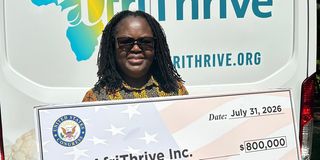
Kenyan academic, Dr Truphena Choti’s passion for farming traditional African vegetables on American soil, has received a facelift after authorities boosted the venture with a $800,000 (Sh103 million) grant.
The money will go into her business venture that focuses on growing and distributing African vegetables such as kunde (pea leaves), managu (African nightshade), misheveve (pumpkin leaves), terere/mchicha (amaranthus) and mrenda (jute mallow) to a wide variety of consumers most of who are African diaspora in the US.
This week on Monday, Maryland Senator Chris Van Hollen formally presented a cheque to Dr Choti, confirming the official interest by American authorities to support her venture of boosting nutrition and safe food to American consumers.
Dr Choti, who has a legal background, developed a passion for healthy living and community wellness, promoting balanced nutrition as a centrepiece of her community work. Her community garden became a collection of familiar African foods, including okra, sweet potatoes and kale.
Her enterprise known as AfriThrive Community Food Center was inspired by interest by many African diaspora in her garden. It now serves some 20,000 people annually. She told the Nation that her background from Kenya also played a role in developing passion to grow foods she was familiar with in the suburb of Essex on the Chesapeake Bay in Maryland.
For most times of the year, families access fresh, healthy and culturally familiar foods. The new money could also boost all-year cultivation, cold storage, food preparation space, nutrition education, Food as Medicine programmes and other community services.
“For us, food security is not just about giving people something to eat.
“We want families to have access to foods they know, foods they enjoy, and foods that remind them of home,” she told the Nation.
When she came to the US, she said, she missed the foods she had grown up eating in Kenya, especially vegetables like managu and saga (African pigweed).
“However, I could not find them in local stores. Then I found a small piece of land near my home, and the Kisii in me said, “Why can’t you grow your own saga?” So I did.
Dr Truphena Choti’s farm in the US.
It is not just tradition, however. Dr Choti has about two decades of experience in international development, which she says helped her see vegetables growing as bigger than a search for a taste of home.
“The garden planted the seed, but my development experience helped me see the bigger picture. That small garden eventually grew into AfriThrive. The rest, as they say, is history.” The $800,000 federal award didn’t come easily, however. She had to show that it was contributing to an overall American war on unhealthy living. It came after years of building AfriThrive's credibility, demonstrating community need, developing strong partnerships, and showing that we had a serious plan for creating permanent food infrastructure, she explained.
“We were also fortunate to have elected leaders who understood the importance of this investment and saw the potential of what AfriThrive is building in Essex.
“We had to present a compelling case that this was not simply about renovating a building. It was about strengthening long-term food security and community health.
“You will come to see that major investments rarely begin with big buildings. They begin with a clear vision, years of consistent work, and communities that believe in what you are building.
Her immediate priority is to first renovate and develop the AfriThrive Community Food Center in Essex, installing cold storage, food handling and preparation areas, and other equipment and spaces needed to safely store and distribute fresh food.
That, she says, will enable all-year service. The longer-term goal, however, is seeing communities’ benefit from awareness of healthier food, helping them keep diet-related illnesses at bay.
“Nutrition education remains very important, especially in communities facing high rates of diet-related illness. But we have also learned that education by itself is not enough. You can tell someone to eat more fresh vegetables, but that advice means very little if those vegetables are unavailable, unaffordable or unfamiliar.
“Our approach is therefore to connect nutrition education with actual access to fresh, nutritious foods. You cannot teach healthy eating in isolation from healthy food access. People need both knowledge and food on the table.”
Eating traditional vegetables may add nutrition to your diet. But Dr Choti says it is also a symbol of cultural attachment. Her African ancestors ate these vegetables for centuries. Seeing something familiar on one’s plate, she said, redefines nutritional wellness.
“I grew up in rural Kisii, Kenya, where we grew much of what we ate. Gardening has always been part of my DNA.
“Today, I lead AfriThrive as the CEO, but Sunday is my farm day. Seeing more than five acres under cultivation with foods like managu and saga connects me back to my childhood, family and the traditions that shaped me.”
“No matter how far I have travelled from Kisii, the soil still takes me home.”
Over time, Dr Choti says she wants her family to be more than just a food distribution enterprise. They want to support Food-as-Medicine programmes, nutrition education, local farmers, young people, families and stronger connections between food and health.
“What excites me most is how far the journey has come. What started with one mother looking for saga has grown into something much bigger.
“Today, we are building a place where thousands of families can find healthy food, dignity and a little taste of home.