When Kenya’s first Vice President, Jaramogi Oginga Odinga, died on January 20, 1994, the shockwave that swept across the country, and especially his Luo Nyanza backyard, was profound.
Bondo became the centre of gravity for grief, politics, and history.
It was as if heaven and earth had collided in sorrow, drawing to the lakeside every soul who had been touched by his towering influence.
Now, more than three decades later, that same tide of emotion has returned — this time for his son, former Prime Minister Raila Amolo Odinga , the political colossus who, like his father, changed Kenya’s destiny without ever sitting on the presidential throne.
Once again, Bondo is the stage of a monumental farewell, as the patriarch and the heir are finally reunited — in life by ideology, in death by destiny.
In 1994, Jaramogi’s death struck the country suddenly. There were no rumours, no advance warnings.
Raila Odinga with his father, Jaramogi Oginga Odinga, after his release from detention in 1988.
Photo credit: File | Nation Media Group
Kenya woke up to the news that the liberation hero, the man who had stood up to colonialists and presidents alike, had breathed his last.
Just like today, the mourning was spontaneous and overwhelming. For the Luo nation, it was as if “the sun had fallen.” Crowds poured into Bondo from every corner of the country — politicians, peasants, clergy, and freedom fighters.
“It was as if heaven and earth had converged in grief,” recalls Mzee Edwin Onyango Radier, who once served as Jaramogi’s aide. “Every Luo felt like an orphan that day. We were lost, broken, and leaderless.”
Just like what the country witnessed in Nairobi on Thursday and Friday and in Kisumu on Saturday, Bondo turned into a sea of humanity.
Roads were clogged, homes overflowed, and the dusty paths of Sakwa became rivers of tears.
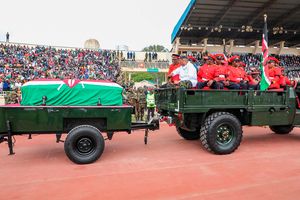
Public viewing of the body of former Prime Minister Raila Odinga at Jomo Kenyatta Stadium in Mamboleo, Kisumu County on October 18, 2025.
Photo credit: Sila Kiplagat | Nation
In the village of Kang’o ka Jaramogi, a mausoleum would soon rise. By contrast, Mr Odinga’s death has unfolded in an era of social media.
Though they are 31 years apart, the Odinga name has once again united and divided Kenya in equal measure.
Veteran journalist and former provincial administrator Kenneth Ogosia says that to compare Jaramogi’s and Mr Odinga’s funerals, one must first grasp who they were.
“Jaramogi Oginga Odinga was the conscience of Kenya’s independence. A man of deep moral conviction, he refused to accept the trappings of power until Jomo Kenyatta was released from detention,” Mr Ogosia said. “That single act immortalised him as a patriot who placed principle above ambition.”
He went on: “Jaramogi was rigid in his convictions — an idealist who believed in seeking first the political kingdom. He was more like Kwame Nkrumah and Julius Nyerere, who saw politics as the means to uplift humanity.”
Mr Ogosia argues that Mr Odinga, on the other hand, was a political strategist — flexible, pragmatic, and emotionally intelligent.
“He could shift tactics without losing the broader vision. Raila knew that politics without economic power is hollow,” he added. “He sought first the economic kingdom, knowing that from it, all else would follow.”
While Jaramogi’s purity of purpose sometimes made him vulnerable to betrayal, Mr Odinga’s adaptability turned him into Kenya’s ultimate political survivor. Yet at the core, both father and son were driven by the same dream: a just, democratic, united and equitable Kenya.
“Whenever Kenya needed reason, he (Mr Odinga) became the voice of reason, courageously. And whenever the country needed a hand of reconciliation, he offered it without hesitation,” President Ruto said of Mr Odinga on Friday, citing the conciliatory spirit as one of Mr Odinga’s greatest lessons.
Bishop of the Anglican Diocese of Bondo, the Right Reverend Professor David Hellington Kodia, during the state service of Former Prime Minister Raila Odinga at Nyayo National Stadium on October 17, 2025.
Photo credit: Lucy Wanjiru | Nation Media Group
When Jaramogi died, Kenya was in the early phases of the return of multiparty democracy. The air was still thick with suspicion, fear, and repression.
“Although Jaramogi had reconciled with President Daniel arap Moi, just like Mr Odinga did with President Ruto last year, Jaramogi’s cooperation with Kanu through Ford-Kenya was short-lived,” Mr Ogosia recalls.
He adds: “The Young Turks – Raila Odinga, James Orengo, Paul Muite, Gitobu Imanyara, Kiraitu Murungi, Mukhisa Kituyi, and others – were sceptical of the rapprochement. They saw Jaramogi’s deal with Moi as a betrayal of the democratic cause. Still, when he died suddenly in Kisumu, the Young Turks set aside their differences to honour their mentor.”
His funeral, held at Kang’o ka Jaramogi, he says, was relatively peaceful — though not without tension.
Fiery speeches by Mr Orengo, now Siaya governor, and former Alego Usonga MP Oloo Aringo, the veteran journalist who covered the funeral recalls, drew warnings from the provincial administration, led by the then Nyanza Provincial Commissioner Joseph Kaguthi, who feared the charged crowd could turn violent.
“The government, wary of the Odinga influence, maintained tight security. “It was a delicate balance,” he recalls. “The people wanted to celebrate Jaramogi’s defiance, while the State wanted to contain it.”
A year later, at Jaramogi’s first anniversary, chaos erupted.
“Police clashed with mourners, and Mr Odinga himself was reportedly the target of an assassination attempt.”
Former Nigerian President Olusegun Obasanjo, who had come to pay respects as the chief guest, would later be arrested on return to Nigeria and charged with treason for allegedly plotting with Kenya’s opposition leaders “to overthrow the Nigerian government”.
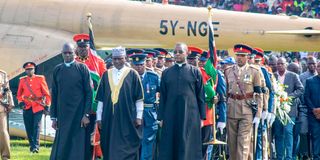
The late Prime Minister Raila Odinga's body arrives at Nyayo National Stadium in the company of Military personnel on October 17, 2025.
Photo credit: Billy Ogada | Nation
Fast forward to 2025, and the script has changed. Kenya’s democracy, though still fragile, is more mature. The State – led by President Ruto – is conducting a state funeral for the ODM leader, marking a symbolic closure to decades of political rivalry.
“Raila’s influence transcends party and tribe. He is a statesman and that’s why his funeral is of this magnitude,” says Mzee Olang’o Nyabola, Mr Odinga’s close ally from Bondo.
The decision by President Ruto to accord Mr Odinga a state funeral is both political and historical.
For a man who spent much of his life in opposition – jailed, exiled, tear-gassed, and vilified – state recognition signifies vindication.
On Friday, Mr Odinga’s elder brother Oburu Oginga expressed disappointment over incidents of teargas use during Thursday's events at Kasarani Stadium, Nairobi, saying his younger brother should not be subjected to similar scenes in death, since during his years as the leader of the opposition and fighting for democracy, he has been teargassed countless times.
“He has been teargassed enough when he was alive. Please, let us not cause a situation where he is teargassed again when we are escorting him,” Dr Oginga said, urging mourners to maintain peace and decorum.
Mr Odinga’s death mirrors how Jaramogi, too, was reconciled with the government of his day before his death, but with a crucial difference: Mr Odinga’s farewell has the full machinery of the State behind it — the Kenya Defence Forces, the National Police Service, and official government protocol.
Mr Odinga’s remains were escorted from Nairobi to Kisumu in a military procession, his casket draped in the national flag.
For Jaramogi, the journey was more subdued. There were no military honours, no gun salutes — only the raw power of the people.
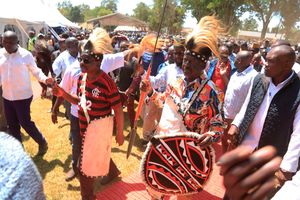
Tens of thousands followed his body from Kisumu to Bondo on foot, chanting freedom songs and waving palm branches in a spontaneous show of love.
The Odinga family has, for over six decades, been the face of Kenya’s political conscience.
From Jaramogi’s bold stand at independence to Mr Odinga’s defiance during the dark years of one-party rule, their story mirrors Kenya’s struggle for justice and reform.
Mzee Radier, the old aide, captures the generational shift in how Kenyans mourn.
The casket bearing the body of former Prime Minister Raila Odinga inside a military chopper on arrival at his Opoda farm in Bondo on October 18, 2025.
Photo credit: Jemutai Ruth | Nation Media Group
“In Jaramogi’s time, the people gathered because of traditional loyalty. Today, it’s more about spiritual connection — a kind of national captivity of the mind,” he said. “Raila inspired people’s faith in democracy the way prophets inspire faith in God.”
On Saturday, Mr Odinga’s journey back to his homeland began. His final stop was Kang’o ka Jaramogi, where a marble-lined tomb – identical to his father’s – awaits.
It will be a moment of closure for a family, a people, and a nation that has been defined by their courage, controversy, and conviction.
As dusk falls over Bondo, the chants will fade, and silence will settle over the twin tombs.
But their spirits – the father who sought the political kingdom and the son who mastered both the political and the economic one – will continue to whisper lessons to the generations yet unborn.