Mount Kenya University (MKU) had recommended an investigation into an examination irregularity during the second year of study at the university by Kimilili MP Didmus Barasa, an affidavit sworn by the legislator shows.
The affidavit does not specifically address a separate notation appearing on his academic transcript by MKU for the 2018/2019 academic year. The transcript, submitted as part of court documents, contains the notation “investigate examination irregularity”.
The document does not state the nature of the alleged examination irregularity, whether an investigation was conducted or its outcome. It nevertheless records an overall mean of 64.00 for the academic year, with grades ranging from A to C.
A subsequent fourth-year transcript recommends that Mr Barasa be awarded a Bachelor of Arts in Public Administration with Second Class Honours, Upper Division.
The document is among those filed in court by the MP in a case where the Consumers Federation of Kenya (Cofek) has sued the Commission for University Education and Murang’a University of Technology (MUT), casting doubt over Mr Barasa’s academic qualifications. The MP is listed as an interested party.
Mount Kenya University main campus in Thika Town.
Photo credit: File | Nation Media Group
He recently graduated with a doctorate from MUT but Cofek argues that the legislator used a contested engineering bachelor’s degree from Jomo Kenyatta University of Agriculture and Technology (JKUAT) to secure admission. JKUAT has denied that Mr Barasa was its alumni and that he did not study for a Bachelor of Electrical and Electronic Engineering degree at the institution.
However, the alleged qualification appears in the MP’s profile on the National Assembly official website.
In the affidavit, Mr Barasa has denied using the disputed engineering degree to secure admission for the PhD programme at Murang’a University of Technology, saying his doctoral studies were based on his qualifications in public administration obtained from MKU.
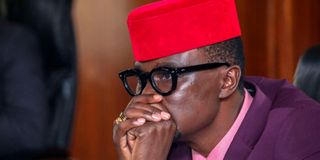
Kimilili MP Didmus Wekesa Barasa.
Photo credit: File | Nation Media Group
Mr Barasa says he obtained a Bachelor of Arts in Public Administration from MKU in 2021, graduating with Second Class Honours, Upper Division, before completing a Master of Arts in Public Administration and Management (Public Policy) degree at the same university in 2022.
“It is therefore beyond dispute, on the face of the documentary record, that both my Bachelor’s degree and my Master’s degree are in Public Administration, the very same discipline in which I was admitted to pursue doctoral studies. My foundational academic identity is not, as the Petitioner erroneously alleges, that of ‘an engineer,’ but that of a scholar of Public Administration holding cognate undergraduate and postgraduate qualifications in that field,” Mr Barasa says.
According to the MP, he was granted provisional admission to the doctoral programme on January 13, 2023, and subsequently underwent the required academic processes, including concept paper presentation, research proposal defence, data analysis and results presentation, seminar and journal paper presentations and an oral thesis defence.
The main entrance of Murang’a University of Technology.
Photo credit: Pool
Mr Barasa describes his “foundational academic identity” as being that of “a scholar of Public Administration holding cognate undergraduate and postgraduate qualifications in that field.”
He adds that his “foundational academic identity” is not that of an engineer but “that of a scholar of Public Administration holding cognate undergraduate and postgraduate qualifications in that field.”
According to the MP, he used the Public Administration qualifications to secure admission to Murang’a University of Technology’s Doctor of Philosophy in Public Administration programme.
“I hold both a Bachelor of Arts and a Master of Arts in Public Administration. My admission into the Doctor of Public Administration programme was founded upon those cognate qualifications in Public Administration, not upon any engineering qualification. The Petitioner's foundational premise thus collapses entirely, and with it the edifice of "apparent inconsistencies" it seeks to build upon it,” he said.
JKUAT Registrar Academic Affairs Dr Aggrey Wanyama said Mr Barasa’s name did not appear in the university’s records and that the institution did not hold a graduation ceremony in May 2008.
“His name doesn’t appear on our alumni records, and JKUAT did not have a graduation in May 2008. His certificate for Bachelor of Electrical and Electronic Engineering Programme is therefore ‘NOT GENUINE,’” Dr Wanyama said.
Jomo Kenyatta University of Agriculture and Technology entrance.
Photo credit: File
The university also said the matter had previously been raised with the Ethics and Anti-Corruption Commission and the Engineers Board of Kenya, with information concerning the qualification communicated to both institutions.
But Mr Barasa says the engineering qualification was not the basis for his admission to the PhD programme.
“Insofar as the Petitioner references qualifications said to have been obtained from other institutions, I depose that those qualifications are genuine,” he says.
Minutes of a postgraduate presentation board meeting held in November 2023 list him as a PhD candidate in public administration and show that the board directed him to proceed with his study after making specified revisions to his concept paper.
A university document dated September 2025 also identifies him as a PhD in Public Administration student and records his research topic as “Effects of Branding Strategies on Service Delivery Satisfaction Among Small and Medium Enterprises in Bungoma County, Kenya.”
He was later invited for his oral thesis defence on March 25, 2026.
Murang’a University of Technology subsequently issued him with a letter dated June 16, 2026, confirming completion of his doctoral studies and stating that the degree would be conferred at the next graduation ceremony.
Mr Barasa has rejected the petition as “misconceived, speculative, premature” and an abuse of the court process.
“The case is, on its own showing, built on conjecture and surmise rather than on any verified fact,” he says.