The National Government-Constituency Development Fund (NG-CDF) board has come under scrutiny for failing to ensure adequate and consistent monitoring of the school bursary and scholarship programme, amid doubts about the prudent use of Sh243.5 billion disbursed over the last five financial years.
Auditor-General Nancy Gathungu, in a 2026 performance audit on the provision of bursaries and scholarships by the NG-CDF to learning institutions currently before Parliament also flagged the delayed disbursement of funds to learning institutions.
In addition to delays in disbursing funds to learning institutions, the audit has highlighted concerns about nepotism, favouritism, political manipulation, and a lack of transparency and accountability in the public bursary and scholarship administration process.
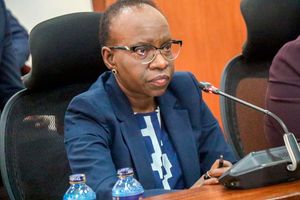
Auditor-General Nancy Gathungu.
Photo credit: File| Nation Media Group
Ms Gathungu cited the adverse effect the delayed disbursement has had on operations, especially day schools, “which highly depended on bursary funds to run the meals programme”.
The net effect of this, the audit reveals, is that “learners would be sent home for school fees, thereby negatively affecting their learning and limiting their retention at school”.
According to the audit, the board “has failed to follow up with constituencies to ensure consistent reporting, which compromises the reliability of data that is submitted for national reporting”.
“As such, the board does not maintain a master list and cannot confidently account for the bursary funds disbursed over the years,” the audit reveals.
The audit also notes that the NG-CDF board, whose CEO is Yusuf Mbuno, does not maintain a master list and cannot therefore confidently account for the bursary funds disbursed over the years.
Sustained public outcries have amplified cases of learners missing school due to a lack of fees and the perceived inequalities in the award of bursaries and scholarships.
Despite multiple education funding mechanisms, many eligible learners continue to be left out as a result of delays, inconsistencies and weak accountability in the allocation process, which Ms Gathungu wants addressed.
“Additionally, the follow-up of beneficiaries in their respective learning institutions is inadequate, leading to a lack of accountability regarding whether beneficiaries genuinely exist and actually receive the funds,” the audit discloses.
The audit has also flagged inadequate acknowledgement of bursary funds by learning institutions, which it says “further aggravates the lack of accountability” by the NG-CDF board in the management of the funds.
According to the International Organisation of Supreme Audit Institutions, of which the Office of the auditor-general has membership, a performance audit is an independent and objective examination of an organisation’s programmes, activities or systems “to determine if they are operating effectively, efficiently and economically”.
Unlike a financial audit, which checks the accuracy of accounts, a performance audit focuses on whether the organization is achieving its goals and providing “value for money”.
The audit sampled 23 constituencies across six counties: Nairobi, Kirinyaga, Makueni, Kilifi, Kisii and Narok for the financial years 2021/22 to 2024/25.
The constituencies sampled during the period under review are Embakasi Central, Kibra, Kasarani, Dagoretti South, Embakasi South, Mbooni, Makueni, Kaiti, Kibwezi East, Ndia, Gichugu and Kirinyaga Central.
The others are Mwea, Kilgoris, Narok West, Narok East, Narok North, Nyaribari Masaba, Bomachoge Chache, Kitutu Chache South, Bobasi, Ganze and Malindi. Within the 23 constituencies, 177 beneficiary learning institutions were appraised.
The NG-CDF is allocated at least 2.5 percent of the national government's annual share of revenue each financial year, as determined by the Division of Revenue Act. The fund may also receive other monies accrued to or donated to the board from any other source.
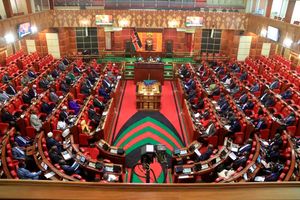
The National Assembly in a past session.
Photo credit: File | Nation Media Group
Over the period under review, constituencies spent Sh55.72 billion on bursaries and scholarships to support 4.9 million learners.
Despite marginal successes, the board has not ensured the timely disbursement of funds to learning institutions.
“Funds are frequently disbursed late and are misaligned with the school calendar. These delays create a ripple effect, often leading to potential beneficiaries missing classes,” the audit says, adding, “ultimately, the lost class time results in an economic loss and the fund's objective of enhancing learner retention is compromised.”
The current use of cheques is uneconomical and “encounters challenges such as loss, misplacement, and errors, which hinder the timely crediting of beneficiary accounts. This preferred mode of disbursement also attracts additional costs for delivery and allowances for clerks, decreasing the funds available for bursary and scholarship.”
The 2020 NG-CDF guidelines for the administration of bursary schemes require constituency fund account managers to submit quarterly reports to the board as per the bursary reporting tool. A bursary beneficiary reporting tool issued in 2023 requires constituencies to capture specific beneficiary data, including the student's name, registration number, NEMIS number, institution, gender and expected year of completion.
The tool should also capture the student's level of study and learners with special needs, as well as disbursement amounts per level of institution and acknowledgement receipt reference number
Despite the guidelines, nine constituencies - Dagoretti South (John Kiarie), Embakasi South (Julius Mawathe), Ndia (George Kariuki), Gichugu (Gichimu Githinji), Kilgoris (Julius Sunkuli),
Narok West (Gabriel Tongoy, Bomachoge Chache (Alfah Miruka), Bobasi (Innocent Obiri) and Malindi (Amina Mnyazi), did not provide evidence of preparation and submission of quarterly bursary reports to the board.
The audit revealed delays and unreliable disbursement of funds from the National Treasury to the State Department for Economic Planning and subsequently to the NG-CDF board account, “which in turn negatively affected disbursement of funds to constituencies.”
The 2020 NG-CDF bursary administration guidelines, 2020, recommended that bursary payments should be remitted directly to the respective education institutions through electronic funds transfer or “alternative efficient means.”
“Where bursaries are remitted via cheque, constituency committees should avoid handover of the cheques directly to the beneficiaries or their guardians.”
Despite this, a review of disbursement records and interviews revealed that all the sampled 23 constituencies made bursary payments using cheques, with Malindi and Ganze constituencies also using electronic funds transfer for amounts exceeding Sh1.5 million and Sh1 million, respectively.
The audit established that nine constituencies- Embakasi South, Embakasi Central, Kasarani, Bomachoge Chache, Kilgoris, Ganze, Narok West, Kibra and Dagoretti South issued individual cheques during bursary award ceremonies.
Bomachoge Chache and Kibwezi East constituencies issued block cheques for multiple beneficiaries in the same local learning institution and constituency committees responsible for delivering the cheques.
However, the use of cheques as a mode of disbursement resulted in inefficiencies like uncollected, unpresented and stale cheques, a lack of guidelines for the selection of beneficiaries of re-issued stale cheques and incomplete records of cheque issuance registers.
Dagoretti South and Embakasi South constituencies had uncollected cheques worth Sh321,000 and Sh312,000, respectively, in the period under review.