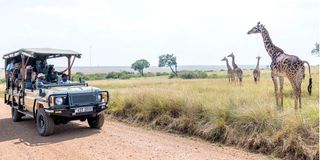
As the country gears up for the high tourism season, the sector is reeling from multi-level levies imposed by the national and county governments on an economically sensitive sector and Kenya’s top foreign exchange earner.
It is the season when Kenya’s airports, seaports and border points usher in millions of tourists for the annual and historic wildebeest migration in the Maasai Mara Game Reserve, an international spectacle.
Tour operators have, as a result, made a passionate plea to the government to review the rates to cushion them from high operating costs, shrinking incomes and projected job losses.
Fuel price hikes have also affected operations in the tourism sector, with operators having to absorb unforeseen additional costs.
Tourists on game drive watch a herd of elephants at Musiara area of the Maasai Mara National Reserve.
Photo credit: File | Nation Media Group
The Maasai Mara Game Reserve is the most affected, with park fees charged by the Narok County Government rising from $80 to $200 per person per day.
The national government has also raised operator licence fees charged by the Tourism Regulatory Authority (TRA) from Sh8, 500 to Sh21,500, a move that players in the sector say is negatively affecting them.
This comes against the backdrop of increased entry fees charged by the Kenya Wildlife Service (KWS) at its parks, from an average of Sh300 to Sh1,500, and the shift from manual to digital billing systems.
This has happened even as the government, in a diversification strategy, is shifting towards "business leisure", including sports and cultural tourism, on travellers' bucket lists, alongside upgrading tourism facilities to luxury hotels in protected areas such as Tsavo National Park.
The tourism sector contributes an average of Sh1.2 trillion annually to Kenya’s Gross Domestic Product (GDP) and supports about 1.7 million jobs, making it the country's third-largest source of foreign exchange after diaspora remittances and agriculture.
Cabinet Secretary for Tourism and Wildlife Rebecca Miano has said the government has rolled out an ambitious plan to raise direct tourism earnings from Sh500 billion to Sh1 trillion by 2028 by attracting more than five million international tourists, up from the current 2.7 million.
“July marks the commencement of Kenya’s peak tourism season, and the government remains steadfast in cultivating a sustainable, inclusive and world-class tourism ecosystem that preserves our natural treasures for generations to come,” Ms Miano said.
She added: “This is the magical time when the world’s eyes turn towards our borders to witness spectacular natural wonders like the Great Wildebeest Migration in the Maasai Mara, explore our pristine coastlines, and experience the unmatched hospitality of our people.”
Ms Miano further said: “To our dedicated tourism stakeholders—our hoteliers, tour operators and conservationists—this is our moment to shine and make the best of Magical Kenya.”
The CS revealed that the tourism sector generated Sh500 billion ($3.84 billion), up from Sh452.2 billion in 2024, while international arrivals increased from 2.47 million in 2024 to 2.7 million in 2025, representing a nine per cent rise.
Kenyans constituted the bulk of the 7.9 million tourists who visited various sites across the country, according to the Kenya Tourism Sector Performance Report 2025, accounting for 5.2 million visitors.
Africans made up 47 percent of visitors, while 25 percent came from Europe and 14 per cent from the United States.
Tourists watch the movement of wildebeests at Masaai Mara Game Reserve.
Photo credit: File I Nation Media Group
Leisure travellers accounted for 46 percent, social tourists 20 percent, and business travellers 19 per cent.
However, stakeholders have raised concerns over the new levies, warning that they threaten to drive operators out of business.
Mr Raymond Cheruiyot, the acting Chief Executive Officer of the Tour Operators Society of Kenya, said the validity period for park tickets has been reduced from 24 hours to 12 hours, meaning that a ticket purchased at 6am expires at 6 pm, just like one bought at 2 pm.
“The cost of travel for tourists is planned well in advance and quotations are issued a year earlier. You cannot wake up one morning and tell clients that the rates have changed. The result is that you lose the clients,” said Mr Cheruiyot, who is also the Managing Partner at Euray Safaris East Africa.
He added: “As a country, we do not have a monopoly on tourists because those visiting the Maasai Mara and the Serengeti are largely the same due to the shared ecosystem. Raising park fees from $80 to $200 per person per day has made Kenya more expensive and less competitive.”
“With the leadership of the current CS (Miano), there has been continuous engagement on existing and emerging challenges in the industry. We appreciate that,” Mr Cheruiyot said.
“However, there was a lapse in the increase of levies, as the TRA suddenly raised tour operator fees from Sh8,500 to Sh21,500, yet we were not involved in the process. We need better engagement and greater consideration of the economic environment, including the security of jobs and incomes,” he added.
Tour operators said: “The government needs to be proactive in many areas to ensure tourism flourishes. It is important to involve tourism players in the formulation and implementation of policies to avoid hurting rather than strengthening the sector.”
Nakuru National Park and Amboseli National Park, for example, charge $90 for adult non-residents and $45 for non-resident children. Kenyan citizens and East African residents pay Sh1,500, while children pay Sh750.
Tourists from outside East Africa are charged $50 for adults, while children and students pay $25 for a 24-hour visit.
Nairobi National Park is slightly cheaper, charging $80 for international tourists. Kenyan residents pay Sh1,350, with children and students paying Sh675, while adult East African residents pay Sh1,000 and children and students Sh500.
Kenya remains a destination of choice for tourists, boasting more than 390 mammal species, over 1,100 bird species, mountains, valleys and a rich cultural heritage.
Lions kill a wildebeest at Maasai Mara game reserve.
Photo credit: Photo | File | Nation
The Big Nine species are the lion, elephant, hippopotamus, buffalo, rhino, leopard, zebra, cheetah and giraffe.
Tour operators said the $200 Maasai Mara park fee is the highest in East and Central Africa, despite facilities not matching those in Tanzania's Serengeti National Park, which charges $70 per person.
Mr Nathan Rana, Chief Executive Officer of Ranath Tours and Travels, said the increase in park charges to Sh3,000 had put visits beyond the reach of many low-income earners.
“Budget tourists are no longer attracted to the Maasai Mara because of the high charges, at a time when the government is seeking to promote domestic tourism. These counterproductive policies are to blame,” Mr Rana said.
“There is a need to convene a tourism stakeholders' meeting to address these issues and conduct proper public participation so that everyone's views are considered instead of the top-down approach the industry has been subjected to,” he added.
Ballon being filled out with hot air PHOTO | POOL
Hot air balloon safaris, mostly conducted in the morning in the Maasai Mara and usually accompanied by a bush breakfast, have also become more expensive.
“Balloon flights are now charged at $550, up from $450, regardless of the season. That represents an increase of $100 (about Sh13, 000) per person,” Mr Rana said.
Mr Fred Odek, chairman of the Kenya Tourism Federation (KTF), and vice-chairman Mr Alex Avedi said the government should avoid burdening the tourism sector, one of the country's leading foreign exchange earners.
“Kenya should make it easier and cheaper for tourists to visit so as to increase revenue, create employment opportunities and sustain the tourism sector in both the short and long term,” Mr Odek said.
Ms Carol Muirimi, Managing Director of Classic Safaris, and Mr Shazmin Manji, Chief Executive Officer of Twiga Tours, said in a recent interview that the increase in national park fees from $43 to $80 was disrupting tourism.
They said the higher fees and the five percent levy introduced by KWS, alongside the new KWSPay digital platform, had made Kenya a more expensive destination, underscoring the need for a review.
Stakeholders claim Narok County increased Maasai Mara park fees without adequately considering the challenges facing operators or comparing the rates with Tanzania's Serengeti National Park, which shares the same ecosystem.
The Narok County Government, however, defended the fee review, saying it reflected the Maasai Mara's status as a premium global destination and one of the world's most important wildlife ecosystems.
“We introduced a seasonal pricing model, with lower park entry fees during the green season from January to June at $100, and high-season rates during the migration period from July to December at $200,” the county government said in response to Nation's inquiries.
It added: “There were recommendations for fees to rise as high as $400 for premium conservation areas, but Narok County settled on a maximum of $200 during the peak migration season. This was carefully done to strike a balance between conservation needs, market competitiveness and visitor accessibility.”
County Executive Committee member Robert Simotwo said the Maasai Mara is a relatively small and fragile ecosystem covering about 1,510 square kilometres, compared with the much larger Serengeti-Ngorongoro ecosystem, which spans more than 20,000 square kilometres.
“The fee review was guided by the National Tourism Strategy 2021–2025, which was developed through consultations with tourism experts, tour operators, hospitality stakeholders and other industry players. The strategy recommended introducing seasonal pricing for Kenya's premium parks, including the Maasai Mara, Amboseli, Lake Nakuru and Nairobi National Park,” Mr Simotwo said.
He said the county aims to market the Maasai Mara under a low-volume, high-value tourism model, borrowing from Rwanda's strategy of generating higher revenues through quality, sustainable tourism rather than visitor numbers alone.
“The challenge is that the Mara has historically been marketed mainly as a seasonal destination centred around the migration period in July, August and September. Yet, in reality, it is a year-round destination with incredible experiences throughout the year,” Mr Simotwo said.
“There has been a deliberate effort to make the Mara accessible to domestic and regional visitors. During the green season, Kenyan citizens pay about Sh1,500, while during the migration season they pay Sh3,000. The intention is to encourage year-round visitation and distribute tourism more sustainably across the calendar,” he said.
Night game drives have also been banned in the Maasai Mara, while private vehicles are no longer allowed for game drives, leaving the activity exclusively to licensed tour companies, unlike in other parks where private vehicles are permitted for a fee.
“The Maasai Mara Game Reserve recently increased its collections from Sh4.5 billion to Sh7.95 billion following the shift to digital payment platforms, which eliminated fake tickets that had been in circulation,” President Ruto said.